

Former Chinese Nationalist Party (KMT) chairman Wu Poh-hsiung (吳伯雄) yesterday hit out at former president Lee Teng-hui (李登輝), who on Saturday called on the public to reject KMT candidates in November’s special municipality elections and President Ma Ying-jeou (馬英九) in the 2012 presidential poll.
“Many people say they love Taiwan, but what is more important is how they demonstrate their love,” Wu said. “To love Taiwan is not only a slogan. They must do so soberly.”
On Saturday Lee said that the economic cooperation framework agreement (ECFA) was a scheme to form a “one China market.” He said it would suck up Taiwan’s capital, manpower and skills before swallowing up the nation, calling on the public to use their votes to punish Ma.
Elections for the heads of five special municipalities will take place on Nov. 27 in Taipei City, Sinbei City (the upgraded Taipei County), Greater Taichung (a merger of Taichung City and Taichung County), Greater Tainan (a merger of Tainan City and Tainan County) and Greater Kaohsiung (a merger of Kaohsiung City and Kaohsiung County).
On the election in the capital, Wu yesterday said Taipei Mayor Hau Lung-bin (郝龍斌) of the KMT and his opponent, the DPP’s Su Tseng-chang (蘇貞昌), were neck and neck but emphasized that many things could yet happen before the vote.
Legislative Speaker Wang Jin-pyng (王金平) yesterday agreed to serve as chief campaign supervisor for KMT candidate for the Greater Kaohsiung election, Huang Chao-shun (黃昭順).
Wang, who had turned down several invitations to become Huang’s campaign chairman, yesterday said he was still not suitable for that position, mainly because of his tight schedule.
As Huang’s chief campaign supervisor, Wang said he would do his best to stump for Huang and seek maximum support for her.
Citing the example of the legislative election in 2008, Wang said “there was room for Huang to win” in the November election if the party could muster enough support and unite all its local factions.
Huang secured more than 58 percent of the votes in Kaohsiung’s First Constituency, convincingly beating her DPP opponent by more than 17 percent.
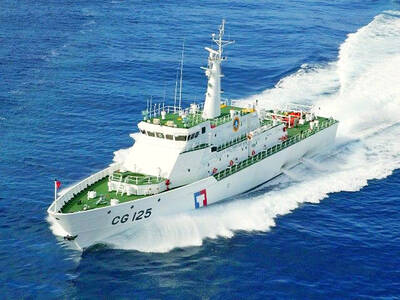
GEOPOLITICAL SIGNIFICANCE: The CGA’s nonmilitary role makes it a tool to avert diplomatic issues, an official said, while confirming the donation of a ship to Manila Coast Guard Administration (CGA) ships are scheduled to sail to the Philippines bearing the words “Taiwan Coast Guard” in a high-profile visit in October next year, the first such visit by a Taiwanese maritime law enforcement vessel to the Southeast Asian nation, the agency said yesterday. The CGA also confirmed that it had donated one of its decommissioned patrol vessels to the Philippines in a rare transfer of a retired ship to a nondiplomatic ally. The Republic of China (ROC) Navy last made such a visit in 1974, shortly before the Philippines switched diplomatic recognition to the People’s Republic of China in
CALL FOR CHANGE: They urged the UN to facilitate Taiwan’s involvement in the body, recognize its peace efforts and to work with members in preventing military conflict Representatives to the UN from five of Taiwan’s diplomatic allies sent a joint letter to UN Secretary-General Antonio Guterres on Friday, calling for the country’s inclusion in the body. Allies in the letter sent ahead of the 81st session of the UN General Assembly General Debate made three demands in support of Taiwan: inclusion, recognition and camaraderie. They implored the UN to seek an appropriate way to facilitate Taiwan’s meaningful involvement in the world governing body, saying that UN Resolution 2758, which accepted the People’s Republic of China (PRC) as a member of the UN, does not exclude Taiwan. Beijing claims that the

‘GLOBAL WARNING’: The infiltration is not just a local problem, as Beijing has been deploying the same tactics worldwide against Western democracies, a report said Between 50,000 and 100,000 Chinese spies are operating in Taiwan, far more than the National Security Bureau’s previous estimate of 5,000, German journalist and author Jurgen Kremb said on Monday. Kremb presented his research, titled “The War of Spies: How China’s Intelligence Services Are Infiltrating Taiwan — and What Europe Must Learn from It,” at a joint event held by the Taiwan offices of the Friedrich Naumann Foundation and the European Values Center for Security Policy. The report was published in June in the Ministry of Justice Investigation Bureau’s Prospect & Exploration Monthly (展望與探索月刊). By spies, he said he was referring to informants,
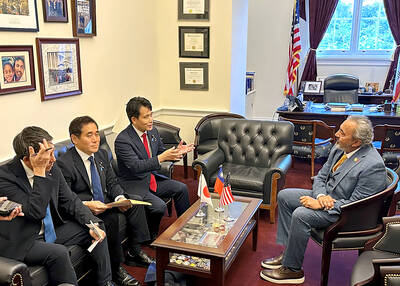
WASHINGTON MEETING: Japan’s Hirofumi Takinami said participants rejected the idea that the US should limit its defensive perimeter to the Second Island Chain US and Japanese lawmakers agree that the US must defend the First Island Chain, including Taiwan, and should not fall back to the Second Island Chain, while “a Taiwan contingency is a Japan contingency and therefore a US-Japan alliance contingency,” media reported after a meeting between officials of the two nations in Washington on Tuesday. A delegation of Japanese lawmakers from the Liberal Democratic Party met with US Senator Thom Tillis, co-chair of the Senate Taiwan Caucus, and US Representative Ami Bera, co-chair of the US Congressional Taiwan caucus, to discuss issues concerning East Asia and the Taiwan Strait. The Japanese and


 RSS
RSS