


Taiwan and China concluded the third round of negotiations on a proposed economic cooperation framework agreement (ECFA) in Beijing yesterday, but both sides were tight-lipped about when they would meet again to finalize the “early harvest” list.
The early harvest list refers to goods and services that will be subject to immediate tariff concessions or exemptions, which are expected to form the backbone of the proposed deal.
Both sides on Sunday reached a consensus on the text of the planned accord and discussed early harvest items.
Mainland Affairs Council (MAC) Deputy Minister Liu Te-shun (劉德勳) yesterday said council Minister Lai Shin-yuan (賴幸媛) was scheduled to brief Legislative Speaker Wang Jin-pyng (王金平) on the progress of Sunday’s negotiations today.
Wang has invited caucus leaders to attend today’s briefing.
The Democratic Progressive Party (DPP) caucus, which has also declined all previous invitations, said it would not attend.
It said the briefing is meaningless because officials are unwilling to tell them anything other than what they already know from media reports and because lawmakers are not able to question officials during the briefing.
DPP Chairperson Tsai Ing-wen (蔡英文) voiced reservations about China’s motives for giving Taiwan benefits on its early harvest list.
Saying the opposition party had yet to see the proposed agreement because the government has kept it under wraps, Tsai said if an ECFA was as good as the government said, “then we have to wonder why China is willing to give us so much.”
“What is the story behind [China’s willingness] to give us these benefits, what is the reason?” Tsai asked. “The government has to tell us clearly and honestly what China expects from us in return.”
Chinese Nationalist Party (KMT) Secretary-General King Pu-tsung (金溥聰) urged the public to rationally examine the trade deal, rather than engage in “emotional criticism.”
“Many people can see very clearly whether an ECFA is good for Taiwan,” he said. “Some media outlets portray it in such a bad light because they want the public to think it is a trap set by China and that the administration is sacrificing Taiwan’s interests. When Beijing says it is willing to yield benefits to Taiwan, they say Beijing has ulterior motives.”
Meanwhile, KMT Legislator Lai Shyh-bao (賴士葆), a member of the legislature’s Finance Committee, praised moves toward creating a cross-strait economic cooperation committee.
“There is a similar mechanism in the TIFA [Trade and Investment Framework Agreement] for trade officials to hold regular negotiation sessions,” Lai said.
KMT Legislator Ting Shou-chung (丁守中), a member of the Economics Committee, said both sides could review the early harvest list regularly via the committee, which would meet every six months and would be responsible for negotiating, supervising and assessing the implementation of the trade pact and settling disputes concerning the interpretation, implementation and application of the agreement.
Also yesterday, the Ministry of Economic Affairs shed some light on the items to be included on the early harvest list.
“We have reached a consensus on most items, but there are differences to be resolved on a small number of items because of different industrial policies on each sides,” Industrial Development Bureau Director-General Woody Duh (杜紫軍) told a media briefing.
Both countries have reached a consensus to include more than 500 items on Taiwan’s early harvest list — including petrochemicals, machinery, auto parts and textile industries — as well as more than 200 on China’s list.
HARVEST LIST
Other items on Taiwan’s list include plastics, agriculture, stocks and bonds, as well as traditional industries, such as underwear, socks, bags and luggage, Duh said.
Ministry sources said an agreement was reached to scrap a prevailing business model under which Taiwanese firms have to find Chinese partners to offer medical care, PC retailing services and airline cargo services in China.
NO VENTURES
The joint venture model would no longer be necessary, as Taiwanese firms would be allowed to take up a 100 percent stake in businesses across the Strait.
The combined value of Taiwan’s early harvest list would exceed US$10 billion, or more than 10 percent of the nation’s total China-bound exports of US$80 billion last year, the ministry said.
On China’s side, it would account for 6 percent, or US$2 billion, of last year’s exports to Taiwan.
RAW MATERIALS
Items proposed by China include raw materials that are scarce in Taiwan, such as chemicals, Duh said, without elaborating.
The ministry also defended the decision that automobiles, which initially were to be included in the early harvest list proposed by Taiwan, would not be included in the final list.
The transportation sector is partially included in Taiwan’s final list, such as auto components, bicycles and bicycle components, but not automobiles.
“Completing discussions on the automobile sector before an ECFA is signed would be difficult, given the complexity,” the ministry said.
RESERVATIONS
Meanwhile, Premier Wu Den-yih (吳敦義) said Taiwan would continue to work for the inclusion of certain petrochemicals and machinery on a list of products eligible for lower tariffs under an ECFA.
China has reservations about Taiwan’s requests to include polypropylene, polyvinyl chloride and polyethylene, as well as digital control machine tools because of concerns of the impact on key industries, Wu said.
The negotiations over the list were stuck partly because Chinese petrochemical manufacturers — most of which are state-owned enterprises — strongly oppose tariff cuts or waivers for their Taiwanese rivals, Wu said, adding that China also has a strong disinclination to open its markets to Taiwanese digital control machine tools.
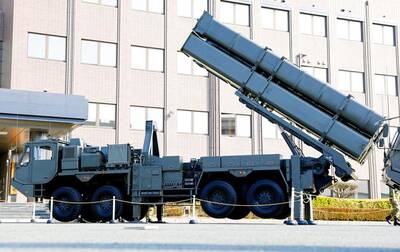
Japan has deployed long-range missiles in a southwestern region near China, the Japanese defense minister said yesterday, at a time when ties with Beijing are at their lowest in recent years. The missiles were installed in Kumamoto in the southern region of Kyushu, as Japan is attempting to shore up its military capacity as China steps up naval activity in the East China Sea. “Standoff defense capabilities enable us to counter the threat of enemy forces attempting to invade our country ... while ensuring the safety of our personnel,” Japanese Minister of Defense Shinjiro Koizumi said. “This is an extremely important initiative for
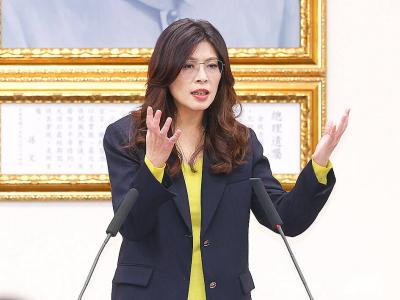
Chinese Nationalist Party (KMT) Chairwoman Cheng Li-wun (鄭麗文) today accepted an invitation from Chinese President Xi Jinping (習近平) to lead a delegation to China next month, saying she hopes to promote the peaceful development of cross-strait relations and bring stability to the Taiwan Strait. “I am grateful and happy to accept this invitation,” Cheng said in a statement from the KMT chairperson’s office. Cheng said she hopes both sides can work together to promote the peaceful development of cross-strait relations, enhance exchange and cooperation, bring stability to the Taiwan Strait and improve people’s livelihoods. At today's news conference, Cheng said any efforts to
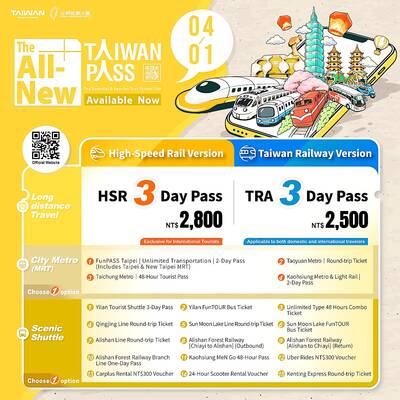
MORE POPULAR: Taiwan Pass sales increased by 59 percent during the first quarter compared with the same period last year, the Tourism Administration said The Tourism Administration yesterday said that it has streamlined the Taiwan Pass, with two versions available for purchase beginning today. The tourism agency has made the pass available to international tourists since 2024, allowing them to access the high-speed rail, Taiwan Railway Corp services, four MRT systems and four Taiwan Tourist Shuttles. Previously, five types of Taiwan Pass were available, but some tourists have said that the offerings were too complicated. The agency said only two types of Taiwan Pass would be available, starting from a three-day pass with the high-speed rail and a three-day pass with Taiwan Railway Corp. The former costs NT$2,800
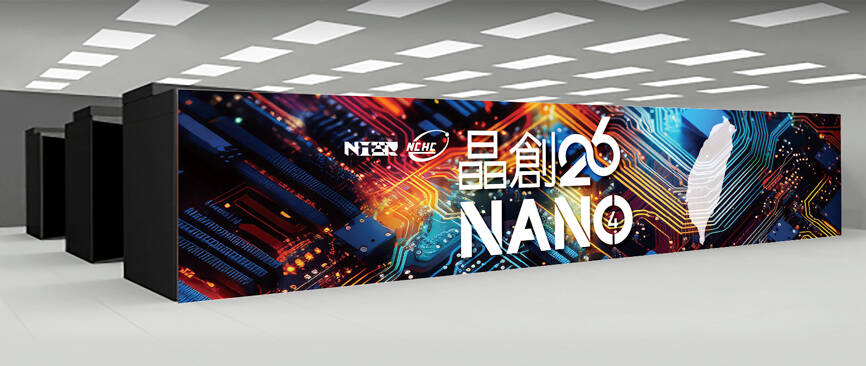
The nation’s fastest supercomputer, Nano 4 (晶創26), is scheduled to be launched in the third quarter, and would be used to train large language models in finance and national defense sectors, the National Center for High-Performance Computing (NCHC) said. The supercomputer, which would operate at about 86.05 petaflops, is being tested at a new cloud computing center in the Southern Taiwan Science Park in Tainan. The exterior of the server cabinet features chip circuitry patterns overlaid with a map of Taiwan, highlighting the nation’s central position in the semiconductor industry. The center also houses Taiwania 2, Taiwania 3, Forerunner 1 and


 RSS
RSS