

Taichung City Police Department Commissioner Hu Mu-yuan (胡木源) yesterday said four police officers were punished for failing to take action while at a crime scene.
“They must be punished for misbehaving as law enforcement officers,” Hu said.
Hu said the officers were at the office of Weng Chi-nan (翁奇楠) on Friday when he was shot dead by an unidentified gunman.
The officers were allegedly connected to gang members and ignored the crime that took place in their presence, he said.
Hu said the officers were Traffic Chief Lin Chi-you (林啟右), Criminal Investigation Corps Third Division lieutenants Lin Wen-wu (林文武) and Shih Chang-hsing (石長興), and Sergeant Tai Chih-hung (戴志宏).
Hu said Lin Chi-yu would be removed from his administrative position. Lin Wen-wu, who will be retiring today, received a demerit.
Shih and Tai, meanwhile, only received citations, as they were following orders from their superiors.
Hu said the officers told investigators they went to Weng's office for a cup of tea at the invitation of a retired officer, but did not realize that Weng was there as well.
A gunman entered Weng's office on Da-dun 10th Street when Weng walked into the office at 4:20pm. Hu said a total of 16 shots were fired, with seven bullets hitting Weng.
Lai Jung-chen (賴榮振), a friend of Weng, was also wounded and remained in critical condition at press time.
Hu said a probe showed that Lin Chi-you and Lin Wen-wu did not see what happened as they were hiding under a coffee table during the shooting.
The four officers were not harmed, Hu said, adding that the gunman hopped into a vehicle and took off after firing the shots, Hu said.
A surveillance camera captured the gunman's face and the license plate of his vehicle, Hu said, adding that the picture of the suspect was distributed to the public.
Police confirmed the license plate was a stolen one.
The National Police Agency has dispatched 40 special force officers to Taichung following reports of a series of violent crimes.
Hu said he asked for help from the central government after consecutive shootings and kidnappings cases in recent weeks.
“As we don't have enough manpower at the moment, we can definitely use some help,” he said.
Also See: Taichung deploys SWAT to fight crime

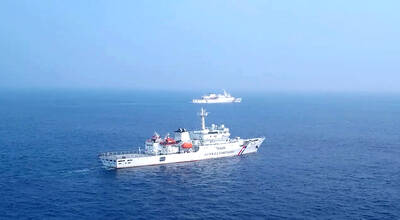
PATROL PARTNERS: The ‘Chiayi’ and the ‘Penghu’ departed for a two-day joint patrol of Palau’s exclusive economic zone, the CGA’s second diplomatic visit to the country The Coast Guard Administration (CGA) set a record for its southernmost deployment of a coast guard vessel as the vessels Chiayi and the Penghu reached Palau’s Pulo Anna Island on Saturday in a cooperative exercise between the two countries. The island, about 217 nautical miles (401km) southwest of Koror in the Palauan state of Sonsorol and 1,220 nautical miles from Taiwan’s southernmost point, Oluanpi (鵝鑾鼻), is the furthest south a CGA vessel has sailed. The two vessels are in Palau for the coast guard’s second diplomatic visit to the country. They docked at Malakal Harbor on Tuesday last week. The coast guard
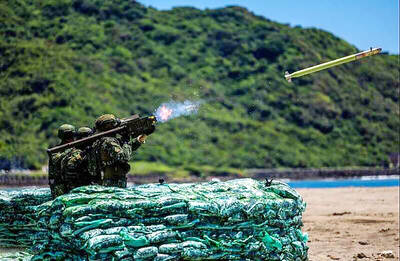
BATCH 1: The military has plans to assign the weapons to the army to defend Taiwan proper, as well as outlying islands and the navy for the Marine Corps, the official said Taiwan is to receive 500 Stinger missiles and 178 launchers from the US by the end of the year, the first batch under a planned two-stage acquisition totaling 2,621 missiles and 763 launchers, a defense official said yesterday on condition of anonymity. The portable missiles would play a vital role in the nation’s air defense capabilities, the source said. The army plans to deploy 2,235 missiles and 657 launchers to defend Taiwan proper and outlying islands, they said, citing military documents. The navy is allotted 295 missiles and 85 launchers to arm the Marine Corps and some surface vessels that lack air defense

The government is monitoring online rumors that a pneumonic plague outbreak has spread from Russia into China, and it might enhance quarantine measures, Premier Cho Jung-tai (卓榮泰) said yesterday. During a legislative meeting, Democratic Progressive Party Legislator Wang Ting-yu (王定宇) said that rumors had circulated that the disease had spread across several Chinese provinces. He asked Cho whether the government was prepared to prevent the disease spreading to Taiwan, given the volume of traffic between the two sides, and how concerned the government was about the alleged outbreak. The Ministry of Health and Welfare had implemented border quarantine measures after briefing the Executive

The European Parliament on Wednesday adopted a recommendation on EU-China political relations that rejected China’s efforts to restrict Taiwan’s participation in international organizations and exchanges. The recommendation, addressed to the European Council, the European Commission and EU High Representative for Foreign Affairs and Security Policy Kaja Kallas, includes several references to EU-Taiwan relations and expresses support for closer ties, saying they would bring positive benefits and have strategic importance. Describing Taiwan as a valuable partner in trade and technology, the European Parliament said it “rejects China’s attempts to coerce international organizations, third countries and other actors into restricting Taiwan’s international participation and


 RSS
RSS