


South Korea blared propaganda broadcasts into North Korea yesterday after a six-year halt and Pyongyang said its troops were bracing for war as tensions spiked on the divided peninsula over the sinking of a warship.
One Seoul-based monitoring agency reported that North Korea’s leader ordered its 1.2 million-member military to get ready for combat after the South blamed the North for a March 26 torpedo strike that sank the warship Cheonan and killed 46 sailors.
South Korean officials could not immediately confirm the report.
The South’s restarting of psychological warfare operations — including radio broadcasts into the North and placing loudspeakers at the border to blast out propaganda — were among measures the government announced on Monday to punish Pyongyang.
A team of international investigators concluded last week that a torpedo from a North Korean submarine tore apart the Cheonan. The North flatly denies involvement and has warned such retaliation would mean war.
The North’s military claimed yesterday that dozens of South Korean navy ships violated the disputed western sea border earlier this month and threatened to take “practical” military measures in response, the official Korean Central News Agency said.
South Korea’s military had no immediate response other than to say that the North routinely makes similar accusations.
The US has thrown its full support behind Seoul’s moves and they are planning two major military exercises off the Korean Peninsula in a display of force intended to deter future aggression by the North, the White House said.
In Beijing, US Secretary of State Hillary Rodham Clinton said she had “very productive and very detailed” discussions with Chinese officials but could not say if any progress had been made in convincing the Chinese to back UN action.
“No one is more concerned about peace and stability in this region as the Chinese,” she told reporters. “We know this is a shared responsibility, and in the days ahead we will work with the international community and our Chinese colleagues to fashion an effective, appropriate response.”
Chinese State Counselor Dai Bingguo (戴秉國), speaking at a news conference with Clinton, called for “relevant parties” to “calmly and properly handle the issue and avoid escalation of tension.”
Meanwhile, Russian President Dmitry Medvedev talked with South Korean President Lee Myung-bak yesterday and said he “understands well” about the South’s moves and will try to give an “appropriate signal” to the North over the sinking, according to Lee’s office.
South Korea’s military resumed radio broadcasts airing Western music, news and comparisons between the South and North Korean political and economic situation late on Monday, the Joint Chiefs of Staff said.
The military also plans to air-drop propaganda leaflets to inform North Koreans about the ship’s sinking.

A signaling system malfunction disrupted high-speed rail (HSR) services beginning at 8am today, with trains temporarily reduced to three northbound and three southbound trains per hour as authorities conduct inspections. The malfunction occurred on a section of track in Miaoli County during pre-operation checks early this morning, forcing northbound and southbound trains to use a single track, the HSR operator said. The regular schedule has been replaced with three hourly trains offering only nonreserved seating in each direction, stopping at every station, it said, adding that business class cars would still have reserved seating. Departures from terminal stations are scheduled at the top
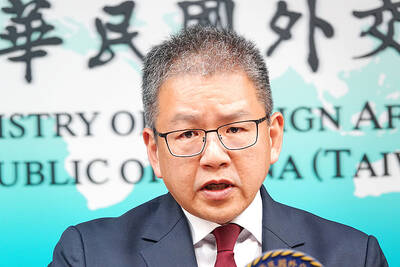
Taiwan is still in the process of assessing the possibility of recruiting workers from Eswatini, the Ministry of Foreign Affairs said yesterday, adding that its goal is to help Eswatini upgrade its vocational training centers. If there are plans to recruit workers from Eswatini, safeguarding national security, protecting public health and ensuring the employment rights of Taiwanese would be prerequisites, Department of West Asian and African Affairs Director-General Yen Chia-liang (顏嘉良) told a news conference. Key considerations would also include filling labor shortages in specific industries, and fostering bilateral professional and technical exchanges, he said. Yen was asked about the progress of labor

VERBOSE VESSELS: A CGA cutter and a China Coast Guard exchanged verbal barbs for more than a day in Taiwanese-controlled waters before the Chinese vessel left The Taiwanese and Chinese coast guards had a standoff near the strategically located Pratas Islands (Dongsha Islands, 東沙群島) in the north of the South China Sea, the Coast Guard Administration (CGA) said yesterday. The two sides engaged in intense radio exchanges over sovereignty claims during the 33-hour standoff. China Coast Guard vessel 3501 eventually left the restricted waters, 26.6 nautical miles (49.2km) west of the Pratas Islands, at 5pm yesterday, the CGA said. Lying approximately between southern Taiwan and Hong Kong, the Taiwan-controlled Pratas are seen by some security experts as vulnerable to Chinese attack due to their distance — more than

A US uncrewed surface vessel (USV) encountered multiple Chinese warships during an autonomous transit of the Taiwan Strait, US defense company Seasats said in a statement on Wednesday. Seasats announced that a Lightfish USV had completed the first autonomous transit of the Taiwan Strait. Over five days, the USV traversed the entire length of the Strait while constantly monitoring surface vessel traffic, the company said. The Lightfish encountered multiple Chinese warships, one of which was a Chinese People’s Liberation Army Navy (PLAN) Type 056 corvette, it said. The Chinese vessels were operating “well within Taiwan’s exclusive economic zone without transmitting their identity via the


 RSS
RSS