


Thai protesters appealed yesterday for UN-mediated talks with the government after several days of violent street battles in the capital left 25 people dead and more than 200 wounded.
A top protest leader also urged the king to intervene in the crisis, which has turned areas of the city into no-go zones as troops fire live ammunition at demonstrators, some armed or using slingshots and fireworks.
The “Red Shirts” were ready to enter peace talks with the government “immediately” as long as the UN mediated, protest leader Nattawut Saikuar told reporters.
“We want the UN because we don’t trust we will receive justice from organizations in Thailand,” he said.
However, the idea was quickly shot down by the government, which has repeatedly warned foreign governments not to meddle in its affairs.
“As for the call of UN interference, no governments allow any organizations to intervene in their internal affairs,” spokesman Panitan Wattanayagorn said.
Previous talks between the two sides have failed to reach an agreement, despite an offer — since withdrawn — by the embattled prime minister to hold elections in November if the anti-government demonstrators go home.
The army yesterday put off a plan to impose a curfew in parts of the city but did not rule out restricting nighttime movements if the situation deteriorates further.
Authorities said they would send workers from the Red Cross to help anti-government protesters — particularly women, children and the elderly — who want to leave the vast protest area in the heart of the capital.
“Men can also leave the site but they have to show they are unarmed,” army spokesman Colonel Sunsern Kaewkumnerd told reporters.
The army moved on Thursday last week to seal off the area to prevent more demonstrators entering, although they have been allowed to leave, as the government grappled with a way to end the two-month standoff.
Sporadic gunfire continued to echo around the fringes of the Red Shirts’ sprawling encampment yesterday as a swathe of the city was shrouded in black smoke after demonstrators torched piles of tires in roads.
Two men were shot and wounded during a confrontation between troops and several hundred anti-government demonstrators who threw stones, Molotov cocktails and firecrackers, a reporter said.
One man died yesterday as street clashes continued, emergency services said. It was not clear how he was killed.
All of the fatalities in recent days have been civilians.
The Red Shirts called on the king to intervene, saying he was the “only hope” for an end to the crisis, which has left more than 50 people dead and 1,600 wounded in total.
“As people in this country, we would like his kindness,” Jatuporn Prompan told reporters at the rally site, where thousands of protesters were camped. “I believe Thais will feel the same, that His Majesty is our only hope.”
King Bhumibol Adulyadej chastised both the military and protest leaders during a 1992 uprising, effectively bringing the violence to an end, but has avoided commenting directly on the current crisis in public.

PROVOCATIVE: Chinese Deputy Ambassador to the UN Sun Lei accused Japan of sending military vessels to deliberately provoke tensions in the Taiwan Strait China denounced remarks by Japan and the EU about the South China Sea at a UN Security Council meeting on Monday, and accused Tokyo of provocative behavior in the Taiwan Strait and planning military expansion. Ayano Kunimitsu, a Japanese vice foreign minister, told the Council meeting on maritime security that Tokyo was seriously concerned about the situation in the East China and South China seas, and reiterated Japan’s opposition to any attempt to change the “status quo” by force, and obstruction of freedom of navigation and overflight. Stavros Lambrinidis, head of the EU delegation to the UN, also highlighted South China Sea
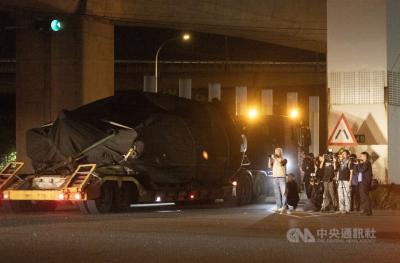
The final batch of 28 M1A2T Abrams tanks purchased from the US arrived at Taipei Port last night and were transported to the Armor Training Command in Hsinchu County’s Hukou Township (湖口), completing the military’s multi-year procurement of 108 of the tanks. Starting at 12:10am today, reporters observed more than a dozen civilian flatbed trailers departing from Taipei Port, each carrying an M1A2T tank covered with black waterproof tarps. Escorted by military vehicles, the convoy traveled via the West Coast Expressway to the Armor Training Command, with police implementing traffic control. The army operates about 1,000 tanks, including CM-11 Brave Tiger

Taiwan Semiconductor Manufacturing Co (TSMC, 台積電), the world’s largest contract chipmaker, said it expects its 2-nanometer (2nm) chip capacity to grow at a compound annual rate of 70 percent from this year to 2028. The projection comes as five fabs begin volume production of 2-nanometer chips this year — two in Hsinchu and three in Kaohsiung — TSMC senior vice president and deputy cochief operating officer Cliff Hou (侯永清) said at the company’s annual technology symposium in Silicon Valley, California, last week. Output in the first year of 2-nanometer production, which began in the fourth quarter of last year, is expected to
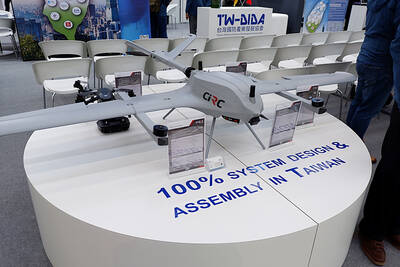
Taiwan’s drone exports surged past US$100 million in the first quarter, exceeding last year’s full-year total, with the Czech Republic emerging as the largest buyer, the Ministry of Economic Affairs said. Exports of complete drones reached US$115.85 million in the period, about 1.2 times the total recorded for all of last year, the ministry said in a report. Exports to the Czech Republic accounted for about US$100 million, far outpacing other markets. Poland, last year’s top destination, recorded about US$11.75 million in the first quarter. Taiwan’s drone exports have expanded rapidly in the past few years, with last year’s total


 RSS
RSS