


A powerful quake with a magnitude of at least 7.2 hit the Indonesian province of Aceh yesterday, causing panic in an area that was devastated by the killer waves of the 2004 tsunami.
Coastal residents fled from their homes and headed inland fearing a destructive tsunami, but officials said no casualties were reported, although one official said part of a school under construction collapsed.
The quake hit at 12:59pm, 66km southwest of Meulaboh on the Aceh coast on the island of Sumatra, according to the local Meteorological and Geophysics Agency.
The US Geological Survey (USGS) put the magnitude at 7.4.
A local tsunami alert was issued by the Indonesian government but lifted about 90 minutes later.
The people of Aceh are still traumatized by memories of Dec. 26, 2004, when the Indian Ocean smashed into the northern tip of Sumatra after a magnitude 9.3 quake split the seabed to the island’s west.
A correspondent in the provincial capital Banda Aceh said the ground shook for about three minutes yesterday, sending people rushing from their homes and heading inland on motorcycles, cars and trishaws.
“This quake turned out not to be destructive. There’s no report of damage to buildings, anyone injured or killed so far,” Disaster Management Agency spokesman Priyadi Kardono told reporters.
“There were many people who panicked and fled their homes. They were just so afraid that a tsunami would happen again,” he said.
Part of a school building that was under construction on the tiny island of Simeulue south of Meulaboh has collapsed, local chief Darmili said, adding that there were no reports of damage elsewhere.
Minor damage to the control tower of the Cut Nyak Dhien airport near Meulaboh — including broken windows and cracks on the wall — did not disrupt airport operations, Transportation Ministry spokesman Bambang Ervan said.
Activities at Meulaboh seaport were also briefly disturbed as workers fled to higher ground after hearing the tsunami alert.
“But all things have returned to normal now,” Ervan said.
Indonesia was the nation hardest hit in the 2004 tsunami, one of the world’s deadliest natural disasters, with at least 168,000 people killed out of more than 220,000 who lost their lives across the region.
Indonesia sits on the Pacific “Ring of Fire,” where the meeting of continental plates causes high volcanic and seismic activity and is frequently rattled by earthquakes.
Yesterday’s quake off Meulaboh, which lies on the northwestern tip of Sumatra, struck at a depth of 30km, the local agency said, while the USGS put the depth at 61km.
Meulaboh was near the epicenter of the 2004 quake and one of the hardest hit areas, with about 40,000 people killed and more than 50,000 people left homeless.
The killer tidal wave had flattened the coastal city, destroying houses, roads and bridges destroyed and bringing down power and telephone lines.
“Although there’s no tsunami, Meulaboh residents had panicked and would stay alert. They’re still outside, scared to return to their homes,” West Aceh district deputy head Fuadri told reporters after yesterday’s quake.
In Malaysia, the Meteorological Department said tremors were felt in the west coast of peninsular Malaysia, including the resort island of Penang.
A magnitude 7.8 earthquake hit Sumatra early last month, leaving 17 people injured when some houses collapsed.
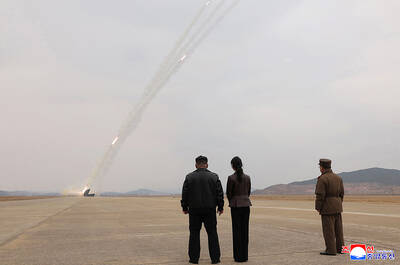
North Korea tested nuclear-capable rocket launchers, state media reported yesterday, a day after Seoul detected the launch of about 10 ballistic missiles. The test comes after South Korean and US forces launched their springtime military drills, due to run until Thursday. North Korean leader Kim Jong-un on Saturday oversaw the testing of the multiple rocket launcher system (MRLS), the Korean Central News Agency (KCNA) said. The test involved 12 600mm-caliber ultra-precision multiple rocket launchers and two artillery companies, it said. Kim said the drill gave Pyongyang’s enemies, within the 420km striking range, a sense of “uneasiness” and “a deep understanding

RECOGNITION: Former Fijian prime minister Mahendra Chaudhry said that Taiwan’s New Southbound Policy serves as a stabilizing force in the Indo-Pacific region Taiwan can lead the unification of the Chinese people, Nobel Peace Prize laureate and former Polish president Lech Walesa said in Taipei yesterday, adding that as the world order is changing, peaceful discussion would find good solutions, and that the use of force and coercion would always fail. Walesa made the remarks during his keynote address at a luncheon of the Yushan Forum in Taipei, titled “Indo-Pacific Partnership Prospects: Taiwan’s Values, Technology and Resilience,” organized by the Taiwan-Asia Exchange Foundation with the Ministry of Foreign Affairs. Walesa said that he had been at the forefront of a big peaceful revolution and “if

North Korea yesterday fired about 10 ballistic missiles to the sea toward Japan, the South Korean Joint Chiefs of Staff (JCS) said, days after Pyongyang warned of “terrible consequences” over ongoing South Korea-US military drills. Pyongyang recently dashed hopes of a diplomatic thaw with Seoul, Washington’s security ally, describing its latest peace efforts as a “clumsy, deceptive farce.” Seoul’s military detected “around 10 ballistic missiles launched from the Sunan area in North Korea toward the East Sea [Sea of Japan] at around 1:20pm,” JCS said in a statement, referring to South Korea’s name for the body of water. The missiles

‘UNWAVERING FRIENDSHIP’: A representative of a Japanese group that co-organized a memorial, said he hopes Japanese never forget Taiwan’s kindness President William Lai (賴清德) yesterday marked the 15th anniversary of the Tohoku earthquake and tsunami, urging continued cooperation between Taiwan and Japan on disaster prevention and humanitarian assistance. Lai wrote on social media that Taiwan and Japan have always helped each other in the aftermath of major disasters. The magnitude 9 earthquake struck northeastern Japan on March 11, 2011, triggering a massive tsunami that claimed more than 19,000 lives, according to data from Japanese authorities. Following the disaster, Taiwan donated more than US$240 million in aid, making it one of the largest contributors of financial assistance to Japan. In addition to cash donations and


 RSS
RSS