


The Ministry of National Defense (MND) yesterday confirmed reports that it had won the case it filed with the international commercial arbitration court in the scandal-plagued Lafayette frigate deal. The French company Thales has been ordered to repay Taiwan’s government around US$861 million.
In the ruling on Monday, the Paris-based court said the money was to make up for unauthorized commissions that had been paid to help Thomson-CSF (now known as Thales) win a deal to sell six Lafayette frigates to Taiwan for US$2.5 billion in 1991.
The Navy filed the arbitration petition with the court in 2001, requesting the repayment of US$520 million in unlawful kickbacks from Thales.
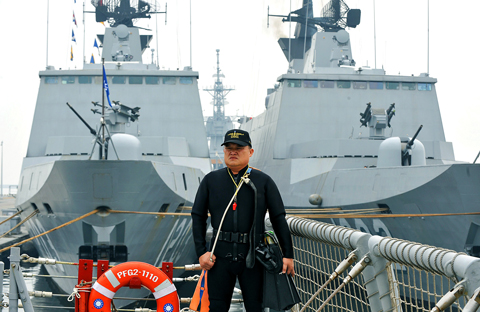
PHOTO: SAM YEH, AFP
Deputy Minister of National Defense Chao Shih-chang (趙世璋) told a press conference yesterday that the ministry hoped that Thales would now repay the money and if the company refused, the Navy would apply to the French court for compulsory enforcement.
Navy attorney Vivian Lee (李孟融) told the press conference that the court ruled that Thales repay US$591 million in unlawful kickbacks, US$250 million in interest and US$20 million in legal expenses, totaling US$861 million.
The ruling was final, she said.
“Thales has been ordered to pay damages and interest,” a company spokesman said, adding that the group was “contesting the very basis of this ruling” and would appeal.
Under Article 18 of the contract, the French company was prohibited from paying any kind of commission and it was stipulated that any illicit commissions would have to be repaid to Taiwan.
The contract also said that any dispute would be settled by a panel of arbitrators.
Prosecutor-General Huang Shih-ming (黃世銘) said Taiwanese prosecutors have not yet completed their investigations into the Lafayette case and they would continue to look into any involvement of former government officials and politicians in the case.
Taiwanese investigators said Thompson-CSF paid US$495 million to Andrew Wang (汪傳浦) and US$25 million to Alfred Sirven, a former vice chairman of the French oil firm Elf-Aquitaine. Sirven is alleged to have played the role of money launderer and allocator of the kickbacks in the transaction.
Wang fled Taiwan in late 1993 following the death of Navy Captain Yin Ching-feng (尹清楓), whose body was found in the sea off the east coast of Taiwan.
Yin is believed to have been ready to blow the whistle on colleagues who had allegedly received kickbacks from the Lafayette deal.
Wang has been wanted in connection with Yin’s death since September 2000.
A French judicial probe opened in 2001 to investigate claims that much of the money paid by Taiwan a decade earlier went toward commissions to middlemen, politicians and military officers in Taiwan, China and France.
In 2001, the Control Yuan ruled that as much as US$400 million in kickbacks may have been paid over the course of the deal.
Thales spearheaded the sale, but the main stake in the contract was held by the French state-owned shipbuilder DCN. Several sources said the French state would have to pay 70 percent of the penalty.
President Ma Ying-jeou (馬英九) expressed gratification over the ruling.
Presidential Office Spokesman Lo Chih-chiang (羅智強) said Ma’s position on the matter was clear and that he supported the ministry’s position that the case should not be settled out of court.
Lo said the legal triumph strengthened the administration’s resolve to build a clean government and military.
Lo declined to comment on whether Ma would accept an offer by the French government to exchange the compensation for the upgrade of existing munitions or additional weaponry, saying it was a hypothetical question.
At a press conference held by the Chinese Nationalist Party (KMT) caucus, KMT Legislator Lin Yu-fang (林郁方) of the Foreign and National Defense Committee described the result as “belated justice.” Lin said he the nation should receive NT$40 billion in compensation rather than NT$20 billion as reported by the media.
Democratic Progressive Party (DPP) legislators said the ruling showed that military officials were also guilty in handing out and receiving kickbacks and asked the defense ministry to publish the names of those involved.
DPP Legislator Chai Trong-rong (蔡同榮) asked the government to redouble its efforts in tracking down escaped fugitive arms dealer Wang, the key suspect in the kickback scandal.
Wang — who also holds a Dominican Republic passport — is ranked No. 4 on a list of Taiwan’s most wanted.
ADDTIONAL REPORTING BY AFP, VINCENT Y. CHAO AND FLORA WANG

‘NO SECURITY RISK’: The Railway Bureau reassured the public that the technicians’ activities were limited to technical guidance and did not involve sensitive systems The Railway Bureau yesterday said it had invited eight Chinese technicians to assist with an airport MRT construction project. The bureau issued the confirmation after an Internet user said Chinese nationals had entered the construction zone of Taiwan Taoyuan International Airport’s Terminal 3 project. They asked why “individuals from an enemy state” were allowed access to such a major national infrastructure project, which raised serious concerns over Taiwan’s industrial safety, sensitive systems and information security. The bureau’s Northern Region Engineering Branch Office said subcontractor Taiwan Handle Industrial Co (台灣手把工業) of the Taoyuan airport MRT’s “Contract No. CU05 Project A14 Station Civil, MEP &

The National Chungshan Institute of Science and Technology yesterday showcased its locally developed variants of the Vision 60 robotic patrol dog, which it plans to deploy on the nation’s outlying territories in the South China Sea. The variants were produced under the Joint Lab project — created by the institute and domestic companies — and assembled with domestically produced motors, lenses and artificial intelligence (AI) systems alongside licensed tech from the US, Missile and Rocket Systems Research Division deputy director Jen Kuo-kang (任國光) told the media event at a military base in Taipei’s Dazhi (大直) area. Taiwan has built up its strengths

RIGHT DIRECTION: Taiwan’s efforts to prevent forced labor include a proposal to ‘fully prohibit’ employers from withholding workers’ documents, an official said Taiwan is to establish a mechanism to restrict imports of goods linked to forced labor, the Executive Yuan said yesterday, after the US proposed imposing additional tariffs on Taiwanese goods over labor concerns. “The Ministry of Labor and the Ministry of Economic Affairs are to establish an interministerial review procedure,” Executive Yuan spokesperson Michelle Lee (李慧芝) said at a news briefing in Taipei. “The government is to use the Foreign Trade Act [貿易法] as the legal basis to restrict imports of goods produced with forced labor” and bring its supply chain governance more in line with international standards on human rights, resilience

NOT IMMEDIATE: Taiwan has a chance to appeal the proposed 10 percent tariff before it starts, while other countries face a 12.5 percent tariff from the trade office Taiwan is among 60 economies determined by the US to have failed to impose or enforce a ban on the importation of goods produced with forced labor, according to a notice released on Tuesday by the Office of the US Trade Representative (USTR), which proposed imposing an additional 10 percent or more tariff on them. The USTR in a statement said that following an investigation, it had determined under Section 301 of the Trade Act of 1974 that the failure of the 60 economies to impose and effectively enforce a prohibition on the importation of goods produced with forced labor is


 RSS
RSS