


A large group of Taiwanese American organizations is petitioning US President Barack Obama to dramatically increase the US’ ability to stop a Chinese military takeover of Taiwan.
Over the past three months, the group has collected 17,000 letters of support from Taiwan, Japan, Canada and across the US.
They met on Tuesday in Washington with Ted Mann, director of the US State Department’s Office of Taiwan Coordination, and Barbara Schrage, managing director of the American Institute in Taiwan (AIT), to present a petition to be passed on to Obama at the White House.
“There was a cordial exchange of views,” a State Department source said later.
The petition asks Obama to reaffirm the US’ Taiwan Relations Act (TRA) and to “voice concern about the erosion of freedom of speech and assembly and the loss of judicial independence on Taiwan.”
It also asks Obama to send a Cabinet member to Taipei, allow US Navy ships to call at Taiwanese ports and deploy two aircraft carrier task forces to the Western Pacific to maintain the capacity to resist any Chinese attack on Taiwan.
While it is unlikely Obama will agree to any of these moves, analysts say the petition will help remind the State Department of the anxiety felt by many Taiwanese over the possibility of a Chinese takeover.
Among the groups presenting the petition were the Formosan Association for Human Rights; the Formosan Association for Public Affairs; the North America Taiwanese Professors’ Association; the North America Taiwanese Women’s Association; the Presbyterian Church of Taiwan; the Taiwan Hakka Association of Public Affairs in North America; the Taiwan Association of University Professors and the Taiwanese American Association.
The letter to Obama says that President Ma Ying-jeou (馬英九) has been pursuing a policy of “incremental capitulation” by reducing the budget and size of Taiwan’s military, deepening the dependency of the nation’s economy on China and downgrading Taiwan’s international status.
“Taiwan is being delivered into Beijing’s grasp by stealth,” the letter says.
Following Tuesday’s closed-door meeting at the AIT offices, Jay Loo (盧主義), spokesman for the petition project, told the Taipei Times that the US would suffer a “geostrategic disaster” if China took over Taiwan.
He said sea lanes and airspace around Taiwan were critical to the survival of Japan and South Korea and that if those two countries fell under Chinese domination, “the US would be forced to retreat all the way back to Hawaii.”

The National Chungshan Institute of Science and Technology yesterday showcased its locally developed variants of the Vision 60 robotic patrol dog, which it plans to deploy on the nation’s outlying territories in the South China Sea. The variants were produced under the Joint Lab project — created by the institute and domestic companies — and assembled with domestically produced motors, lenses and artificial intelligence (AI) systems alongside licensed tech from the US, Missile and Rocket Systems Research Division deputy director Jen Kuo-kang (任國光) told the media event at a military base in Taipei’s Dazhi (大直) area. Taiwan has built up its strengths

RIGHT DIRECTION: Taiwan’s efforts to prevent forced labor include a proposal to ‘fully prohibit’ employers from withholding workers’ documents, an official said Taiwan is to establish a mechanism to restrict imports of goods linked to forced labor, the Executive Yuan said yesterday, after the US proposed imposing additional tariffs on Taiwanese goods over labor concerns. “The Ministry of Labor and the Ministry of Economic Affairs are to establish an interministerial review procedure,” Executive Yuan spokesperson Michelle Lee (李慧芝) said at a news briefing in Taipei. “The government is to use the Foreign Trade Act [貿易法] as the legal basis to restrict imports of goods produced with forced labor” and bring its supply chain governance more in line with international standards on human rights, resilience
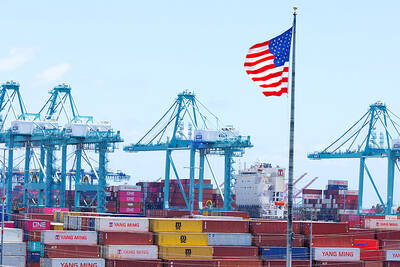
NOT IMMEDIATE: Taiwan has a chance to appeal the proposed 10 percent tariff before it starts, while other countries face a 12.5 percent tariff from the trade office Taiwan is among 60 economies determined by the US to have failed to impose or enforce a ban on the importation of goods produced with forced labor, according to a notice released on Tuesday by the Office of the US Trade Representative (USTR), which proposed imposing an additional 10 percent or more tariff on them. The USTR in a statement said that following an investigation, it had determined under Section 301 of the Trade Act of 1974 that the failure of the 60 economies to impose and effectively enforce a prohibition on the importation of goods produced with forced labor is
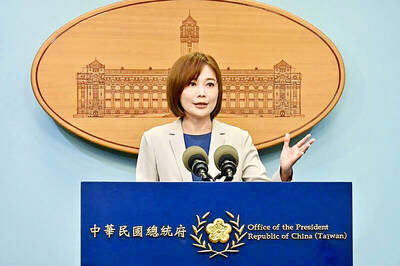
TIT-FOR-TAT: The US allegedly revoked the visa of a Chinese national working at Xinhua News Agency in the US in response to Beijing’s expulsion of Vivian Wang The Presidential Office yesterday condemned China for expelling a New York Times correspondent from Beijing following the newspaper’s interview with President William Lai (賴清德), saying the move highlighted Beijing’s suppression of press freedom and its threat to international news media. Taiwan has noted a series of recent incidents in which Beijing used similar tactics to “threaten and pressure international media outlets and journalists,” Presidential Office spokeswoman Karen Kuo (郭雅慧) said in a statement. “This concerns not only press freedom and freedom of expression, but also the safety of journalists, and Taiwan and relevant partners are paying close attention to the situation,” she


 RSS
RSS