

Local consumer confidence hit its highest level in more than four years last month, with public expectations over the job environment in the next six months showing the strongest sign of improvement, a report released by National Central University showed yesterday.
The consumer confidence index (CCI) edged up to 73.16 points last month, from 65.98 in January, with all six sub-indexes registering increases, the university’s Research Center for Taiwan Economic Development said in the report.
“Besides seasonal factors, the results showed public satisfaction with the recovering economy,” Shia Ben-chang (謝邦昌), professor in the statistics and information science department at Fu Jen Catholic University, said by telephone yesterday.
As the economy continues to improve, the employment outlook sub-index rose 18.45 points to 61.95 last month, posting the strongest growth among all categories, the Taoyuan-based research center said.
“With the unemployment rate falling for three to four straight months, consumers have become more confident about the job market,” Shia said.
The survey, which polled 2,410 adults nationwide from Feb. 19 to Feb. 22, also showed that 65 percent of respondents thought the next six months would be a good time to buy durable goods.
Shia said it was the first time since July 2008 that consumers had expressed optimism toward buying durable goods over the next six months, with the sub-index rising to 101 points, from 91.55 in January.
“This sub-index has been on the rise for the past eight months. With increased confidence in the economy, the public is more willing to buy durable goods such as cars and houses,” he said.
In addition, the sub-index for stocks rose to 99.4 points — its second-highest score in history, after the 99.7 points recorded in January 2001, the report showed.
A CCI figure between 100 points and 200 points indicates growing optimism about the outlook for the next six months, while a score of less than 100 points shows increasing pessimism, the center said.
Shia said that with the economy continuing to pick up, the CCI should rise further in the second and third quarters, barring any non-economic factors.

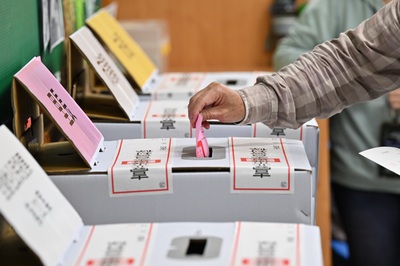
Preliminary voter turnout in Taipei for today’s nine-in-one local elections reached 68.85 percent, surpassing the 67.7 percent recorded in the 2022 mayoral race, according to initial tallies reported by district offices to the Taipei Department of Civil Affairs. Among the capital’s 12 administrative districts, Nangang District (南港) posted the highest preliminary turnout at 72.19 percent, while Wanhua District (萬華) recorded the lowest at 65.65 percent, the department said. Turnout climbed steadily throughout the afternoon ahead of the 4pm close of polls in the closely watched Taipei mayoral race. Taiwanese went to the polls today to choose more than 11,000 local government positions across
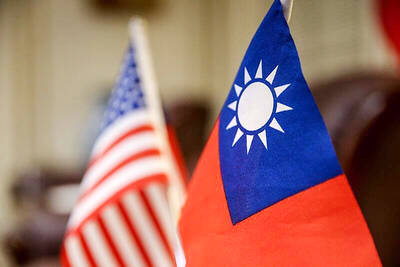
‘NOT FINAL’: US President Donald Trump proposed new tariffs on trading powers, including Taiwan, but signed agreements would still hold sway, a source said Tariff rates proposed by Washington under a Section 301 investigation into structural overcapacity would be procedural recommendations rather than final decisions, and Taiwan’s final rate is expected to revert to the agreed 15 percent non-stacked cap, a source familiar with Taiwan-US trade affairs said yesterday. US President Donald Trump later yesterday proposed new tariffs on major trading powers, including China. His administration proposed levies on 14 trading partners to combat structural excess industrial capacity, with the highest rate of 20 percent to hit China, which Washington accuses of flooding world markets with cheap exports of everything from steel to electric vehicles and
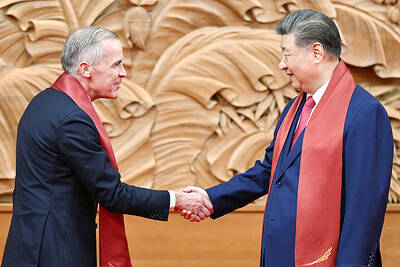
CALL FOR COLLABORATION: ‘We have a high respect of Prime Minister [Mark] Carney’s vision, and we want to be part of this vision,’ the deputy minister of foreign affairs said Canadian Prime Minister Mark Carney risks exposing Canada to the very economic coercion he has cautioned against by deepening trade ties with China, Deputy Minister of Foreign Affairs Chen Ming-chi (陳明祺) said on Saturday, adding that Taiwan has learned the hard way that dependence on Beijing comes with consequences. “We worry. We worry,” Chen said in an interview at the Halifax International Security Forum in Nova Scotia when asked about Carney’s efforts to improve relations with China. Carney has said that major powers are using economic integration as a weapon, citing US tariffs and China’s restrictions on critical minerals. He

LONG-ARM TACTICS: China’s new law allows authorities to label anyone who does not promote unification as ‘undermining ethnic unity,’ the Mainland Affairs Council said China’s Ethnic Unity and Progress Promotion Law disguises unification as ethnic unity, escalating the Chinese Communist Party’s (CCP) legal warfare against Taiwan from “opposing independence” to “forcing unification,” Mainland Affairs Council Minister Chiu Chui-cheng (邱垂正) said yesterday. The Tibet Religious Foundation of His Holiness the Dalai Lama yesterday held a forum “addressing the adverse impact of the People’s Republic of China’s Ethnic Unity and Progress Promotion Law and strategies for response.” Chiu in his speech said the law, that was implemented on July 1 is not only a set of legal regulations, but also a crucial part of the “long-arm


 RSS