


Residents of the US East Coast began digging up from under a thick blanket of snow yesterday after a record-breaking blizzard paralyzed Washington and the region, snapping power to 350,000 residents and killing two people.
The monster storm stretched more than 1,000km from eastern Indiana across into New Jersey and as far south as North Carolina, affecting tens of millions of Americans.
With winds gusting at almost 90km an hour, meteorologists said they had recorded snowfall as high as 96cm near Baltimore, Maryland — a record.
The heavy, sticky snow toppled trees and snapped power lines, leaving more than 350,000 people without electricity in Maryland and neighboring Virginia.
“Snowmageddon here in DC,” US President Barack Obama told Democrats in a speech, only a year after chiding the capital for over-responding to small snowfalls.
The National Weather Service put the Washington-Baltimore metropolitan area under a rare 24-hour blizzard warning until 10pm on Saturday.
Forecasters warned residents to hunker down, with no let-up in the weather for most of the day, and said chilly temperatures yesterday would mean the wet snow would swiftly turn icy.
“Officially this won’t break records in DC, but unofficially, you bet it will,” Paul Kochin, an expert in northeast weather systems, told reporters.
“It’s very rare to have two such big storms in one season,” he said, after the capital region was already crippled by a smaller but still massive storm in December.
Maryland and Virginia were bearing the brunt of the storm and seeing the highest snowfalls, he said.
“It’s pretty rough out there,” said the Maryland Emergency Management Agency’s Ed McDonough.
In terms of the Baltimore-Washington corridor, “this is probably the biggest storm we’ve ever had,” he said.
Emergency teams that struggled to repair the power cuts were hampered by the miserable weather.
“We have a lot of scattered outages and the road conditions are not really working with us,” said Pepco spokesman Andre Francis, pleading for patience as some customers were told the blackouts could last days.
About 200 National Guardsmen had been deployed across Maryland, while in Virginia police confirmed that a father and son were killed on Friday when they stopped to give assistance to a stranded car.
Police in the state had responded to 3,167 calls for help, more than two-thirds of which were because of car accidents or stranded vehicles.
Three state troopers were also injured in storm-related accidents in Virginia.
All flights out of the capital’s Reagan National airport were canceled, along with most flights out of Dulles International Airport in Virginia, while there was limited service at Baltimore.
A hangar roof collapsed at the Dulles Jet Center early on Saturday, said Rob Yengling, spokesman for the Metropolitan Washington Airports Authority. Five people spending the night inside to shelter from the storm escaped without injuries.
States to the north like Pennsylvania, New Jersey and Delaware are more used to heavy snowfalls and got their share of the great blizzard.
Philadelphia, Pennsylvania, was buried by 68cm, reportedly the city’s second-deepest all-time snowfall, and 69.9cm were reported at American University in Washington, DC.
The storm generated equal parts frustration and fascination.
In the normally bustling capital, sight-seers walked thigh-deep through the snow along the famous national mall or went cross-country skiing down eerily empty boulevards.
Alix Lawe, who works with the US Air Force, was out for a run in the snow, and told reporters: “It’s so fun. I’m from Florida, I’ve never seen so much snow.”
Snowplows were trying to keep emergency routes and main highways clear, but most officials said it would take days to reach the smaller streets, and warned of a difficult morning commute today.
The capital’s transportation system has shut down 40 above-ground subway stations and halted bus service, meaning transport links between Washington and its heavily populated suburbs were snapped, with most major roads impassable.

‘NO SECURITY RISK’: The Railway Bureau reassured the public that the technicians’ activities were limited to technical guidance and did not involve sensitive systems The Railway Bureau yesterday said it had invited eight Chinese technicians to assist with an airport MRT construction project. The bureau issued the confirmation after an Internet user said Chinese nationals had entered the construction zone of Taiwan Taoyuan International Airport’s Terminal 3 project. They asked why “individuals from an enemy state” were allowed access to such a major national infrastructure project, which raised serious concerns over Taiwan’s industrial safety, sensitive systems and information security. The bureau’s Northern Region Engineering Branch Office said subcontractor Taiwan Handle Industrial Co (台灣手把工業) of the Taoyuan airport MRT’s “Contract No. CU05 Project A14 Station Civil, MEP &

A US uncrewed surface vessel (USV) encountered multiple Chinese warships during an autonomous transit of the Taiwan Strait, US defense company Seasats said in a statement on Wednesday. Seasats announced that a Lightfish USV had completed the first autonomous transit of the Taiwan Strait. Over five days, the USV traversed the entire length of the Strait while constantly monitoring surface vessel traffic, the company said. The Lightfish encountered multiple Chinese warships, one of which was a Chinese People’s Liberation Army Navy (PLAN) Type 056 corvette, it said. The Chinese vessels were operating “well within Taiwan’s exclusive economic zone without transmitting their identity via the
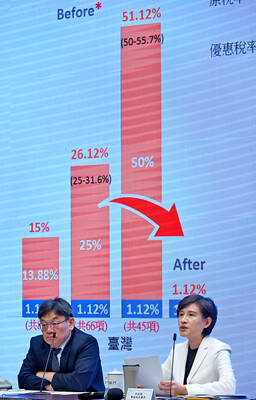
GREATER REACH? Auto parts and wood products would face tariffs of up to 15%, matching those targeting the EU, Japan and South Korea, Vice Premier said The US has announced that preferential tariff treatment for Taiwan’s non-semiconductor Section 232 goods would take effect retroactively from May 1, the Executive Yuan said yesterday. The US government yesterday posted a notice on the Federal Register’s public inspection Web site previewing tariff concessions for Taiwan under a memorandum of understanding (MOU) on Taiwan-US investment after two months of negotiations. The MOU signed on Jan. 15 stipulated three major preferential tariff arrangements: a 15 percent “reciprocal” tariff rate for Taiwan without stacking most-favored nation (MFN) rates; preferential Section 232 treatment for semiconductors and related products; and preferential Section 232 treatment for non-semiconductor

TIT-FOR-TAT: The US allegedly revoked the visa of a Chinese national working at Xinhua News Agency in the US in response to Beijing’s expulsion of Vivian Wang The Presidential Office yesterday condemned China for expelling a New York Times correspondent from Beijing following the newspaper’s interview with President William Lai (賴清德), saying the move highlighted Beijing’s suppression of press freedom and its threat to international news media. Taiwan has noted a series of recent incidents in which Beijing used similar tactics to “threaten and pressure international media outlets and journalists,” Presidential Office spokeswoman Karen Kuo (郭雅慧) said in a statement. “This concerns not only press freedom and freedom of expression, but also the safety of journalists, and Taiwan and relevant partners are paying close attention to the situation,” she


 RSS
RSS