


Negotiations on an economic cooperation framework agreement (ECFA) with China scheduled to start this week are likely to be delayed, a Straits Exchange Foundation (SEF) official said yesterday.
Premier Wu Den-yih (吳敦義) had said the first round of talks was scheduled for today in Beijing and that the pact could be signed in May, but SEF spokesman Maa Shaw-chang (馬紹章) said yesterday that the time and place had yet to be decided.
“It would be extremely difficult to begin talks on Wednesday as planned as we’re still discussing the details with Beijing,” Maa said.
The Economic Daily News said the delay was likely related to Taiwan’s wish that its vice minister of economic affairs lead the talks, while Beijing wanted lower-level trade officials to be in charge.
Vice Minister of Economic Affairs Francis Liang (梁國新) said yesterday the timetable was unchanged.
The timetable is moving according to schedule, he said, adding that he didn’t foresee any delays in signing the pact in May despite the fact that negotiations could be tight as it is only four months away.
Meanwhile, Mainland Affairs Council (MAC) Deputy Minister Kao Charng (高長) said an ECFA would be different from a free-trade agreement (FTA) because while an FTA has full market access once the accord takes effect, an ECFA would be signed in a piecemeal manner and its initial impact would be limited to “early harvest” items.
“It is like building a house,” he said. “You first build the structure and then you take your time to decorate the place.”
Kao made the remarks while addressing members of the Importers and Exporters Association of Taipei yesterday afternoon.
During the question-and-answer session, however, he said that the term “down payment” was an inappropriate description of the pact.
Both sides intend to launch official negotiations later this month.
Kao said that while Beijing had yet to produce its list of “early harvest” items, one thing was certain: The “early harvest” would only represent a small percentage of the country’s traded goods.
“Taiwanese exports to China are valued at between NT$70 billion [US$2.2 billion] and NT$80 billion annually, so 10 percent would represent between NT$7 billion and NT$8 billion,” he said. “The remaining 90 percent will be opened gradually.”
Kao said many have criticized the administration for failing to offer a clear account of the proposed pact, but there was a reason for it.
“The two sides have yet to negotiate the deal,” he said. “Because it is a framework agreement, the purpose is to have free trade and open market. On trade in goods, both sides hope to reduce the tariffs to as low as zero percent.”
Referring to the ASEAN-China framework agreement on economic cooperation, Kao said it took the two sides two years to sign an agreement on trade in goods and another two years for an agreement on trade in services.
Taiwan could follow this model by signing one agreement on trade in goods and one in services, he said.
“The more open the local market, the more the impact in its depth and scope,” he said. “Negative impact is inevitable.”
ADDITIONAL REPORTING BY JASON TAN AND AFP
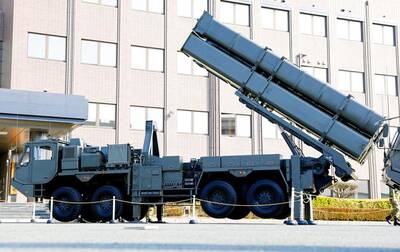
Japan has deployed long-range missiles in a southwestern region near China, the Japanese defense minister said yesterday, at a time when ties with Beijing are at their lowest in recent years. The missiles were installed in Kumamoto in the southern region of Kyushu, as Japan is attempting to shore up its military capacity as China steps up naval activity in the East China Sea. “Standoff defense capabilities enable us to counter the threat of enemy forces attempting to invade our country ... while ensuring the safety of our personnel,” Japanese Minister of Defense Shinjiro Koizumi said. “This is an extremely important initiative for
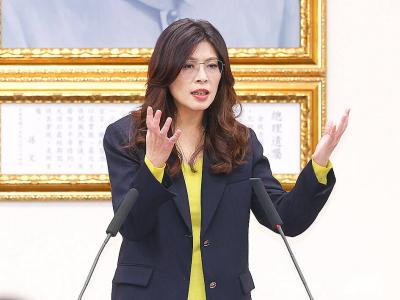
Chinese Nationalist Party (KMT) Chairwoman Cheng Li-wun (鄭麗文) today accepted an invitation from Chinese President Xi Jinping (習近平) to lead a delegation to China next month, saying she hopes to promote the peaceful development of cross-strait relations and bring stability to the Taiwan Strait. “I am grateful and happy to accept this invitation,” Cheng said in a statement from the KMT chairperson’s office. Cheng said she hopes both sides can work together to promote the peaceful development of cross-strait relations, enhance exchange and cooperation, bring stability to the Taiwan Strait and improve people’s livelihoods. At today's news conference, Cheng said any efforts to
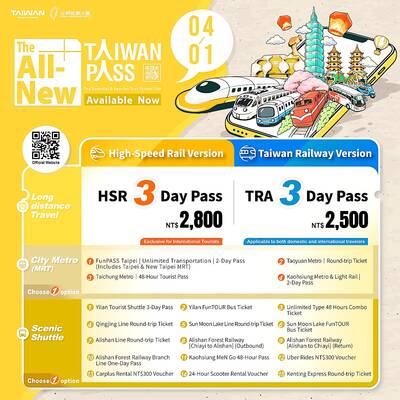
MORE POPULAR: Taiwan Pass sales increased by 59 percent during the first quarter compared with the same period last year, the Tourism Administration said The Tourism Administration yesterday said that it has streamlined the Taiwan Pass, with two versions available for purchase beginning today. The tourism agency has made the pass available to international tourists since 2024, allowing them to access the high-speed rail, Taiwan Railway Corp services, four MRT systems and four Taiwan Tourist Shuttles. Previously, five types of Taiwan Pass were available, but some tourists have said that the offerings were too complicated. The agency said only two types of Taiwan Pass would be available, starting from a three-day pass with the high-speed rail and a three-day pass with Taiwan Railway Corp. The former costs NT$2,800

The nation’s fastest supercomputer, Nano 4 (晶創26), is scheduled to be launched in the third quarter, and would be used to train large language models in finance and national defense sectors, the National Center for High-Performance Computing (NCHC) said. The supercomputer, which would operate at about 86.05 petaflops, is being tested at a new cloud computing center in the Southern Taiwan Science Park in Tainan. The exterior of the server cabinet features chip circuitry patterns overlaid with a map of Taiwan, highlighting the nation’s central position in the semiconductor industry. The center also houses Taiwania 2, Taiwania 3, Forerunner 1 and


 RSS
RSS