


Legislative Speaker Wang Jin-pyng (王金平) yesterday expressed reservations over a suggestion by Chinese Nationalist Party (KMT) legislators that he exercise his power to have police remove lawmakers who are blocking a legislative review if a provisional session is convened to deal with a disputed bill.
Wang told reporters that there was no law that empowers him to call in the police to maintain order during a plenary session.
He added that even if the speaker possessed this authority, he would never exercise it to avoid fueling controversy and harming the legislature’s image, Wang said.
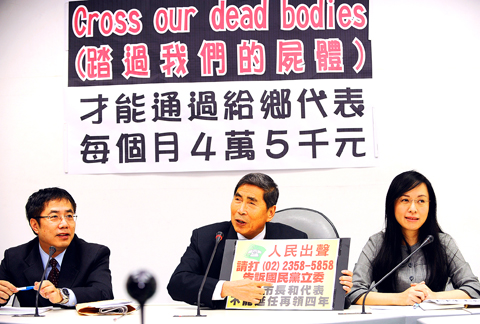
PHOTO: FANG PIN-CHAO, TAIPEI TIMES
Wang made the comment after KMT legislators Alex Fai (費鴻泰) and Ting Shou-chung (丁守中) called on him to have police at the legislature take away lawmakers blocking plenary sessions.
“[Speakers] all over the world enjoy such power. We should establish such a system instead of allowing legislators to get into fist fights with each other,” Ting said.
Whether the speaker should enjoy such power has been a recurring subject of debate over the past few years.
The KMT has been pushing the mechanism in a bid to have Democratic Progressive Party (DPP) legislators removed when the DPP paralyzes a plenary session to stall the KMT’s proposals.
Fai and Ting made the suggestion after DPP legislators threatened to boycott the review of the KMT’s proposed amendment to the Local Government Act (地方制度法) if the legislature holds an extraordinary session to push through the bill.
The DPP caucus has accused the KMT caucus of trying to use the proposal to buy support for the KMT’s candidates in the year-end special municipality mayoral elections.
The amendment would reorganize local governments ahead of December’s elections for the heads of five newly created special municipalities.
At the crux of the dispute is the KMT’s proposal for township chiefs and councilors, who are set to lose their posts by the end of the year when townships are converted into districts under the special municipalities.
Under the KMT proposal, the township chiefs would be appointed as directors of districts under the special municipalities, while the township councilors would be advisers to the directors, with a monthly salary of about NT$45,000.
Despite the DPP’s criticism, President Ma Ying-jeou (馬英九), who doubles as KMT chairman, urged the KMT caucus to pursue an extra legislative session to pass the proposal.
However, Ma appeared to be at odds with Wang as the latter on Wednesday downplayed the urgency to call a provisional legislative meeting.
Wang said yesterday morning that Ma did not inform him prior to telling the KMT legislative caucus to push for an extra session.
However, “President Ma called me earlier this morning saying he felt sorry for not informing me [of his decision] first,” Wang said.
Wang said since the government is under the rule of the KMT and the legislature is also dominated by the KMT, it is “necessary” for the party to keep the speaker informed if the party were pursuing an extra session.
Wang said he had decided to resolve the issue with different caucuses on Monday “no matter how difficult it may be.”
At a separate setting yesterday, the DPP said the KMT’s proposed amendment to the Local Government Act violates the Constitution and was anti-democratic.
The party said the proposal was proof that the KMT was using the tactic to ensure its victory in the 2012 presidential election.
DPP spokesman Tsai Chi-chang (蔡其昌) said the government would singlehandedly create chaos by “wasting” more than NT$3 billion of the public’s money on a doomed policy.
DPP Legislator Ker Chien-ming (柯建銘) said his caucus would oppose the proposal to the end and was willing to “shed blood” for the cause if necessary.
Caucus whip Chai Trong-rong (蔡同榮) said the KMT would have to “cross over our dead bodies” before the DPP would ever consent to the proposal.
DPP Legislator Chiu Yi-ying (邱議瑩) said allowing incumbent local representatives to automatically become district consultants for the next four years was a violation of the four-year term limit rule as set forth in the Constitution.
Amid disputes over the amendment, the KMT announced later in the day that it would revise its proposed amendment to the Local Government Act.
It said it would cancel the proposed monthly salary for advisers to district directors.
The revised version would also propose to allow only 52 township chiefs and councilors to assume new posts as district directors, KMT Secretary-General King Pu-tsung (金溥聰) told a press conference at the KMT headquarters yesterday afternoon.
Seeking to resolve the deadlock over the proposed amendment, King yesterday gathered Presidential Office Secretary-General Liao Lioa-yi (廖了以), Minister of Interior Jiang Yi-huah (江宜樺) and party legislators for a negotiation.
Those attending the meeting then decided to revise the controversial part of its proposed amendment.
King said the KMT would invite party legislators to conduct another round of negotiations on the issue and finalize the content of the proposed amendment this afternoon.
ADDITIONAL REPORTING BY JENNY W. HSU AND MO YAN-CHIH

PROVOCATIVE: Chinese Deputy Ambassador to the UN Sun Lei accused Japan of sending military vessels to deliberately provoke tensions in the Taiwan Strait China denounced remarks by Japan and the EU about the South China Sea at a UN Security Council meeting on Monday, and accused Tokyo of provocative behavior in the Taiwan Strait and planning military expansion. Ayano Kunimitsu, a Japanese vice foreign minister, told the Council meeting on maritime security that Tokyo was seriously concerned about the situation in the East China and South China seas, and reiterated Japan’s opposition to any attempt to change the “status quo” by force, and obstruction of freedom of navigation and overflight. Stavros Lambrinidis, head of the EU delegation to the UN, also highlighted South China Sea
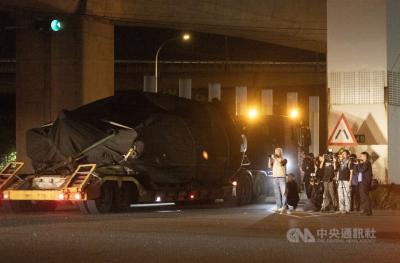
The final batch of 28 M1A2T Abrams tanks purchased from the US arrived at Taipei Port last night and were transported to the Armor Training Command in Hsinchu County’s Hukou Township (湖口), completing the military’s multi-year procurement of 108 of the tanks. Starting at 12:10am today, reporters observed more than a dozen civilian flatbed trailers departing from Taipei Port, each carrying an M1A2T tank covered with black waterproof tarps. Escorted by military vehicles, the convoy traveled via the West Coast Expressway to the Armor Training Command, with police implementing traffic control. The army operates about 1,000 tanks, including CM-11 Brave Tiger
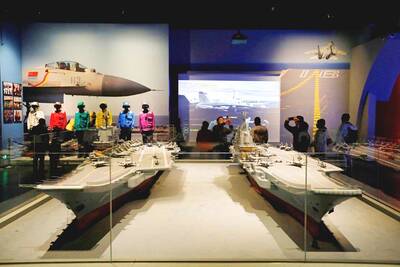
China on Wednesday teased in a video an aircraft carrier that could be its fourth, and the first using nuclear power, while making an allusion to Taiwan and vowing to further build up its islands, as it looks to boost maritime power, secure resources and bolster territorial claims. The video, issued on the eve of the 77th founding anniversary of the Chinese People’s Liberation Army Navy, featured fictional officers with names that are homophones of three commissioned aircraft carriers, the Liaoning (遼寧), Shandong (山東) and Fujian (福建). Titled Into the Deep, it showed a 19-year-old named “Hejian” (何劍) joining the group, sparking
Taiwan Semiconductor Manufacturing Co (TSMC, 台積電), the world’s largest contract chipmaker, said it expects its 2-nanometer (2nm) chip capacity to grow at a compound annual rate of 70 percent from this year to 2028. The projection comes as five fabs begin volume production of 2-nanometer chips this year — two in Hsinchu and three in Kaohsiung — TSMC senior vice president and deputy cochief operating officer Cliff Hou (侯永清) said at the company’s annual technology symposium in Silicon Valley, California, last week. Output in the first year of 2-nanometer production, which began in the fourth quarter of last year, is expected to


 RSS
RSS