

Chinese Nationalist Party (KMT) and Democratic Progressive Party (DPP) officials yesterday made last-ditch efforts to solicit support for their candidates in the lead-up to today’s legislative by-elections.
Three by-elections will be held in Taoyuan, Taichung and Taitung. Winning any of the three by-elections will be a breakthrough for the DPP, which hopes to grab more seats in the KMT-dominated Legislative Yuan.
The by-elections in Taoyuan and Taichung counties are being held following the invalidation of the election of the KMT’s Liao Cheng-ching (廖正井) and Chiang Lien-fu (江連福) after they were convicted of vote-buying. The Taitung by-election is being held to fill the seat left vacant by former KMT Legislator Justin Huang (黃健庭), who resigned in October to run in last month’s Taitung County commissioner election, which he won.
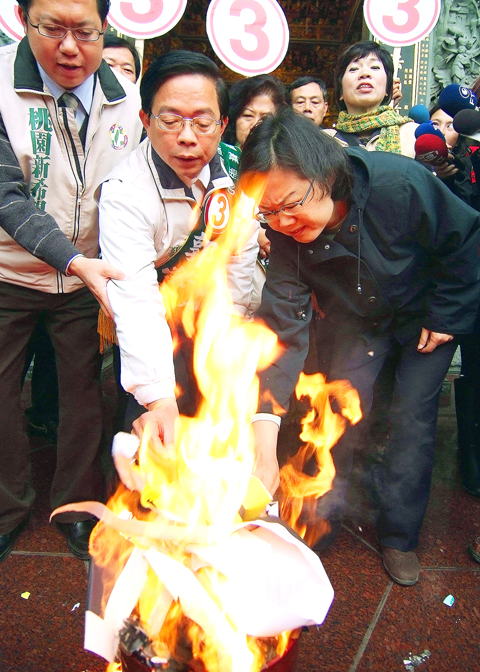
PHOTO: CNA
President Ma Ying-jeou (馬英九) yesterday traveled to Taoyuan, Taichung and Taitung counties to campaign for KMT candidates in his capacity as KMT chairman.
Ma did not attend any by-election-related campaigning events before yesterday.
He brushed off allegations about his reluctance to campaign for former Taitung County commissioner Kuang Li-cheng (鄺麗貞) and walked the streets with her in the morning.
“My schedule has been really tight. I hope I can visit all three counties and campaign for party candidates in one day and dispel all the rumors,” Ma said yesterday in Taitung.
Kuang, who sparked controversy over her frequent foreign trips during typhoon seasons while she was commissioner, had agreed to withdraw from last month’s Taitung County commissioner election race.
She yesterday thanked Ma for his support and expressed confidence she would win today’s by-election.
Ma also campaigned for legislative candidates Yu Wen-chin (余文欽) of Taichung and Chen Li-ling (陳麗玲) of Taoyuan.
The DPP yesterday also pulled out all last-minute stops on election eve to ensure victory in today’s by-elections.
The DPP’s main strategy is to stress that the three seats up for grabs today were all made available after the former KMT winners were convicted of vote-buying.
Braving the cold, DPP Chairperson Tsai Ing-wen (蔡英文) zigzagged across Taoyuan, Taichung and Taitung counties in the last week to support party candidates.
Tsai appeared at a rally for Taichung County nominee Chien Chao-tung (簡肇棟) yesterday before heading north to Taoyuan where an ensemble of DPP heavyweights such as former vice president Annette Lu (呂秀蓮) and former premiers Su Tseng-chang (蘇貞昌) and Yu Shyi-kun (游錫堃) were to stump for Kuo Jung-tsung (郭榮宗), a former DPP lawmaker.
DPP Secretary-General Su Chia-chuan (蘇嘉全) sat at the helm for the race in Taitung where Lai Kun-cheng (賴坤成) will face Kuan.
The DPP have 27 seats in the legislature. If it can take two additional seats, it will pass the crucial threshold of one-fourth of the 113-seat legislature.
In another development, DPP nominee Hsiao Bi-khim (蕭美琴) yesterday completed her registration to vie for the legislative seat for Hualien County in the legislative by-election scheduled to take place on Feb. 27. Also, KMT Secretary-General King Pu-tsung (金溥聰) yesterday announced the nomination of former KMT legislator Apollo Chen (陳學聖) as the party’s candidate to grab another legislative seat in Taoyuan County.
The KMT also completed the nomination process of party candidates in the Feb. 27 by-election in Hualien, Hsinchu, Taoyuan and Chiayi counties.
Cheng Yung-tang (鄭永堂), brother of former Hsinchu County Commissioner Cheng Yung-chin (鄭永金), will run in the legislative by-election in Hsinchu. Lin De-ruei (林德瑞), a professor at National Chungcheng University, will represent the party in Chiayi County, while Wang Ting-sheng (王廷升), a professor at National Tunghua University, will run in Hualien.
ADDITIONAL REPORTING BY CNA
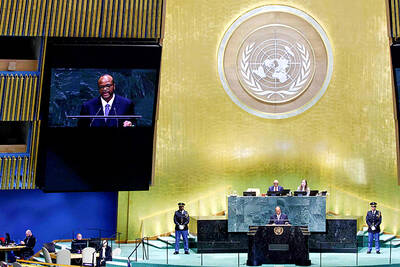
UNITY: Lai thanked the nations who spoke up for Taiwan, saying that democracies must stand together to face global authoritarian expansion Taiwan yesterday thanked eight European and Indo-Pacific countries for opposing unilateral changes to the “status quo” in the Taiwan Strait in a joint statement earlier this week, as well as three of Taiwan’s allies for speaking up for the nation’s participation in the UN at the body’s General Assembly in New York. Minister of Foreign Affairs Lin Chia-lung (林佳龍) welcomed the support and expressed his appreciation for the countries’ stance, the Ministry of Foreign Affairs said in a statement. Foreign ministers and senior representatives of Australia, France, Germany, Japan, New Zealand, Poland, South Korea and the UK issued a statement on Tuesday
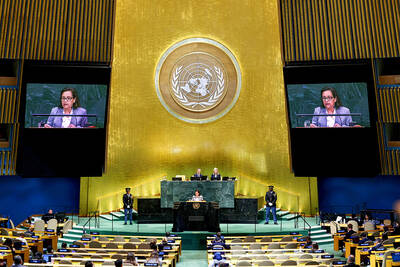
PLEA: How the UN addresses Taiwan’s security issue would be a test of its strength and relevance, Marshall Islands President Hilda Heine told the UN General Assembly Only Taiwan’s elected government can represent the people of Taiwan, Marshall Islands President Hilda Heine said on Friday at the UN General Assembly, calling for the nation’s inclusion in the UN. Taiwan and its 23 million people are a reality, and only its democratically elected government can represent it, Heine said when addressing the 81st session of the UN General Assembly General Debate. Appropriate ways must be found for Taiwan’s substantive participation in UN meetings if the UN is to be truly inclusive and effective in years to come, she said. UN member states would experience pressure to accept a

FACTS DISTORTION: The MAC rejected Xi’s remarks that the US and ‘China’ fought side-by-side during WWII, saying the ROC was Washington’s true ally during the war Taiwan yesterday denounced Chinese President Xi Jinping’s (習近平) comments to US President Donald Trump on the nation’s future, after Xi appeared to push Trump for a subtle change in stance that could erode US support for Taiwan. Xi told Trump in Washington on Thursday that he hoped the US would adhere to the “correct position” of opposing Taiwanese independence, according to a Chinese readout of the talks. That would be a tougher version of Washington’s long-standing formulation that it does not “support” independence. There was no immediate White House readout of the exchange. Xi’s remarks represent “the consistent Chinese approach of distorting facts
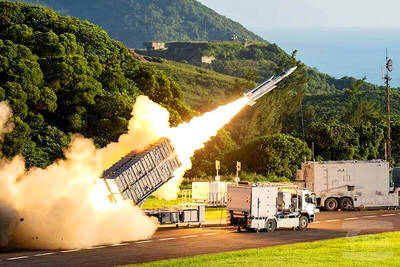
RESILIENCE: Keeping the defense industry’s assembly lines open would prove essential should the nation be involved in a prolonged conflict, a source said The Ministry of National Defense has prepared a NT$22 billion (US$692.3 million) program to acquire about 200 improved Hsiung Feng anti-ship missiles from next year to 2035, a source said. Commenting on condition of anonymity, a high-ranking defense official said the ministry’s plan for enhanced-capability Hsiung Feng II and Hsiung Feng III missiles would be funded as part of the regular defense budget. The 200 missiles would be added on top of the 1,400 missiles being funded via the Sea-Air Combat Power Improvement Plan, they said. The program is not about padding missile numbers, but expanding the capability to defeat


 RSS
RSS