


An outbreak of bitter recrimination has erupted among politicians and delegates following the Copenhagen accord for tackling climate change.
The deal finally hammered out early on Saturday had been expected to commit countries to deep cuts in carbon emissions. In the end, it fell short. Instead a draft agreement put forward by China — and backed by Brazil, India and African nations — commits the world to the broad ambition of preventing global temperatures from rising above 2ºC. Last night some delegates openly attacked China.
Asked who was to blame for blocking the introduction of controlled emissions, the director-general of the Swedish environment protection agency, Lars-Erik Liljelund, replied: “China. China doesn’t like numbers.”
The accord was formally recognized after a dramatic all-night plenary session, during which the Danish chairman was forced to step aside, a Venezuelan delegate cut her hand and the UK’s climate and energy secretary, Ed Miliband, salvaged the deal just as it appeared on the verge of being rejected.
The tumultuous events concluded a fortnight of fraught and sometimes machiavellian negotiations that saw a resurgent China link forces with India, Brazil and African nations to thwart efforts by rich nations to steamroller through a treaty suiting their interests.
Although hailed by US President Barack Obama, the deal has been condemned by activists and NGOS, while European Commission President Jose Manuel Barroso said he was disappointed after EU attempts to introduce long-term targets for reducing global emissions by 50 percent by 2050 were blocked.
“This accord is not legally binding, it’s a political statement. Without legally binding commitments, there is no way to be sure it will be attainable,” said Nnimmo Bassey, chair of Friends of the Earth International. “This is a disaster for the poor nations — the urgency of climate change was not really considered.”
Last night Miliband was being credited with helping rescue the summit from disaster. He had been preparing to go to bed at 4am, after the main accord had been agreed, only to be called by officials and warned that several countries were threatening to veto its signature. Miliband returned to the conference center in time to hear Sudanese delegate Lumumba Di-Aping comparing the proposed agreement to the Holocaust. He said the deal “asked Africa to sign a suicide pact, an incineration pact, in order to maintain the economic dominance of a few countries.”
A furious Miliband intervened. He dismissed Di-Aping’s claims as disgusting.
This was “a moment of profound crisis,” he told delegates. The proposed deal was by no means perfect and would have many problems, he admitted.
“But it is a document that in substantive ways will make the lives of people around this planet better because it puts into effect fast-start finance of US$30 billion, it puts into effect a plan for US$100 billion of long-term public and private finance,” he said.
The deal was then agreed by delegates.
However, the Tory shadow energy and climate change secretary, Greg Clark, described the deal last night as a disappointment.
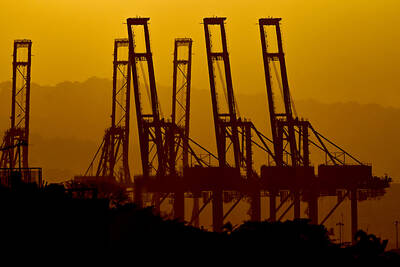
A subsidiary of a Hong Kong-based company that has lost control of two critical ports on the Panama Canal said it is seeking US$2 billion of compensation in damages from Panama over its “illegal” takeover of the ports. Panama Ports Co, a unit of Hong Kong’s CK Hutchison Holdings (長江和記實業), on Friday said in a statement that it is demanding the sum under international arbitration proceedings that it had already started. The Panamanian government last week seized control of the Balboa and Cristobal ports on each end of the Panama Canal, after the country’s Supreme Court declared earlier that a concession allowing
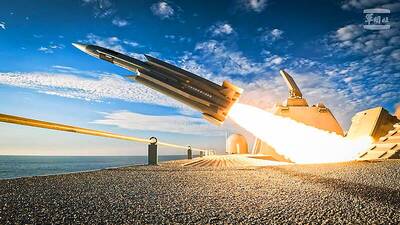
DETERRENCE: With 1,000 indigenous Hsiung Feng II and III missiles and 400 Harpoon missiles, the nation would boast the highest anti-ship missile density in the world With Taiwan wrapping up mass production of Hsiung Feng II and III missiles by December and an influx of Harpoon missiles from the US, Taiwan would have the highest density of anti-ship missiles in the world, a source said yesterday. Taiwan is to wrap up mass production of the indigenous anti-ship missiles by the end of year, as the Chungshan Institute of Science and Technology has been meeting production targets ahead of schedule, a defense official with knowledge of the matter said. Combined with the 400 Harpoon anti-ship missiles Taiwan expects to receive from the US by 2028, the nation would have

POSSIBILITIES EMERGE: With Taiwan’s victory and Japan’s narrow win over Australia, Taiwan now have a chance to advance if South Korea also beat the Aussies Taiwan has high hopes that the national baseball team would advance to the World Baseball Classic (WBC) quarter-finals after clinching a crucial 5-4 victory over South Korea in a nail-biting extra-inning game at the Tokyo Dome yesterday. Boosted by three home runs — two solo shots by Yu Chang (張育成) and Cheng Tsung-che (鄭宗哲) and a two-run homer by Stuart Fairchild — the triumph gave Taiwan a much-needed second victory in the five-team Pool C, where only the top two finishers would advance to the knockout stage in Miami, Florida. Entering extra innings with the game tied at four apiece, Taiwan scored
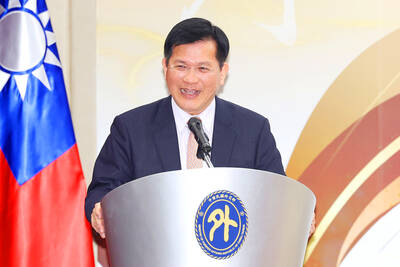
MISSION OF PEACE: The foreign minister urged Beijing to respect Taiwan’s existence as an independent nation, and work together to ensure peace and stability in the region Minister of Foreign Affairs Lin Chia-lung (林佳龍) yesterday rejected Chinese Minister of Foreign Affairs Wang Yi’s (王毅) comments about Taiwan, criticizing China as a “troublemaker” in the international community and a disruptor of cross-strait peace. Speaking at a news conference on the sidelines of the Chinese National People’s Congress, Wang said that Taiwan has always been a territory of China and that it would be impossible for it to become its own country. The “return” of Taiwan to China was the natural outcome of the Chinese people’s resistance against Japan in World War II, and that any pursuit of independence was “doomed


 RSS
RSS