


Premier Wu Den-yih (吳敦義) yesterday called for “mutual respect” between Taiwan and the US, as Taipei moved to adopt measures to block imports of US ground beef and bovine offal.
Wu dismissed remarks made by American Institute in Taiwan (AIT) Chairman Raymond Burghardt when he met with Legislative Speaker Wang Jyn-ping (王金平) on Monday that the controversy surrounding Taiwan’s relaxation of US beef imports was a “phony issue,” saying it was a “real issue of concern to the public.”
“We respect what [Burghardt] said, but we think and feel differently about this issue as he is an American and from a beef-exporting country,” Wu told reporters at the Executive Yuan.
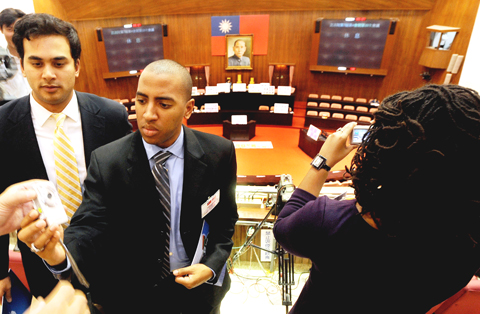
PHOTO: LIN CHENG-KUNG, TAIPEI TIMES
“When people still have doubts over the safety of US ground beef and bovine offal, of course the government has to prohibit imports of such products,” Wu said. “We respect [Burghardt’s] views, and we hope he can understand the public sentiment.”
Taiwan recently signed a protocol with the US to expand market access for US beef to include bone-in beef and other beef products that have not been contaminated with “specific risk materials.”
OUTCRY
In response to a public outcry, the government promised to adopt administrative means to block ground beef and bovine offal, a move supported by the Chinese Nationalist Party (KMT) lawmakers, but a stance that has put them at odds with their Democratic Progressive Party (DPP) counterparts, who have proposed amending the Act Governing Food Sanitation (食品衛生管理法) to statutorily ban the imports.
Wu said the KMT’s version of the amendments — requiring all imports of ground beef and intestines be thawed for examination in a way that will effectively destroy the products — could create a win-win-win situation to safeguard public health, conform to the spirit of the WTO and respect the Taiwan-US protocol.
“I think there would be no reason for the US to oppose [administrative measures] targeting ground beef and bovine offal, which account for between 1 and 3 percent of its exports, nor would it let [the controversy] pose a negative influence on imports of its bone-in beef into Taiwan,” the premier said.
‘RISKY’ PRODUCTS
Meanwhile, Legislative Speaker Wang Jin-pyng (王金平) said yesterday it was unlikely the legislature would deal with a number of proposed amendments to the Act Governing Food Sanitation seeking to ban “risky” beef products from the US before the local elections next Saturday.
“We can sit down and discuss the proposals after the elections or the legislature will be paralyzed as a result,” Wang told reporters.
Wang made the remarks after the DPP once again occupied the speaker’s podium and threatened to boycott plenary sessions through next Saturday.
PARALYZED
The DPP has paralyzed the plenary session since Nov. 3, making it impossible for any bills to clear the legislative floor over the past three weeks.
By law, the legislature should review and pass the central government’s fiscal budget request by the end of next month.
The deadlock continued because the DPP and the KMT still could not agree on the wording of the proposals.
The DPP would like to enshrine a ban on “risky” US beef products in the law, while the KMT wants to authorize the government to draw up measures to inspect bovine products from places where the risk of mad cow disease has been under control.
The KMT caucus condemned the DPP for paralyzing the plenary session again.
At a press conference, KMT caucus whip Lin Yi-shih (林益世) accused the DPP of refusing to negotiate relevant proposals even if the KMT had proposed a week ago to “ban the import of beef materials or products that are found risky or inedible.”
Showing reporters a number of snapshots of yesterday morning’s plenary session, KMT caucus secretary-general Lu Hsueh-chang (呂學樟) said only three DPP legislators — Chai Trong-rong (蔡同榮), Yeh Yi-jin (葉宜津) and Kuo Wen-cheng (郭玟成) — participated in the boycott, while the remaining 25 DPP lawmakers were absent.
Lu accused the DPP of manipulating the controversy for political gain in the elections.
Meanwhile, KMT Legislator Kung Wen-chi (孔文吉) alleged that the DPP mobilized supporters to paralyze his phone lines in protest against his proposed amendment to the act.
Kung’s proposal sought to “draw up measures to inspect beef products from areas where the risk of mad cow disease has been under control.”
Kung said his cellphone and the phone at his office had been paralyzed by angry callers since an anonymous Netizen posted an article on Coolloud — a Web site for civic groups to publicize press releases and press conference notices — calling on the public to call the 22 KMT legislators endorsing Kung’s proposal.
Meanwhile, Taiwan Solidarity Union (TSU) Chairman Huang Kun-huei (黃昆輝) said yesterday that Burghardt could not be more erroneous on the safety of US beef, demanding the US envoy recant his statement that US beef was safe for human consumption.
“It is possible that because Burghardt does not live on the continental US, he has lost touch with the current situation [of beef safety] and needs to be taught a lesson,” Huang said.
The TSU said the Consumer Union — a US-based consumer protection foundation — is engaged in a dispute with the US Food and Drug Administration (FDA), arguing that the US private meat plants should be allowed to conduct their own tests on cattle for bovine spongiform encephalopathy (BSE).
Huang said that the Consumer Union has long questioned the safety of US beef because of the prevalent practice of using chicken excrement as part of cow feed.
Such a practice has been blamed for being a source of BSE and other neurological diseases found in US cattle, Huang said.
Although the Consumer Union has formally asked the FDA to allow private meat establishments to conduct their own BSE tests, which the TSU said would only cost US$0.10 per test, the US government has flatly refused to do so, he said.
“Burghardt was obviously dead wrong when he said US beef is safe for human consumption and that no one in the US worries about its safety. He must recant his statement because, Mr Burghardt, you are wrong,” Huang said.
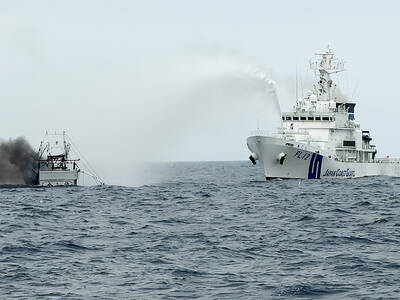
CREDIT-GRABBER: China said its coast guard rescued the crew of a fishing vessel that caught fire, who were actually rescued by a nearby Taiwanese boat and the CGA Maritime search and rescue operations do not have borders, and China should not use a shipwreck to infringe upon Taiwanese sovereignty, the Coast Guard Administration (CGA) said yesterday. The coast guard made the statement in response to the China Coast Guard (CCG) saying it saved a Taiwanese fishing boat. The Chuan Yu No. 6 (全漁6號), a fishing vessel registered in Keelung, on Thursday caught fire and sank in waters northeast of Diaoyutai Islands (釣魚台). The vessel left Keelung’s Badouzih Fishing Harbor (八斗子漁港) at 3:35pm on Sunday last week, with seven people on board — a 62-year-old Taiwanese captain surnamed Chang (張) and six
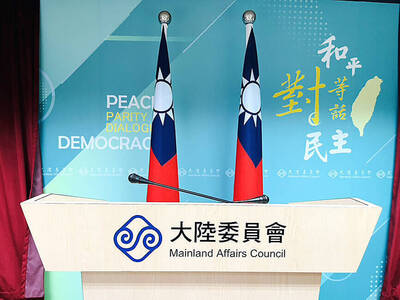
RISKY BUSINESS: The ‘incentives’ include initiatives that get suspended for no reason, creating uncertainty and resulting in considerable losses for Taiwanese, the MAC said China’s “incentives” failed to sway sentiment in Taiwan, as willingness to work in China hit a record low of 1.6 percent, a Ministry of Labor survey showed. The Directorate-General of Budget, Accounting and Statistics (DGBAS) also reported that the number of Taiwanese workers in China has nearly halved from a peak of 430,000 in 2012 to an estimated 231,000 in 2024. That marked a new low in the proportion of Taiwanese going abroad to work. The ministry’s annual survey on “Labor Life and Employment Status” includes questions respondents’ willingness to seek employment overseas. Willingness to work in China has steadily declined from

LEVERAGE: China did not ‘need to fire a shot’ to deny Taiwan airspace over Africa when it owns ‘half the continent’s debt,’ a US official said, calling it economic warfare The EU has raised concerns about overflight rights following the delay of President William Lai’s (賴清德) planned state visit to the Kingdom of Eswatini after three African nations denied overflight clearance for his charter at the last minute. Taiwanese allies Paraguay and Saint Kitts and Nevis, as well as several US lawmakers and the Inter-Parliamentary Alliance on China (IPAC) condemned China for allegedly pressuring the countries. Lai was scheduled to fly directly to Taiwan’s only African ally from yesterday to Sunday to celebrate the 40th anniversary of King Mswati III’s accession and his 58th birthday, but Seychelles, Mauritius and Madagascar suddenly revoked
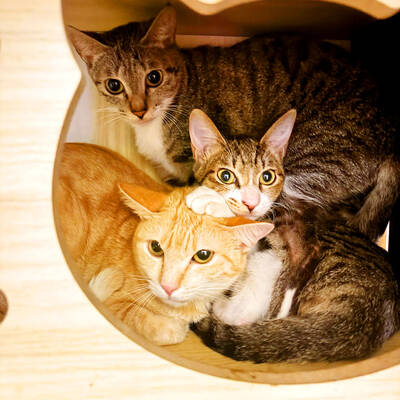
The number of pet cats in Taiwan surpassed that of pet dogs for the first time last year, reaching 1,742,033, a 32.8 percent increase from 2023, the Ministry of Agriculture said yesterday, citing a survey. By contrast, the number of pet dogs declined slightly by 1.2 percent over the same period to 1,462,528, the ministry said. Despite the shift, households with dogs still slightly outnumber those with cats by 1.2 percent. However, while the number of households with multiple dogs has remained relatively stable, households keeping more than two cats have increased, contributing to the overall rise in the feline population. The trend


 RSS
RSS