


Revelations that ducks contaminated with toxic chemical dioxins and a host of other chemicals may have been sold to consumers have sparked a health scare.
Authorities on Wednesday culled about 9,000 ducks that had been raised on land contaminated with steel furnace slag at a farm in Daliao Township (大寮), Kaohsiung County, after they were found to contain up to five times the recommended maximum level of dioxins, the Council of Agriculture said.
“The contaminated ducks have been destroyed,” Lee Chun-chin (李春進), a council official, told reporters.

PHOTO: CNA
The Environmental Protection Administration (EPA) later confirmed that the ducks also contained levels of copper, nickel, chromium, zinc, arsenic and lead that were two to 10 times the safety limit.
The farm, which covers an area of about 1 hectare and is surrounded by a barbed-wire fence, was a former landfill filled with illegally dumped steel mill slag.
The law stipulates that steel furnace slag can be used for landfill or road paving — but not on farmland.
There were fears that some contaminated ducks from the farm had been sold and eaten by consumers.
The farmer told reporters yesterday that he rented the land from a company 10 years ago, but only began raising ducks there after Typhoon Morakot hit the country in early August and that “not a single duck was sold because they were all killed” in the typhoon.
However, Huang Huan-chang (黃煥彰), an environmental activist and organizer of an environmental protection program at Tainan Community University, told reporters that the duck farm had been in operation since 2006 and provided photos as evidence.
He said he believed that dioxin-contaminated ducks had already been sold on the market.
Huang, who tipped off the government about the contaminated duck farm, said yesterday that there were six other contaminated sites in the county.
The findings prompted the EPA to launch an investigation yesterday.
The seven contaminated zones include Hongsiashan (紅蝦山), Dapingding (大坪頂) and Luotuoshan (駱駝山), which were filled with steel slag containing heavy metal compounds two times above safety limits, Huang said.
Some of the sites are still being used to grow pineapples and other crops, Huang said.
At the center of the contaminated areas is Fongshan Reservoir, which holds up to 8.7 million tonnes of water for industrial and household use in the greater Kaohsiung area. A thorough inspection will be needed to determine whether the reservoir is polluted, Huang said.
Yesterday, the EPA took pond-raised tilapia from the duck farm to determine the source of the dioxins in the area. The results will be available in a week.
Initial tests revealed that the amount of dioxins in the soil under the pond was 23.2 pico-grams per gram of fat — 11 times in excess of the EPA standard.
As the duck farm operator had not registered for a license to run the farm as stipulated in the Animal Industry Act, he could face a fine ranging from NT$30,000 to NT$150,000, the county government said.
Exposure to dioxins can affect liver function, the WHO has stated.
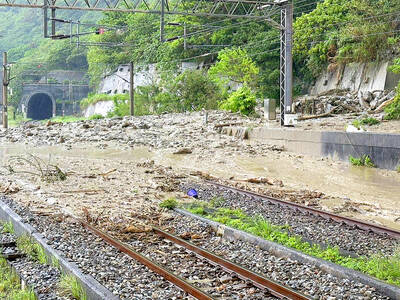
ROLLER-COASTER RIDE: More than five earthquakes ranging from magnitude 4.4 to 5.5 on the Richter scale shook eastern Taiwan in rapid succession yesterday afternoon Back-to-back weather fronts are forecast to hit Taiwan this week, resulting in rain across the nation in the coming days, the Central Weather Administration said yesterday, as it also warned residents in mountainous regions to be wary of landslides and rockfalls. As the first front approached, sporadic rainfall began in central and northern parts of Taiwan yesterday, the agency said, adding that rain is forecast to intensify in those regions today, while brief showers would also affect other parts of the nation. A second weather system is forecast to arrive on Thursday, bringing additional rain to the whole nation until Sunday, it
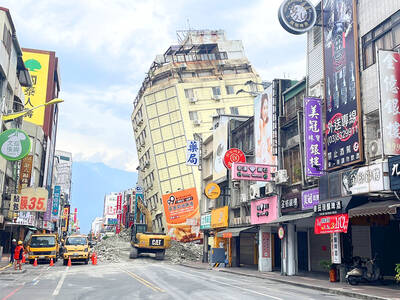
LANDSLIDES POSSIBLE: The agency advised the public to avoid visiting mountainous regions due to more expected aftershocks and rainfall from a series of weather fronts A series of earthquakes over the past few days were likely aftershocks of the April 3 earthquake in Hualien County, with further aftershocks to be expected for up to a year, the Central Weather Administration (CWA) said yesterday. Based on the nation’s experience after the quake on Sept. 21, 1999, more aftershocks are possible over the next six months to a year, the agency said. A total of 103 earthquakes of magnitude 4 on the local magnitude scale or higher hit Hualien County from 5:08pm on Monday to 10:27am yesterday, with 27 of them exceeding magnitude 5. They included two, of magnitude

CONDITIONAL: The PRC imposes secret requirements that the funding it provides cannot be spent in states with diplomatic relations with Taiwan, Emma Reilly said China has been bribing UN officials to obtain “special benefits” and to block funding from countries that have diplomatic ties with Taiwan, a former UN employee told the British House of Commons on Tuesday. At a House of Commons Foreign Affairs Committee hearing into “international relations within the multilateral system,” former Office of the UN High Commissioner for Human Rights (OHCHR) employee Emma Reilly said in a written statement that “Beijing paid bribes to the two successive Presidents of the [UN] General Assembly” during the two-year negotiation of the Sustainable Development Goals. Another way China exercises influence within the UN Secretariat is

Taiwan’s first drag queen to compete on the internationally acclaimed RuPaul’s Drag Race, Nymphia Wind (妮妃雅), was on Friday crowned the “Next Drag Superstar.” Dressed in a sparkling banana dress, Nymphia Wind swept onto the stage for the final, and stole the show. “Taiwan this is for you,” she said right after show host RuPaul announced her as the winner. “To those who feel like they don’t belong, just remember to live fearlessly and to live their truth,” she said on stage. One of the frontrunners for the past 15 episodes, the 28-year-old breezed through to the final after weeks of showcasing her unique


 RSS
RSS