


President Ma Ying-jeou (馬英九) yesterday urged the legislature to be cautious in blocking imports of US beef, saying any legal revisions should not violate the protocol that Taiwan has signed with the US.
“Unless we have a very convincing reason, it is very hard to turn down [the US’] request for ‘free trade’ because we are both WTO members,” Ma said. “The most important thing is to always put public health and safety first during negotiations.”
Ma made the remarks in a meeting with Cabinet officials and the Chinese Nationalist Party (KMT) legislative caucus at the Presidential Office.
Under the terms of the protocol signed by the US and Taiwan, US bone-in beef, ground beef, bovine intestines, brains, spinal cords and processed beef from cattle younger than 30 months that have not been contaminated with “specific risk materials” will be allowed into Taiwan starting on Tuesday.
In response to criticism that the market opening could endanger public health, the government said last week it would use administrative means to block the import of ground beef and bovine intestines.
As the legislature is planning to complete the amendments to the Act Governing Food Sanitation (食品衛生管理法) around Tuesday, Ma yesterday said the government could adopt administrative measures and strengthen inspections to block the import of controversial US beef products, but the legislation could not stipulate a ban because it would violate the protocol.
“But if consumers don’t eat or buy and importers don’t bring in the products, we will not be violating the protocol,” he said. “When they see there is no profit in selling the products, there won’t be any in the market.”
“Besides, there are many limitations and inspection procedures that the products have to go through before they come in. They may well quit after learning of the difficulties,” he said.
This way, Ma said, when his administration talks to the US, it could say the government has relaxed the restrictions but it is not responsible for promoting the products and that the public is free to choose what it wants to eat.
Ma said this would ensure public safety, secure relations with the US and protect the nation’s credibility.
The president dismissed speculation that there was any trade-off in the government’s decision to relax restrictions on US beef, adding that the negotiations were made to improve overall ties with the US.
While the Democratic Progressive Party (DPP) has asked the government to clearly state it would “ban” US beef and launch new negotiations with Washington, Ma said to do so would violate not only the protocol but also the regulations of the WTO and the World Organization for Animal Health.
He asked the DPP and the public to think twice whether the country was willing to pay the price for reneging on the deal, adding that he was not sure Taipei would get a better deal if new negotiations were held.
“We are not afraid of the Americans,” he said. “But as a member of the international community, we must play by the rules if we want to participate in international activities and that is an important global perspective.”
On other issues, Ma yesterday backed Premier Wu Den-yih’s (吳敦義) call on Tuesday for the executive branch to brief the legislature about signing cross-strait memorandum of understandings (MOU) on financial supervision over the banking, insurance and securities industries.
Ma said Legislative Speaker Wang Jin-pyng (王金平) would call a meeting tomorrow and invite caucus heads to hear reports from the Financial Supervisory Commission (FSC), the Mainland Affairs Council and the Ministry of Economic Affairs on the proposed MOU to help lawmakers better understand the content and impact of the agreement.
“Some of the impacts are positive and some are not so positive, but the legislature must know them all,” Ma said. “The FSC must also further communicate with industries ... We must be ready before we sign them.”
In China, Yang Yi (楊毅), spokesman for China’s Taiwan Affairs Office, told a press conference that Beijing was ready to sign the agreement on financial cooperation.
Yang said the two sides had agreed on the details of the MOU on financial supervision. He did not specify when, where or how the signing would take place, but said China “would have no problem” with those details. ADDITIONAL REPORTING BY AFP
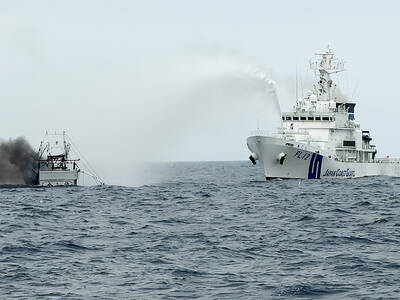
CREDIT-GRABBER: China said its coast guard rescued the crew of a fishing vessel that caught fire, who were actually rescued by a nearby Taiwanese boat and the CGA Maritime search and rescue operations do not have borders, and China should not use a shipwreck to infringe upon Taiwanese sovereignty, the Coast Guard Administration (CGA) said yesterday. The coast guard made the statement in response to the China Coast Guard (CCG) saying it saved a Taiwanese fishing boat. The Chuan Yu No. 6 (全漁6號), a fishing vessel registered in Keelung, on Thursday caught fire and sank in waters northeast of Diaoyutai Islands (釣魚台). The vessel left Keelung’s Badouzih Fishing Harbor (八斗子漁港) at 3:35pm on Sunday last week, with seven people on board — a 62-year-old Taiwanese captain surnamed Chang (張) and six
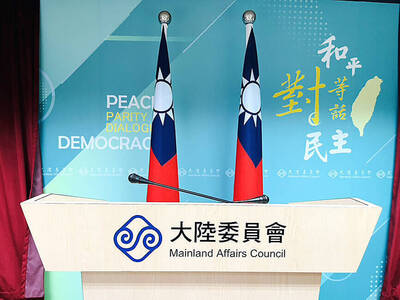
RISKY BUSINESS: The ‘incentives’ include initiatives that get suspended for no reason, creating uncertainty and resulting in considerable losses for Taiwanese, the MAC said China’s “incentives” failed to sway sentiment in Taiwan, as willingness to work in China hit a record low of 1.6 percent, a Ministry of Labor survey showed. The Directorate-General of Budget, Accounting and Statistics (DGBAS) also reported that the number of Taiwanese workers in China has nearly halved from a peak of 430,000 in 2012 to an estimated 231,000 in 2024. That marked a new low in the proportion of Taiwanese going abroad to work. The ministry’s annual survey on “Labor Life and Employment Status” includes questions respondents’ willingness to seek employment overseas. Willingness to work in China has steadily declined from

LEVERAGE: China did not ‘need to fire a shot’ to deny Taiwan airspace over Africa when it owns ‘half the continent’s debt,’ a US official said, calling it economic warfare The EU has raised concerns about overflight rights following the delay of President William Lai’s (賴清德) planned state visit to the Kingdom of Eswatini after three African nations denied overflight clearance for his charter at the last minute. Taiwanese allies Paraguay and Saint Kitts and Nevis, as well as several US lawmakers and the Inter-Parliamentary Alliance on China (IPAC) condemned China for allegedly pressuring the countries. Lai was scheduled to fly directly to Taiwan’s only African ally from yesterday to Sunday to celebrate the 40th anniversary of King Mswati III’s accession and his 58th birthday, but Seychelles, Mauritius and Madagascar suddenly revoked
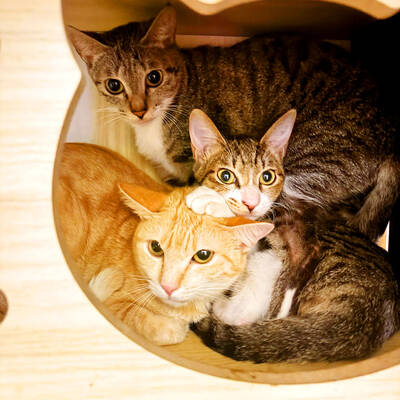
The number of pet cats in Taiwan surpassed that of pet dogs for the first time last year, reaching 1,742,033, a 32.8 percent increase from 2023, the Ministry of Agriculture said yesterday, citing a survey. By contrast, the number of pet dogs declined slightly by 1.2 percent over the same period to 1,462,528, the ministry said. Despite the shift, households with dogs still slightly outnumber those with cats by 1.2 percent. However, while the number of households with multiple dogs has remained relatively stable, households keeping more than two cats have increased, contributing to the overall rise in the feline population. The trend


 RSS
RSS