


Floods and landslides left at least 124 people dead in El Salvador yesterday after a late-season hurricane ravaged parts of Central America and took aim for the US.
Landslides and overflowing rivers carried away houses, while a raging torrent ripped through an entire section of one town. Some of the bodies were taken to a chapel and covered in mud-caked sheets.
“All we heard in the morning was loud noise,” said Arnoldo Paz, a resident of Verapaz in the central region of the country. “It was a torrent of water and mud that swept away everything in its path. All I could do was tell my wife to grab the kids and flee.”
He said his house had been swept away by the current.
Although Hurricane Ida did not hit El Salvador directly, it brought heavy rain that affected the entire region. The storm was crossing the Gulf of Mexico yesterday, heading toward the US.
Late on Sunday, Salvadorean President Mauricio Funes declared a state of emergency, saying the rains and subsequent flooding had claimed at least 124 lives.
“Today is a very sad day for the country and its government, in fact it is one of the most tragic days in memory,” Funes said in a televised address to the nation. “I want to express my condolences to the families of the 124 victims that have been identified thus far.”
Heavy downpours have lashed the country since Thursday, causing mudslides and flooding in various areas. Most of the deaths have occurred in the areas of San Salvador, La Libertad, Cuscatlan, La Paz and San Vicente.
Funes said the state of emergency would allow his government access to special funds necessary to provide assistance to disaster areas, but he stopped short of saying how much money would be spent to help victims and repair the damage. The emergency declaration also signals the country’s readiness to receive international aid.
Jorge Melendez, director of the Civil Protection Service, said the rains were also caused by a pocket of low atmospheric pressure that had formed over the region as the hurricane, now a Category 1 storm, approached from the Caribbean. There could be more fatalities in the eastern regions of Verapaz and Tepetitan, he said.
In Tepetitan, landslides and overflowing rivers carried away some 30 houses, authorities said.
Some residents had agreed to evacuate the area, but a number “refused to leave their homes,” Tepetitan Mayor Ana Jovel said.
In Verapaz, 114km southeast of the capital San Salvador, officials reported a raging torrent of mud, rocks and tree trunks ripping through a whole section of the town, burying houses and cars.
Dozens of bodies were taken from the devastation to a local chapel and covered with white sheets, caked with mud, as they awaited identification by relatives.
El Salvador has been on a state of alert since heavy rains associated with Ida began to affect the region, destroying an estimated 930 homes and leaving some 13,000 people homeless in Nicaragua.
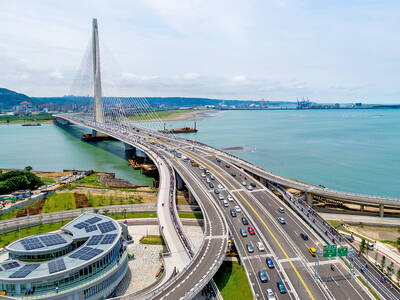
The Ministry of Transportation and Communications yesterday inaugurated the Danjiang Bridge across the Tamsui River in New Taipei City, saying that the structure would be an architectural icon and traffic artery for Taiwan. Feted as a major engineering achievement, the Danjiang Bridge is 920m long, 211m tall at the top of its pylon, and is the longest single-pylon asymmetric cable-stayed bridge in the world, the government’s Web site for the structure said. It was designed by late Iraqi-British architect Zaha Hadid. The structure, with a maximum deck of 70m, accommodates road and light rail traffic, and affords a 200m navigation channel for boats,

Taiwan Semiconductor Manufacturing Co (TSMC, 台積電), the world’s largest foundry service provider, yesterday said that global semiconductor revenue is projected to hit US$1.5 trillion in 2030, after the figure exceeds US$1 trillion this year, as artificial intelligence (AI) demand boosts consumption of token and compute power. “We are still at the beginning of the AI revolution, but we already see a significant impact across the whole semiconductor ecosystem,” TSMC deputy cochief operating officer Kevin Zhang (張曉強) said at the company’s annual technology symposium in Hsinchu City. “It is fair to say that in the past decade, smartphones and other mobile devices were
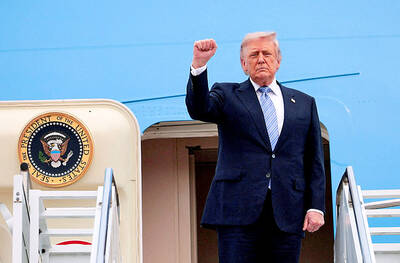
US-CHINA SUMMIT: MOFA welcomed US reassurance of no change in its Taiwan policy; Trump said he did not comment when Xi talked of opposing independence US President Donald Trump yesterday said he has not made a decision on whether to move forward with a major arms package for Taiwan after hearing concerns about it from Chinese President Xi Jinping (習近平). Trump’s comments on Taiwan came as he flew back to Washington after wrapping up critical talks in which both leaders said important progress was made in stabilizing US-China relations even as deep differences persist between the world’s two biggest powers on Iran and Taiwan. “I will make a determination,” Trump said, adding: “I’ll be making decisions. But, you know, I think the last thing we need right

TAIWAN ISSUE: US treasury secretary Scott Bessent said on the first day of meetings that ‘it wouldn’t be a US-China summit without the Taiwan issue coming up’ There were no surprises on the first day of the summit between US President Donald Trump and Chinese President Xi Jinping (習近平), the Mainland Affairs Council (MAC) said yesterday, as the government reiterated that cross-strait stability is crucial to the Asia-Pacific region, as well as the world. As the two presidents met for a highly anticipated summit yesterday, Chinese state media reported that Xi warned Trump that missteps regarding Taiwan could push their two countries into “conflict.” Trump arrived in China with accolades for his host, calling Xi a “great leader” and “friend,” and extending an invitation to visit the White House


 RSS
RSS