


President Ma Ying-jeou (馬英九) yesterday promised to improve the scandal-plagued professional baseball environment and help develop the national sport.
Ma said the government would work toward saving professional baseball by making it free of gambling fraud.
“Professional baseball is not at fault,” he said. “It is those who abuse the sport that are wrong.”
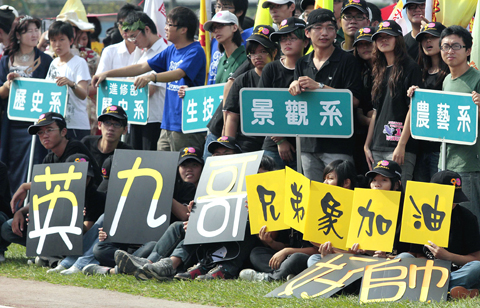
PHOTO: CHAN CHAO-YANG, TAIPEI TIMES
Ma made the remarks in Taichung while attending a sports event held by National Chung Hsing University to mark the 90th anniversary of its founding yesterday.
Ma said because baseball was the national sport, his government would do whatever it could to support the development of professional baseball and protect it from being corrupted by “external forces.”
Ma also urged athletes to be honest, saying that it was a pity if professional baseball players were involved in betting scandals because if they are found guilty, they would likely never play again.
The nation’s first professional league was inaugurated in 1989. The joy was short-lived, however, after a major betting scandal and the creation of another league resulted in fewer fans.
In April this year, the Executive Yuan approved a four-year, NT$1.26 billion (US$38.6 million) proposal to boost the sport. Under the proposal, each of the four teams in the Chinese Professional Baseball League (CPBL) will be subsidized NT$10 million a year to set up lower league teams that play at least 60 games in a regular season.
The government will gradually establish an amateur baseball league, lifting the number of amateur teams from two to 12, the proposal said. Nine more amateur teams would be formed by local governments and state-owned businesses. The government will also offer colleges and high schools NT$10 million each to hold competitions every year to cultivate athletic skills, the proposal said.
The government plan at the time was made under public pressure following the lackluster performance of Taiwan’s baseball team at the World Baseball Classic.
Taiwan’s baseball team returned home after they were eliminated from the competition following losses to South Korea and China. The team’s loss to China marked the second defeat to the country in a year.
At a separate setting yesterday, Premier Wu Den-yih (吳敦義) said the government would not sit by and watch baseball weaken or disappear because it is the national sport.
Promising to hold those who fix games legally responsible, Wu said the government would work to create a clean environment for baseball development.
“Cronies will not be eliminated without their masterminds being hunted down,” Wu said when approached by reporters for comment.
Wu did not propose any concrete measures yesterday, except saying that granting tax breaks to companies to encourage their sponsorship of baseball teams could be one measure.
On Tuesday, the Sports Affairs Council will meet with the Ministry of Justice, the Ministry of the Interior, the National Police Agency and the Ministry of Education and the four baseball teams to map out a recovery plan.
ADDITIONAL REPORTING BY SHIH HSIU-CHUAN
Also See: CPBL president slams prosecutors

‘NO SECURITY RISK’: The Railway Bureau reassured the public that the technicians’ activities were limited to technical guidance and did not involve sensitive systems The Railway Bureau yesterday said it had invited eight Chinese technicians to assist with an airport MRT construction project. The bureau issued the confirmation after an Internet user said Chinese nationals had entered the construction zone of Taiwan Taoyuan International Airport’s Terminal 3 project. They asked why “individuals from an enemy state” were allowed access to such a major national infrastructure project, which raised serious concerns over Taiwan’s industrial safety, sensitive systems and information security. The bureau’s Northern Region Engineering Branch Office said subcontractor Taiwan Handle Industrial Co (台灣手把工業) of the Taoyuan airport MRT’s “Contract No. CU05 Project A14 Station Civil, MEP &

The National Chungshan Institute of Science and Technology yesterday showcased its locally developed variants of the Vision 60 robotic patrol dog, which it plans to deploy on the nation’s outlying territories in the South China Sea. The variants were produced under the Joint Lab project — created by the institute and domestic companies — and assembled with domestically produced motors, lenses and artificial intelligence (AI) systems alongside licensed tech from the US, Missile and Rocket Systems Research Division deputy director Jen Kuo-kang (任國光) told the media event at a military base in Taipei’s Dazhi (大直) area. Taiwan has built up its strengths

NOT IMMEDIATE: Taiwan has a chance to appeal the proposed 10 percent tariff before it starts, while other countries face a 12.5 percent tariff from the trade office Taiwan is among 60 economies determined by the US to have failed to impose or enforce a ban on the importation of goods produced with forced labor, according to a notice released on Tuesday by the Office of the US Trade Representative (USTR), which proposed imposing an additional 10 percent or more tariff on them. The USTR in a statement said that following an investigation, it had determined under Section 301 of the Trade Act of 1974 that the failure of the 60 economies to impose and effectively enforce a prohibition on the importation of goods produced with forced labor is

TIT-FOR-TAT: The US allegedly revoked the visa of a Chinese national working at Xinhua News Agency in the US in response to Beijing’s expulsion of Vivian Wang The Presidential Office yesterday condemned China for expelling a New York Times correspondent from Beijing following the newspaper’s interview with President William Lai (賴清德), saying the move highlighted Beijing’s suppression of press freedom and its threat to international news media. Taiwan has noted a series of recent incidents in which Beijing used similar tactics to “threaten and pressure international media outlets and journalists,” Presidential Office spokeswoman Karen Kuo (郭雅慧) said in a statement. “This concerns not only press freedom and freedom of expression, but also the safety of journalists, and Taiwan and relevant partners are paying close attention to the situation,” she


 RSS
RSS