

A political ploy to help Taiwan buy advanced F-16C/D fighter aircraft is still on track despite moves by China to derail it.
The US Department of Defense is being ordered to make a study of Taiwan’s air force — a study that is expected to conclude that the new planes are needed.
It is part of a complex plan by friends of Taiwan on Capitol Hill to make sure the Taiwanese military can continue to defend Taiwan against China’s ever expanding forces.
When the US National Defense Authorization Bill for the next fiscal year was first being separately debated by the House and Senate in July, Republican Senator John Cornyn introduced an amendment requiring the Pentagon to make a full report on the Taiwanese air force.
Military analysts have told the Taipei Times that Cornyn and others feared that US President Barack Obama would bow to pressure during his visit to China next month and decide that Taiwan did not need the 66 F-16C/Ds that have been requested.
These analysts, however, say the pro-Taiwan faction reasoned that an unbiased report from the Pentagon on Taiwan’s air force would make it abundantly clear that new state-of-the-art fighters were in fact badly needed. Such a report could make it more politically difficult for Obama to refuse the sale.
An amendment demanding the report was included in the Senate version of the bill that passed with unanimous support. No such amendment, however, was included in the House version of the bill.
When a conference committee from both the House and Senate considered the bill last week, they decided not to include the amendment in the final bill. That decision followed heavy lobbying by Beijing that the sale of the F-16C/Ds would harm US-China relations.
However, a member of Cornyn’s staff told the Taipei Times on Thursday: “The actual bill language was not included in the conference report, but they included language in the Joint Explanatory Statement that will have the desired effect [of forcing the Obama administration to report to Congress on this issue].”
Under the heading “Report on Taiwan’s Air Defense Force” the Joint Explanatory Statement says: “The Senate amendment contained a provision that would have required a report on Taiwan’s air forces. The House bill contained no similar provision. The Senate recedes.
“The conferees direct the secretary of state for defense to submit to Congress, not later than 90 days after the date of enactment of this Act, a report that contains an assessment of the following:
“(1) The current state of Taiwan’s air defense forces; (2) the ability of Taiwan’s air defense forces to defend Taiwan’s air space in response to a range of cross-strait scenarios; and (3) possible measures, if any, that Taiwan could undertake to strengthen its air defense forces. The report shall be submitted in an unclassified form, but may include a classified annex if necessary,” it states.
At a Washington press conference on Wednesday, Senator John McCain was asked if the amendment had survived the conference committee and what his own view was of providing Taiwan with F-16s.
“The provision was not included in the final bill. My position on F-16s for Taiwan is that I believe that we should provide Taiwan with the equipment that they feel is necessary to defend themselves. We know that there’s a significant military buildup on the other side of the Strait,” McCain said.
“So, I personally favor the sale of F-16s to Taiwan. I will be glad to listen to the administration’s arguments if they are not in agreement with that, but I think that it would be very helpful for them to maintain their ability to defend themselves with the acquisition of that aircraft,” McCain said.
Senior administration members have said that a decision on selling F-16s to Taiwan will not be announced until next year.
As part of his original amendment, Cornyn said that China had based 490 combat aircraft — 330 fighters and 160 bombers — within unrefueled operational range of Taiwan and had the airfield capacity to expand that number by hundreds. In contrast, Taiwan had 390 combat aircraft, all of them fighters, he said.
The original amendment ordered the Pentagon to provide the US Congress with the number and type of Taiwan’s fighters; the age and capability and effectiveness of the aircraft; an analysis of the specific weapons systems and platforms that Taipei would need for its self-defense and to maintain control of its own airspace; and options for the US to assist Taiwan in achieving these capabilities.
It also asked the Pentagon to provide a five-year plan for fulfilling the obligations of the US under the Taiwan Relations Act to provide for Taiwan’s self-defense and aid Taipei in maintaining control of its own air space.
Asked to comment on the news, Wendell Minnick, Asia bureau chief for Defense News magazine, was less optimistic.
“Based on the current atmosphere in Washington, there is a mood to make friends with China. Selling F-16s to Taiwan would disrupt relations. Improved relations between Beijing and Taipei also make future US arms sales doubtful,” he said.
“There is a ‘wait-and-see’ attitude now in Washington. If China does something stupid, threatens to attack Taiwan, then you can expect F-16s to go forward. But as relations across the [Taiwan] Strait improve, Taiwan has less justification for F-16s and other arms,” he said.
“With Obama going to China in November and the economic and diplomatic influence China now has in the world, I would say F-16s are a no go for now,” he said.
ADDITIONAL REPORTING BY RICHARD HAZELDINE

‘GLOBAL WARNING’: The infiltration is not just a local problem, as Beijing has been deploying the same tactics worldwide against Western democracies, a report said Between 50,000 and 100,000 Chinese spies are operating in Taiwan, far more than the National Security Bureau’s previous estimate of 5,000, German journalist and author Jurgen Kremb said on Monday. Kremb presented his research, titled “The War of Spies: How China’s Intelligence Services Are Infiltrating Taiwan — and What Europe Must Learn from It,” at a joint event held by the Taiwan offices of the Friedrich Naumann Foundation and the European Values Center for Security Policy. The report was published in June in the Ministry of Justice Investigation Bureau’s Prospect & Exploration Monthly (展望與探索月刊). By spies, he said he was referring to informants,

PRICE STABILIZATION: The Ministry of Economic Affairs has urged the legislature to support the Cabinet’s supplementary budget for state-owned energy companies State-owned oil supplier CPC Corp, Taiwan (CPC, 台灣中油) on Saturday announced that it would raise domestic gasoline prices by NT$0.7 (US$0.02) per liter and diesel prices by NT$0.6 per liter this week after international crude oil prices rose above US$100 per barrel last week. Formosa Petrochemical Corp (台塑石化) yesterday said that it matched CPC’s price adjustments for this week. The decisions end a six-week period during which CPC and Formosa kept fuel prices in Taiwan unchanged. Retail gasoline prices this week would rise to NT$31.2, NT$32.7 and NT$34.7 per liter for 92, 95 and 98-octane unleaded gasoline respectively at CPC
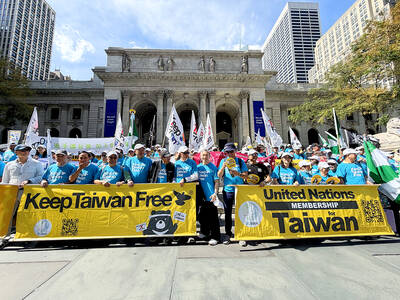
More than 100 Taiwanese-Americans, Taiwanese lawmakers and members of civic groups on Saturday marched through New York City to call for Taiwan’s participation in the UN, with Marshall Island Permanent Representative to the UN John Silk joining the event to show support. Participants chanted: “UN for Taiwan” and “Keep Taiwan Free” as they marched through central Manhattan, passing Times Square and Bryant Park before ending near the New York Public Library. The annual march brought together Taiwanese community groups from across the US East Coast. Silk expressed hope that Taiwan would one day be able to participate in UN meetings
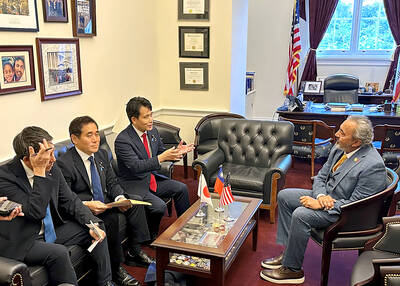
WASHINGTON MEETING: Japan’s Hirofumi Takinami said participants rejected the idea that the US should limit its defensive perimeter to the Second Island Chain US and Japanese lawmakers agree that the US must defend the First Island Chain, including Taiwan, and should not fall back to the Second Island Chain, while “a Taiwan contingency is a Japan contingency and therefore a US-Japan alliance contingency,” media reported after a meeting between officials of the two nations in Washington on Tuesday. A delegation of Japanese lawmakers from the Liberal Democratic Party met with US Senator Thom Tillis, co-chair of the Senate Taiwan Caucus, and US Representative Ami Bera, co-chair of the US Congressional Taiwan caucus, to discuss issues concerning East Asia and the Taiwan Strait. The Japanese and


 RSS
RSS