


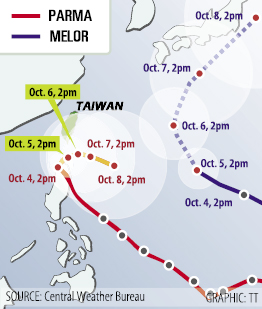
Having learned a bitter lesson from the tragic events of villages buried under mudslides and lost lives and property because of flooding brought by Typhoon Morakot in early August, central and local governments yesterday geared up to take all possible precautionary measures as Typhoon Parma approaches.
President Ma Ying-jeou (馬英九) flew to Taitung County yesterday morning to inspect anti-typhoon measures and said the central government would make every effort to assist local governments with evacuating residents and other measures.
He also ordered all ministers to cancel their holiday plans for the Mid-Autumn Festival yesterday to focus on preparations for the typhoon.
“People should not fight nature or compete with it for land. Disaster prevention is more important than rescue work, and the central and local governments should work together closely,” he said.
Ma was forced to reshuffle the Cabinet earlier last month after his government faced criticism over its slow reaction to the damage caused by Morakot.
Then-premier Liu Chao-shiuan (劉兆玄) resigned to take responsibility for the delayed evacuation of people living in mountain villages.
Ma said yesterday that the government would be more efficient in disaster prevention ahead of the approaching typhoon, while urging local residents to follow evacuation orders.
Premier Wu Den-yih (吳敦義) inspected Kaohsiung and Pingtung counties yesterday, while Vice Premier Eric Chu (朱立倫) was assigned to inspect measures in the Taipei, Keelung and Yilan areas.
Council of Agriculture Minister Chen Wu-hsiung (陳武雄) monitored the situation in Taichung, Changhua and Nantou counties, while Vice Minister of the Interior Chien Tai-lang (簡太郎) was responsible for Yunlin, Chiayi and Tainan counties.
Minister of the Interior Jiang Yi-huah (江宜樺), meanwhile, is serving as the commander of the ad hoc Central Emergency Operation Center (CEOC), which was set up yesterday after the issuance of the sea warning for Typhoon Parma earlier in the morning.
Wu urged government officials to stay alert and prepare for the worst.
“The military forces and rescue team resources have been well deployed. Local governments should all gear themselves up to minimize damage,” Wu said as he inspected Kaohsiung City Government’s emergency operation center.
He also gave a positive answer to Pingtung County Commissioner Tsao Chi-hung’s (曹啟鴻) request that Taiwan Railway Administration temporarily suspend its bridge construction in the county’s Linbian Township (林邊) during any potential flooding as the project was regarded by some as the main cause of the flooding in August.
Meanwhile, Chu stressed the importance of enhancing cooperation between central and local governments.
The Disaster Prevention and Protection Act (災害防救法) stipulates that local governments are in charge, but central government bears the responsibility to support local governments, Chu said.
“Previously, local governments sought help from the armed forces via the central government. But now, there are already armed forces deployed in counties and cities ahead of the typhoon that are available to take orders from local governments,” Chu said.
Because military personnel were dispatched around the country on a standby basis, local governments could contact commanders of each division directly without having to communicate first with the ministry and the CEOC, director of the Ministry of National Defense’s Joint Warfare Planning Department Hau Yi-chi (郝以知) told a press conference at the CEOC yesterday afternoon.
The ranks of military personnel stationed at the CEOC have been upgraded and additional staff will be stationed there to help coordinate government agencies, supply equipment, dispatch personnel and pass on information, the ministry said.
ADDITIONAL REPORTING BY CNA

FALSE DOCUMENTS? Actor William Liao said he was ‘voluntarily cooperating’ with police after a suspect was accused of helping to produce false medical certificates Police yesterday questioned at least six entertainers amid allegations of evasion of compulsory military service, with Lee Chuan (李銓), a member of boy band Choc7 (超克7), and actor Daniel Chen (陳大天) among those summoned. The New Taipei City District Prosecutors’ Office in January launched an investigation into a group that was allegedly helping men dodge compulsory military service using falsified medical documents. Actor Darren Wang (王大陸) has been accused of being one of the group’s clients. As the investigation expanded, investigators at New Taipei City’s Yonghe Precinct said that other entertainers commissioned the group to obtain false documents. The main suspect, a man surnamed

The government is considering polices to increase rental subsidies for people living in social housing who get married and have children, Premier Cho Jung-tai (卓榮泰) said yesterday. During an interview with the Plain Law Movement (法律白話文) podcast, Cho said that housing prices cannot be brought down overnight without affecting banks and mortgages. Therefore, the government is focusing on providing more aid for young people by taking 3 to 5 percent of urban renewal projects and zone expropriations and using that land for social housing, he said. Single people living in social housing who get married and become parents could obtain 50 percent more

DEMOGRAPHICS: Robotics is the most promising answer to looming labor woes, the long-term care system and national contingency response, an official said Taiwan is to launch a five-year plan to boost the robotics industry in a bid to address labor shortages stemming from a declining and aging population, the Executive Yuan said yesterday. The government approved the initiative, dubbed the Smart Robotics Industry Promotion Plan, via executive order, senior officials told a post-Cabinet meeting news conference in Taipei. Taiwan’s population decline would strain the economy and the nation’s ability to care for vulnerable and elderly people, said Peter Hong (洪樂文), who heads the National Science and Technology Council’s (NSTC) Department of Engineering and Technologies. Projections show that the proportion of Taiwanese 65 or older would
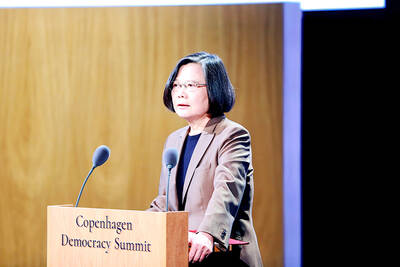
Democracies must remain united in the face of a shifting geopolitical landscape, former president Tsai Ing-wen (蔡英文) told the Copenhagen Democracy Summit on Tuesday, while emphasizing the importance of Taiwan’s security to the world. “Taiwan’s security is essential to regional stability and to defending democratic values amid mounting authoritarianism,” Tsai said at the annual forum in the Danish capital. Noting a “new geopolitical landscape” in which global trade and security face “uncertainty and unpredictability,” Tsai said that democracies must remain united and be more committed to building up resilience together in the face of challenges. Resilience “allows us to absorb shocks, adapt under


 RSS
RSS