


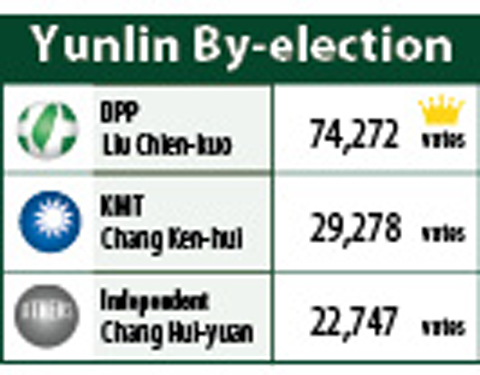
Democratic Progressive Party (DPP) candidate Liu Chien-kuo (劉建國) secured a landslide victory in yesterday’s Yunlin legislative by-election, giving the party a boost as corruption charges against former president Chen Shui-bian (陳水扁) continue to dog the opposition party.
Liu garnered 74,272 votes, beating his Chinese Nationalist Party (KMT) rival Chang Ken-hui (張艮輝) by nearly 45,000 votes. Voter turnout was 45.55 percent.
The DPP had previously said that former Department of Health minister Yeh Ching-chuan’s (葉金川) defeat in the KMT primary for the Hualien County commissioner election in August was a reflection of growing discontent with the government and a mark of no-confidence in President Ma Ying-jeou (馬英九).
It had also said that the KMT would suffer a setback in the Yunlin County legislative by-election.
Liu’s victory was significant to the DPP, which prior to the vote held 27 legislative seats, one shy of a quarter of the 113-seat legislature.
With a quarter of legislative seats, the DPP will be eligible to propose a recall of the president or vice president, as well as constitutional amendments.
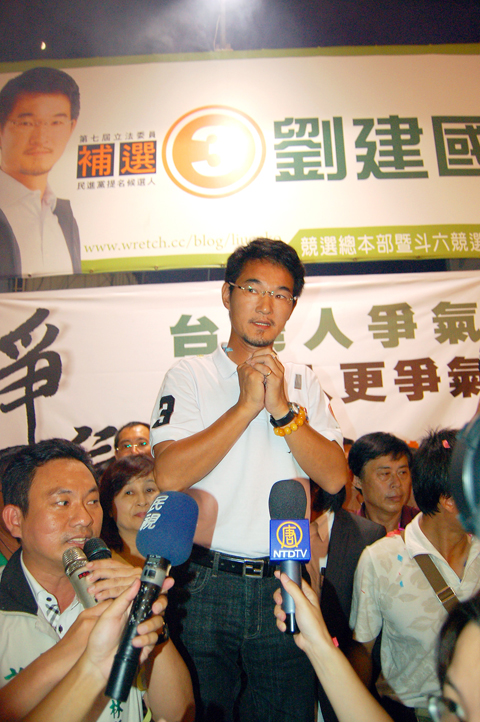
PHOTO: LIN KUO-HSIEN, TAIPEI TIMES
Bowing to his supporters, Liu said his victory was not his alone but that of the residents of Yunlin and the people of Taiwan.
“Today marks a very touching day in the history of Taiwan’s democracy,” he said at his campaign office.
“Yunlin residents’ hope for a better democracy and cleaner politics has finally come true. We oppose vote-buying and we utterly detest smear campaigns. That is the key to my victory,” he said.
Liu said his win showed that democratic politics trounced factional politics. It also showed that even a poor kid like him had the opportunity to serve the people and the country.
“The people used their ballots to prove that I am not a gangster,” he said.
In a statement, the DPP thanked voters for giving the party another chance to serve the public.
The by-election campaign saw the three contenders attack and sue each other. Independent candidate Chang Hui-yuan (張輝元) branded Liu a “gangster” and accused KMT candidate Chang Ken-hui of buying votes. Liu sued Chang Hui-yuan for slander.
The by-election was necessary to fill the seat left vacant by Chang Hui-yuan’s son, Chang Sho-wen (張碩文), who won the seat in January last year, but lost it this year after the High Court found him guilty of taking part in a vote-buying scheme organized by his father.
Chang Hui-yuan — who was found guilty of vote buying in the first trial — wanted to run as the KMT candidate in the election, but the party rejected his registration because its “black-gold exclusion clause” prevents party members found guilty of corruption in their first trial from standing for public office.
Chang Sho-wen filed a defamation lawsuit against Chang Ken-hui at the Yunlin Prosecutors’ Office on Monday, accusing him of making groundless vote-buying allegations.
Chang Ken-hui yesterday attributed his defeat to time constraints, saying he only had 48 days to campaign and that most voters were not familiar with him.
Conceding defeat, he gave Liu his blessing and said he would respect the people’s decision.
He said he did not work hard enough and that he would examine himself honestly.
He declined to comment on factionalism or a split within the KMT, but said that “somebody used despicable means during the campaign.”
“All I wanted was a fair election,” he said.
There were signs that KMT heavyweights were cool to Chang Ken-hui standing as the party’s candidate. During a campaign rally last Saturday, KMT Chairman Wu Poh-hsiung (吳伯雄) said it was Premier Wu Den-yi who had recommended that Chang Ken-hui stand in the by-election during his stint as KMT secretary-general.
Analysts saw Wu Poh-hsiung’s remarks as a means to distance himself from Chang Ken-hui if he failed.
Neither Ma nor Legislative Speaker Wang Jin-pyng (王金平) stumped for Chang Keng-hui.
In a statement yesterday, the KMT said it respected the choice of Yunlin residents, adding it was aware of the difficult situation in the run-up to the election, but had insisted on nominating a young, professional academic with a clean image.
The party is determined to reform because only reform will bring hope, the statement said. It also called for unity among party members.
ADDITONAL REPORTING BY STAFF WRITER

‘NO SECURITY RISK’: The Railway Bureau reassured the public that the technicians’ activities were limited to technical guidance and did not involve sensitive systems The Railway Bureau yesterday said it had invited eight Chinese technicians to assist with an airport MRT construction project. The bureau issued the confirmation after an Internet user said Chinese nationals had entered the construction zone of Taiwan Taoyuan International Airport’s Terminal 3 project. They asked why “individuals from an enemy state” were allowed access to such a major national infrastructure project, which raised serious concerns over Taiwan’s industrial safety, sensitive systems and information security. The bureau’s Northern Region Engineering Branch Office said subcontractor Taiwan Handle Industrial Co (台灣手把工業) of the Taoyuan airport MRT’s “Contract No. CU05 Project A14 Station Civil, MEP &

A US uncrewed surface vessel (USV) encountered multiple Chinese warships during an autonomous transit of the Taiwan Strait, US defense company Seasats said in a statement on Wednesday. Seasats announced that a Lightfish USV had completed the first autonomous transit of the Taiwan Strait. Over five days, the USV traversed the entire length of the Strait while constantly monitoring surface vessel traffic, the company said. The Lightfish encountered multiple Chinese warships, one of which was a Chinese People’s Liberation Army Navy (PLAN) Type 056 corvette, it said. The Chinese vessels were operating “well within Taiwan’s exclusive economic zone without transmitting their identity via the
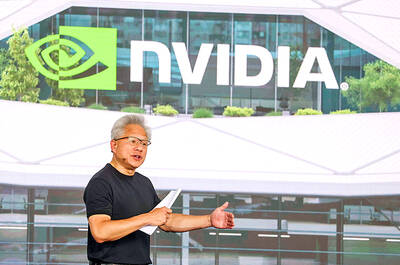
‘BOOMING’: ’ The number of partners we have here is incredible. You can see from their stock prices. They’re doing so well, they’re so happy,’ Jensen Huang said Nvidia Corp’s spending in Taiwan has ballooned to about US$150 billion a year, 10 times the US$10 billion to US$15 billion the company spent five years ago, Nvidia chief executive officer Jensen Huang (黃仁勳) said yesterday, suggesting Taiwan’s strategic importance in the global artificial intelligence (AI) supply chain. “Taiwan is the epicenter of the AI revolution. This is where the chips come, packaging comes. This is where the systems are made. This is where AI supercomputers were created,” Huang said at a meeting for the company’s employees in Beitou-Shilin Technology Park (北投士林科技園區) in Taipei, the planned site of Nvidia’s Taipei headquarters. “Taiwan
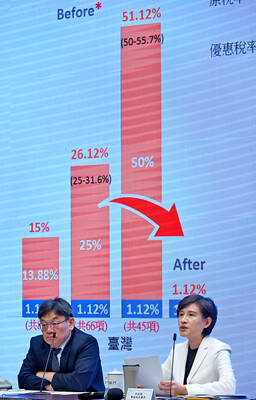
GREATER REACH? Auto parts and wood products would face tariffs of up to 15%, matching those targeting the EU, Japan and South Korea, Vice Premier said The US has announced that preferential tariff treatment for Taiwan’s non-semiconductor Section 232 goods would take effect retroactively from May 1, the Executive Yuan said yesterday. The US government yesterday posted a notice on the Federal Register’s public inspection Web site previewing tariff concessions for Taiwan under a memorandum of understanding (MOU) on Taiwan-US investment after two months of negotiations. The MOU signed on Jan. 15 stipulated three major preferential tariff arrangements: a 15 percent “reciprocal” tariff rate for Taiwan without stacking most-favored nation (MFN) rates; preferential Section 232 treatment for semiconductors and related products; and preferential Section 232 treatment for non-semiconductor


 RSS
RSS