


The controversy surrounding the construction of the Taipei Dome intensified after the contractor, Farglory Group (遠雄集團), ran an advertisement in several Chinese-language newspapers yesterday.
The ad suggested foul play was behind the Control Yuan’s recent issuance of corrective measures against the Taipei City Government, a move that could lead to suspension of the project.
In the statement, Farglory chairman Chao Teng-hsiung (趙藤雄) suggested there were “ulterior motives” behind the corrective measures implemented against the Public Construction Commission and the Taipei City Government earlier this month.
The Control Yuan ruled that the commission infringed on the authority of the city government by annulling decisions about the construction made by a city review commission on three separate occasions.
The Control Yuan said that there were 39 problems with the project, including the changing of subcontractors and the design of the stadium, as well as the expansion of the building from three stories to four to create more space for department stores.
The city government failed to refer the revised construction plan, which included changing subcontractors, to its review commission for approval in violation of the Act for Promotion of Private Participation in Infrastructure Projects (促進民間參與公共建設法), the Control Yuan said.
Following the issuance of the corrective measures, which were released one day before the group’s new construction plan was to be reviewed, the city government called off the scheduled meeting.
Chao held a press conference protesting the measures.
He insisted that the group did not violate any regulation by changing subcontractors and accused architect Ricky Liu (劉培森), head of a former subcontractor, of instigating a smear campaign against him after Farglory ended its cooperation with him.
In the statement, Chao said that the group’s original subcontractors — Liu, Japan’s Takenaka Corp and Japanese architect Hara Hiroshi — pulled out of the project in September 2004 after the group rejected their “unreasonable” demands for “enormous profits.”
Since then, Liu has tried every means possible to persuade the Taipei City Government and the city council to nullify the bid for the construction project after Farglory was named as the preferred bidder and started contract negotiations with the city government, Chao’s statement said.
“It seemed that there was an invisible figure manipulating the Control Yuan’s investigation, as it was timed to coincide with the Taipei City Government’s meeting to review the project. This coincidence looked like a repetition of the drama in September 2004,” Chao said.
Chao described the Taipei Dome project as a major municipal project that would “benefit the public,” saying the city needed a world-class stadium for sports events. Chao expressed his disappointment over the delays.
“A construction project that Taipei residents have been looking forward to is being delayed indefinitely because of some individuals ... I will not participate in any public construction in the future,” he said.
Huang Huang-hsiung (黃煌雄), the Control Yuan member in charge of the case, called a press conference in the afternoon to respond to Chao’s accusations.
“I will not allow anyone to harm the Control Yuan’s image and reputation,” Huang said, adding that the investigation into the case was prompted by “pure motives” and conducted to “fulfill [the Control Yuan’s] constitutional duty.”
The Control Yuan’s probe into the project stemmed from complaints filed by environmentalists who oppose the removal of more than 700 old trees, 169 of which were designated as “preserved trees,” to make way for the construction, which will occupy about 18 hectares on the former site of the Songshan Tobacco Factory in Xinyi District (信義). The Dome will feature an indoor 40,000-seat stadium, hotels, department stores, a shopping center and an office building.
Huang dismissed questions about the timing of the review, saying it was a long-held practice for the Control Yuan’s Education and Cultural Committee to meet on the Thursday of the second week of each month, which was when his motion to issue the corrective measures was passed.
The Taipei City Government, meanwhile, said it would consider annulling its build-operate-transfer contract with Farglory for the construction of the Dome if the contractor refused to cooperate and propose new subcontractors for the project.
Taipei Mayor Hau Lung-bin (郝龍斌) said yesterday that the city government had stuck to the contract since it was signed with the company in 2006, but would review the project after the Control Yuan ordered the corrective measures.
“Although the city government has been executing the contract, we should examine the problems with the contract following the Control Yuan’s issuance of corrective measures,” he said during a question-and-answer session at Taipei City Council.
Hau said that the city government would ask the contractor to propose new subcontractors for the project before determining whether to annul the contract.
Democratic Progressive Party (DPP) Taipei City Councilor Hsu Chia-ching (徐佳青) yesterday blasted President Ma Ying-jeou (馬英九) for initiating the project during his tenure as Taipei mayor, calling it a bad policy and urging Hau to halt the project.
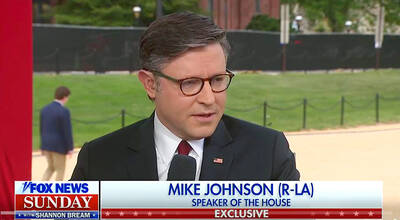
RESOLUTE BACKING: Two Republican senators are planning to introduce legislation that would impose immediate sanctions on China if it attempts to invade Taiwan US House of Representatives Speaker Mike Johnson on Sunday reaffirmed US congressional support for Taiwan, saying the US and “all freedom-loving people” have a stake in preventing China from seizing Taiwan by force. Johnson made the remarks in an interview with Fox News Sunday on US President Donald Trump’s summit with Chinese President Xi Jinping (習近平) last week. In an interview that aired on Friday on Fox News, just as Trump wrapped up a high-stakes visit to China, he said he has yet to green-light a new US$14 billion arms package to Taiwan and that it “depends on China.” “It’s a very good
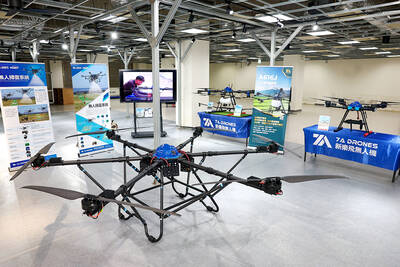
DRONE CENTRAL: Taiwan aims to become Asia’s democratic hub for drones, with most exports focused on high-quality military-grade models, an official said Taiwan’s drone industry is expected to expand significantly by 2030, producing 100,000 units per month and exporting half of them, the Ministry of Economic Affairs said yesterday. Current drone production capacity is about 15,000 units per month, but the industry can quickly scale up as demand increases, Industrial Development Administration Director-General Chiou Chyou-huey (邱求慧) told a news conference in Taipei. Taiwan’s drone output grew 2.5-fold last year to NT$12.9 billion (US$408.3 million) under a government program to develop the uncrewed vehicle sector, he said. The Executive Yuan in October last year approved plans to invest NT$44.2 billion into domestic production of uncrewed aerial
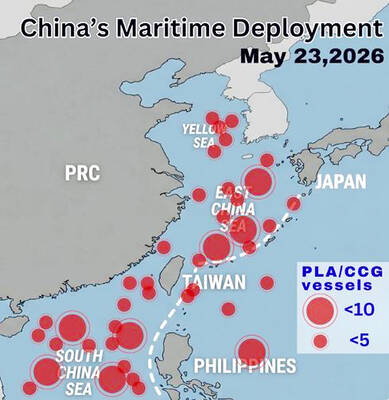
WARNING: China should stop engaging in actions that undermine regional peace and stability, as it would only build resentment among people across the Strait, the CGA said China has deployed more than 100 navy, coast guard and other vessels in waters from the Yellow Sea to the South China Sea and the western Pacific since US President Donald Trump and Chinese President Xi Jinping (習近平) met in Beijing, National Security Council Secretary-General Joseph Wu (吳釗燮) said yesterday. “In this part of the world, #China is the one & only PROBLEM wrecking the #StatusQuo & threatening regional peace & stability,” Wu wrote on X. In a separate post, he said Beijing was coercing Taiwan’s maritime domain, calling it illegal and provocative, after the Coast Guard Administration (CGA) expelled a
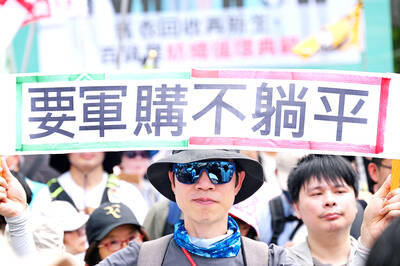
More than 8,000 people took part in a rally in Taipei yesterday to express support for more defense spending, after the opposition slashed the Cabinet’s proposed NT$1.25 trillion (US$39.6 billion) special defense budget and capped it at NT$780 billion. The demonstrators urged the Cabinet to propose another bill. Taiwan Economic Democracy Union convener Lai Chung-chiang (賴中強) said the main problem of the passed budget plan is the removal of funding for critical items, not just that the total amount is smaller. Critical budget items included purchasing or developing uncrewed vehicles, Strong Bow (強弓) missile systems, additional ammunition, artificial intelligence-powered combat systems and Taiwan-US


 RSS
RSS