


Fresh protests erupted in the restive Chinese city of Urumqi yesterday, one day after mass demonstrations over a spate of mysterious syringe attacks that have fanned ethnic tensions.
The new protests took place as thousands of security forces were deployed to lock down the capital of northwestern Xinjiang region, where violence erupted in July between mainly Muslim Uighurs and Han Chinese, leaving nearly 200 dead.
The central government dispatched Public Security Minister Meng Jianzhu (孟建柱) to the scene to oversee efforts to restore calm in Urumqi, a city of 1.8 million people.
“Maintaining stability is the central task of overriding importance in Xinjiang at the present time,” Meng told local officials, Xinhua news agency reported.
Meng blamed ethnic separatist forces for the needle attacks, saying they were “plotted by unlawful elements and instigated by ethnic splittist forces.”
At one protest witnessed by a reporter, about 1,000 people threw plastic bottles at a similar number of police near People’s Square, where the main demonstrations took place on Thursday.
The crowd repeatedly scuffled with police, shouting “Release him! Release him!” whenever they tried to subdue a protester who had challenged them.
Hundreds of regular and armed police reinforcements rushed to the scene and eventually dispersed the crowd about an hour later.
Xinhua later reported that police had used tear gas to break up two other protests. One man in his 20s was injured and taken to hospital, it said.
A “number of other small-scale confrontations” took place throughout the day, Xinhua said.
Some Han Chinese have blamed Uighurs for the hundreds of reported syringe attacks in the city, but official reports have been vague about the identities of the alleged perpetrators, 21 of whom have been detained.
State media, quoting police, said a total of 531 people had sought treatment in hospital after being stabbed with syringes in Urumqi since the middle of last month. But the report noted that only 106 of them had “obvious signs of needle attacks.”
No one had been infected or poisoned in the assaults, Xinhua reported, and it remained unclear what the syringes contained, if anything.
On Thursday and again yesterday, protesters called for the resignation of regional Communist Party boss Wang Lequan (王樂泉) a close ally of Chinese President Hu Jintao (胡錦濤). Wang has called for calm and urged residents to show restraint.
Across Urumqi, armed police in riot gear were stationed at key points and erected barricades to block major roads. Traffic was cut off in several areas.
Government notices were posted banning all large gatherings, the use of any weapons and any incitement to violence.
“We seriously warn those criminals engaging in the acts of disruption to immediately cease these illegal criminal activities or pay the price of severe punishment in accordance with the law,” the city government said.
Some shops and banks were open, but at least two key mosques were closed for Friday prayers as Muslims observed Ramadan.
“We were ordered to keep the mosque closed,” said an official at the Hantenggeli mosque in the city’s central Nanmen area. “It is for everyone’s safety.”
Also See: Victims of Xinjiang syringe attack fear hidden infections

CREDIT-GRABBER: China said its coast guard rescued the crew of a fishing vessel that caught fire, who were actually rescued by a nearby Taiwanese boat and the CGA Maritime search and rescue operations do not have borders, and China should not use a shipwreck to infringe upon Taiwanese sovereignty, the Coast Guard Administration (CGA) said yesterday. The coast guard made the statement in response to the China Coast Guard (CCG) saying it saved a Taiwanese fishing boat. The Chuan Yu No. 6 (全漁6號), a fishing vessel registered in Keelung, on Thursday caught fire and sank in waters northeast of Diaoyutai Islands (釣魚台). The vessel left Keelung’s Badouzih Fishing Harbor (八斗子漁港) at 3:35pm on Sunday last week, with seven people on board — a 62-year-old Taiwanese captain surnamed Chang (張) and six

RISKY BUSINESS: The ‘incentives’ include initiatives that get suspended for no reason, creating uncertainty and resulting in considerable losses for Taiwanese, the MAC said China’s “incentives” failed to sway sentiment in Taiwan, as willingness to work in China hit a record low of 1.6 percent, a Ministry of Labor survey showed. The Directorate-General of Budget, Accounting and Statistics (DGBAS) also reported that the number of Taiwanese workers in China has nearly halved from a peak of 430,000 in 2012 to an estimated 231,000 in 2024. That marked a new low in the proportion of Taiwanese going abroad to work. The ministry’s annual survey on “Labor Life and Employment Status” includes questions respondents’ willingness to seek employment overseas. Willingness to work in China has steadily declined from

LEVERAGE: China did not ‘need to fire a shot’ to deny Taiwan airspace over Africa when it owns ‘half the continent’s debt,’ a US official said, calling it economic warfare The EU has raised concerns about overflight rights following the delay of President William Lai’s (賴清德) planned state visit to the Kingdom of Eswatini after three African nations denied overflight clearance for his charter at the last minute. Taiwanese allies Paraguay and Saint Kitts and Nevis, as well as several US lawmakers and the Inter-Parliamentary Alliance on China (IPAC) condemned China for allegedly pressuring the countries. Lai was scheduled to fly directly to Taiwan’s only African ally from yesterday to Sunday to celebrate the 40th anniversary of King Mswati III’s accession and his 58th birthday, but Seychelles, Mauritius and Madagascar suddenly revoked
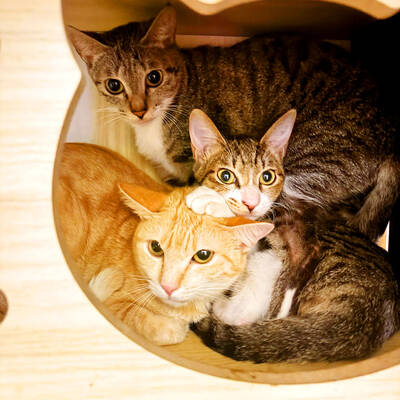
The number of pet cats in Taiwan surpassed that of pet dogs for the first time last year, reaching 1,742,033, a 32.8 percent increase from 2023, the Ministry of Agriculture said yesterday, citing a survey. By contrast, the number of pet dogs declined slightly by 1.2 percent over the same period to 1,462,528, the ministry said. Despite the shift, households with dogs still slightly outnumber those with cats by 1.2 percent. However, while the number of households with multiple dogs has remained relatively stable, households keeping more than two cats have increased, contributing to the overall rise in the feline population. The trend


 RSS
RSS