


The chorus of smiling Muslims and Han Chinese wore matching yellow polo shirts and appeared on television singing: “We are all part of the same family.”
The TV spot on Wednesday was the latest effort in a relentless propaganda campaign by the Chinese government to end the worst ethnic rioting in the far western Xinjiang region in decades.
However, the message was falling flat on the streets of the dusty jade-trading oasis city of Hotan, where many Muslims were still seething with resentment over the Han, the dominant ethnic group in China. The residents spoke about the long-standing tensions in hushed voices in the Silk Road town’s bustling bazaar, where donkeys pulled carts piled high with melons and women in colorful head scarves sold wheels of flat bread that looked like pizza crust.
One Muslim shopkeeper picked up a hatchet, raised it over his head and lowered it with one quick stroke, before saying: “That’s the best way to deal with the Han Chinese.”
The store owner, who only identified himself as Abdul, scoffed at the TV shows featuring members of his own Turkic minority ethnic group, the Uighurs, gushing about how harmonious and happy most of the people were in the sprawling oil-rich Xinjiang region, three times the size of Texas.
“I don’t believe these people,” the businessman said with a whisper, as he scouted the street for police. “They get paid to say these things. Ninety percent of the Uighurs don’t believe that stuff.”
The media campaign began after July 5 when ethnic rioting killed at least 192 people in Xinjiang’s capital, Urumqi. In the first days after the rioting, state-run media provided extensive reports about Uighurs savagely attacking Han Chinese, while playing down the subsequent Han-led violence. The government was quick to frame the Uighur attacks as an act of terrorism by a tiny minority of violent miscreants, led by the US-based Uighur dissident Rebiya Kadeer.
Kadeer has repeatedly denied the allegations and has condemned the violence.
As thousands of security forces restored order in Urumqi, the government’s propaganda campaign kicked in with TV shows, loudspeaker trucks and red banners. Many slogans warned against the “three evil forces” of terrorism, separatism and extremism. The campaign targeted all of Xinjiang, even Hotan on the edge of the Taklamakan desert — a two-hour flight south of Urumqi.
Hotan is predominantly Uighur. The city is famous for its carpets and a statue of late Communist leader Mao Zedong (毛澤東) shaking hands with a Uighur worker.
On Wednesday, the propaganda continued with local TV showing the Uighur and Han singers swaying together as they sang: “We are all part of the same family.”
There were also several personal profiles of Uighurs who acted heroically during the riots.
One elderly Uighur couple reportedly gave refuge to a Han teenager, allowing him to spend the night in their apartment until his father could pick him up in the morning.
Another Uighur man was an ambulance driver who continued to rescue the wounded, even though he was injured and the windows of his vehicle were smashed.
“I’m a Communist Party member,” the man said. “I should be doing more than the average citizen.”
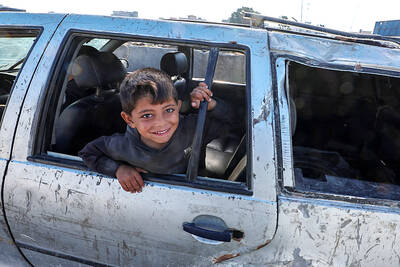
Gaza is rapidly running out of its limited fuel supply and stocks of food staples might become tight, officials said, after Israel blocked the entry of fuel and goods into the war-shattered territory, citing fighting with Iran. The Israeli military closed all Gaza border crossings on Saturday after announcing airstrikes on Iran carried out jointly with the US. Israeli authorities late on Monday night said that they would reopen the Kerem Shalom crossing from Israel to Gaza yesterday, for “gradual entry of humanitarian aid” into the strip, without saying how much. Israeli authorities previously said the crossings could not be operated safely during

Hungarian authorities temporarily detained seven Ukrainian citizens and seized two armored cars carrying tens of millions of euros in cash across Hungary on suspicion of money laundering, officials said on Friday. The Ukrainians were released on Friday, following their detention on Thursday, but Hungarian officials held onto the cash, prompting Ukraine to accuse Hungary’s Russia-friendly government of illegally seizing the money. “We will not tolerate this state banditism,” Ukrainian Minister of Foreign Affairs Andrii Sybiha said. The seven detained Ukrainians were employees of the Ukrainian state-owned Oschadbank, who were traveling in the two armored cars that were carrying the money between Austria and

Kosovar President Vjosa Osmani on Friday after dissolving the Kosovar parliament said a snap election should be held as soon as possible to avoid another prolonged political crisis in the Balkan country at a time of global turmoil. Osmani said it is important for Kosovo to wrap up the upcoming election process and form functional institutions for political stability as the war rages in the Middle East. “Precisely because the geopolitical situation is that complex, it is important to finish this electoral process which is coming up,” she said. “It is very hard now to imagine what will happen next.” Kosovo, which declared

MORE BANS: Australia last year required sites to remove accounts held by under-16s, with a few countries pushing for similar action at an EU level and India considering its own ban Indonesia on Friday said it would ban social media access for children under 16, citing threats from online pornography, cyberbullying, online fraud and Internet addiction. “Accounts belonging to children under 16 on high-risk platforms will start to be deactivated, beginning with YouTube, TikTok, Facebook, Instagram, Threads, X, Bigo Live and Roblox,” Indonesian Minister of Communications and Digital Meutya Hafid said. “The government is stepping in so that parents no longer have to fight alone against the giants of the algorithm. Implementation will begin on March 28, 2026,” she said. The social media ban would be introduced in stages “until all platforms fulfill their


 RSS
RSS