


A decision by the Department of Health to relax standards for a pesticide residue on apples has angered consumer activists who believe the move may have been the result of pressure from the US.
The government had previously banned the presence of any residues of the pesticide endosulfan on any apples sold in the country, but announced on March 29 that endosulfan residues of up to 0.5ppm would now be acceptable.
“All apples, whether imported or locally grown, will be subject to the new endosulfan inspection level,” said Hsieh Ting-hung (謝定宏), deputy director of the Bureau of Food Safety.
Hsieh said the new norm was set after consulting joint standards established by the WHO and the UN’s Food and Agriculture Organization, as well as US and EU standards, as part of an effort to review standards for residues of various pesticides on different agricultural products.
The new endosulfan standard for apples, which will take effect three days after being officially promulgated, has sparked criticism from consumer advocates.
Sun Lih-chyun (孫立群), an associate professor at National Taiwan University’s College of Bio-Resources and Agriculture and a member of the nonprofit Consumers’ Foundation, cited the foundation and local farmers’ associations as saying the US had exerted political pressure on Taiwan to force it to lower food safety standards.
The US is one of the main sources of apples sold in Taiwan, along with Japan, New Zealand and Chile.
Sun said two shipments of US apples were rejected earlier this year by authorities because they were found to have endosulfan residues ranging from 0.02ppm to 0.04ppm.
Information from the Consumer Protection Commission shows that two US apple shipments were rejected in February and six more in March, mostly because they were found to contain endosulfan residue.
Gaston Wu (吳家誠), a professor at National Taiwan Normal University and secretary-general of the Consumers’ Foundation, said many local fruit growers have filed complaints with the foundation over the government’s decision to lower the standard for the pesticide in apples.
Lin Ja-liang (林杰樑), a clinical toxicology specialist with Chang Gung Memorial Hospital in Linkou, said endosulfan is a highly toxic pesticide that affects the central nervous system.
“It should not be allowed to be present in any apple because a large intake of it can lead to liver damage, the weakening of the immune system, and even miscarriages,” Lin said.
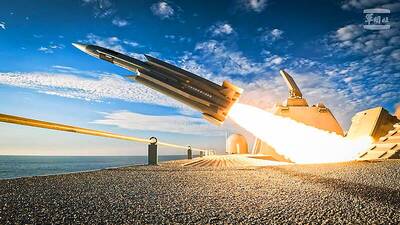
DETERRENCE: With 1,000 indigenous Hsiung Feng II and III missiles and 400 Harpoon missiles, the nation would boast the highest anti-ship missile density in the world With Taiwan wrapping up mass production of Hsiung Feng II and III missiles by December and an influx of Harpoon missiles from the US, Taiwan would have the highest density of anti-ship missiles in the world, a source said yesterday. Taiwan is to wrap up mass production of the indigenous anti-ship missiles by the end of year, as the Chungshan Institute of Science and Technology has been meeting production targets ahead of schedule, a defense official with knowledge of the matter said. Combined with the 400 Harpoon anti-ship missiles Taiwan expects to receive from the US by 2028, the nation would have

North Korea yesterday fired about 10 ballistic missiles to the sea toward Japan, the South Korean Joint Chiefs of Staff (JCS) said, days after Pyongyang warned of “terrible consequences” over ongoing South Korea-US military drills. Pyongyang recently dashed hopes of a diplomatic thaw with Seoul, Washington’s security ally, describing its latest peace efforts as a “clumsy, deceptive farce.” Seoul’s military detected “around 10 ballistic missiles launched from the Sunan area in North Korea toward the East Sea [Sea of Japan] at around 1:20pm,” JCS said in a statement, referring to South Korea’s name for the body of water. The missiles

‘UNWAVERING FRIENDSHIP’: A representative of a Japanese group that co-organized a memorial, said he hopes Japanese never forget Taiwan’s kindness President William Lai (賴清德) yesterday marked the 15th anniversary of the Tohoku earthquake and tsunami, urging continued cooperation between Taiwan and Japan on disaster prevention and humanitarian assistance. Lai wrote on social media that Taiwan and Japan have always helped each other in the aftermath of major disasters. The magnitude 9 earthquake struck northeastern Japan on March 11, 2011, triggering a massive tsunami that claimed more than 19,000 lives, according to data from Japanese authorities. Following the disaster, Taiwan donated more than US$240 million in aid, making it one of the largest contributors of financial assistance to Japan. In addition to cash donations and
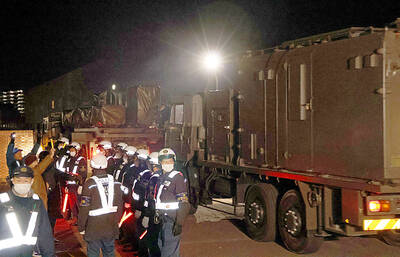
CLOSER TO CHINA: The upgraded Type-12 missile has a range of about 1,000km, compared with the original model’s range of 200km, and can reach mainland China Japan is preparing to deploy its first batch of domestically developed long-range missiles, with their launchers arriving at an army camp yesterday, as the country accelerates its offensive capability in response to rising challenges in the region. The upgraded Type-12 land-to-ship missiles are to be deployed at Camp Kengun in Japan’s southwestern prefecture of Kumamoto by the end of this month, completing the process of deployment, Japanese Chief Cabinet Secretary Minoru Kihara said without giving details. Army vehicles carrying the launchers and other equipment arrived past midnight in a highly secretive mission criticized by residents. Dozens of people stood outside of the


 RSS
RSS