


Witnesses yesterday said police were using tear gas and water cannons to disperse thousands of protesters rallying in Tehran to demand a new presidential election.
Iranian anti-riot policemen also reportedly blocked and beat protesters trying to reach the site of a planned mass rally in Tehran yesterday, a witness said.
Police blocked all access routes to the main rally site, Enghelab Square, the witness said.
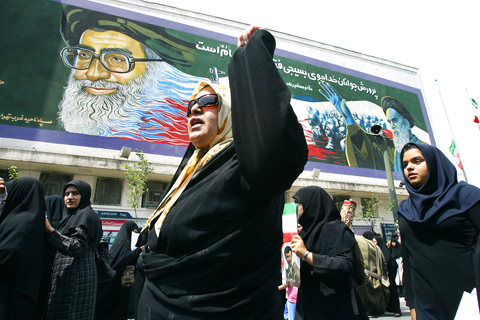
PHOTO: AP
“They are blocking the side lanes and beating them,” the witness said.
Eyewitnesses said a crowd of 3,000 chanted “Death to the dictator!” and “Death to dictatorship!” near Revolution Square in central Tehran before police used tear gas and water cannon.
Supreme Leader Ayatollah Ali Khamenei warned opposition leaders on Friday to end street protests or be held responsible for any “bloodshed and chaos” to come.
Also yesterday, a suicide bomber blew himself up at the Tehran mausoleum of Iranian revolutionary leader Ayatollah Ruhollah Khomeini, killing himself and wounding a pilgrim, a police official told the Mehr news agency.
Earlier in the day, the government threatened harsh action if opposition supporters took to the streets again to demand a new election in open defiance of the country’s supreme leader.
Web sites run by supporters of opposition leader Mir Hossein Mousavi called for street protests at 4pm, but the candidate himself issued no public statement.
Mousavi did not attend a meeting of the country’s top election authority, but one of his sites said he planned to issue a statement “soon.” It did not elaborate.
The decision to rally or stay off the streets will be crucial for the opposition movement and the unprecented threat it poses to Iran’s cleric-led government.
Rallying could spark a bloody crackdown on Mousavi’s supporters, or greatly weaken the government by forcing it to back away from its threat of violence.
If the opposition heeds the official warnings and cancels, it could give the government the opening it needs to suppress its greatest internal challenge since the 1979 Islamic Revolution.
It was not clear if Mousavi has the power to halt street demonstrations even if he orders his supporters to stay inside. The government appeared to be preparing for a confrontation.
Police and members of the pro-government Basij militia were out in force on the streets, particularly in central commercial districts.
Tehran Province Police Chief Ahmad Reza Radan said “police forces will crack down on any gathering or protest rally which are being planned by some people.”
State TV said the country’s highest national security body had ordered security forces to deal with the situation. It did not elaborate.
The government statements were the most explicit warnings yet of force against protesters who gathered in massive rallies last week to demand the government cancel and rerun elections that ended with a declaration of overwhelming victory for Iranian President Mahmoud Ahmadinejad. Mousavi said he won and that Ahmadinejad stole the election through widespread fraud.
Supreme Leader Ayatollah Ali Khamenei sided with Ahmadinejad on Friday, saying the result reflected popular will.
The statement effectively closed the door to Mousavi’s demand for a new election, ratcheting up the possibility of a confrontation.
The Iranian Interior Ministry raised the possibility of directly punishing the 67-year-old former prime minister, saying he would “be held responsible for the consequences of any illegal gatherings.”
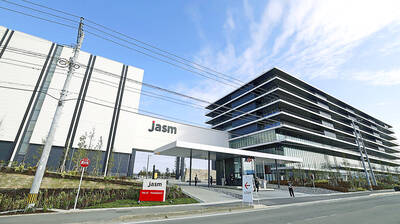
The subsidiary of Taiwan Semiconductor Manufacturing Co (TSMC, 台積電) in Kumamoto, Japan, turned a profit in the first quarter of this year, marking the first time the first fab of the unit has become profitable since mass production started at the end of 2024. According to the contract chipmaker’s financial statement released on Friday, Japan Advanced Semiconductor Manufacturing Inc (JASM), a joint venture running the fab in Kumamoto, posted NT$951 million (US$30.19 million) in profit in the January-to-March period, compared with a loss of NT$1.39 billion in the previous quarter, and a loss of NT$3.25 billion in the first quarter of
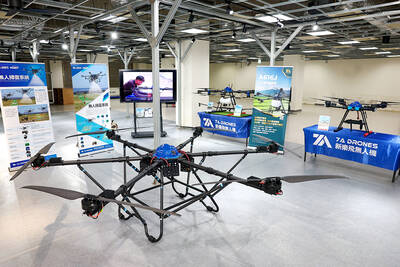
DRONE CENTRAL: Taiwan aims to become Asia’s democratic hub for drones, with most exports focused on high-quality military-grade models, an official said Taiwan’s drone industry is expected to expand significantly by 2030, producing 100,000 units per month and exporting half of them, the Ministry of Economic Affairs said yesterday. Current drone production capacity is about 15,000 units per month, but the industry can quickly scale up as demand increases, Industrial Development Administration Director-General Chiou Chyou-huey (邱求慧) told a news conference in Taipei. Taiwan’s drone output grew 2.5-fold last year to NT$12.9 billion (US$408.3 million) under a government program to develop the uncrewed vehicle sector, he said. The Executive Yuan in October last year approved plans to invest NT$44.2 billion into domestic production of uncrewed aerial
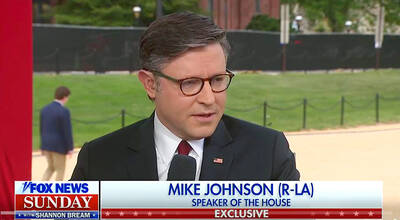
RESOLUTE BACKING: Two Republican senators are planning to introduce legislation that would impose immediate sanctions on China if it attempts to invade Taiwan US House of Representatives Speaker Mike Johnson on Sunday reaffirmed US congressional support for Taiwan, saying the US and “all freedom-loving people” have a stake in preventing China from seizing Taiwan by force. Johnson made the remarks in an interview with Fox News Sunday on US President Donald Trump’s summit with Chinese President Xi Jinping (習近平) last week. In an interview that aired on Friday on Fox News, just as Trump wrapped up a high-stakes visit to China, he said he has yet to green-light a new US$14 billion arms package to Taiwan and that it “depends on China.” “It’s a very good
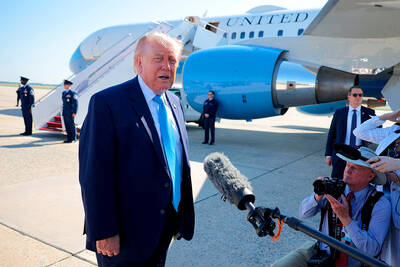
US President Donald Trump yesterday said he would speak to President William Lai (賴清德) as his administration considers whether to move ahead with a US$14 billion weapons sale to Taiwan — a potential arms deal that has drawn criticism from China. “Well, I’ll speak to him. I speak to everybody,” Trump told reporters yesterday when asked if he had any plans to call his counterpart, although he did not offer a time frame for when such a conversation could take place. Trump previously said he would speak to the person “that’s running Taiwan,” without specifying who he meant. “We have that situation very


 RSS
RSS