


Jurgen Gerbig was clearing out his desk at Taipei’s German Cultural Center when I finally caught up with him on May 28. Over the previous 10 days he’d been in Warsaw and Beijing, but now he finally had to come to terms with quitting a job he’s had since 2002, directing what anywhere else would be called the Goethe Institute, but what in Taiwan had to adjust to Chinese sensibilities.
Nowhere else in Taiwan can free wine have been dispensed so liberally at arts events that were free-of-charge and open to all.
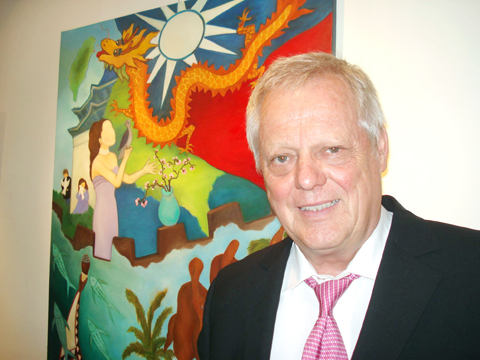
PHOTO COURTESY OF THE GERMAN CULTURAL CENTER, TAIPEI
Gerbig was ideally suited to be the host of such largesse — his warmth and openness shone out, and indeed these same qualities came to characterize the events themselves.
“Last week there was a farewell party for me here,” he said, “and it ended with all the musicians present jamming together, mixing every possible style. But, as if that wasn’t enough, they went on to announce that our center wasn’t only open to everyone — it represented the very principle of open-mindedness itself! I couldn’t possibly have had a more welcome farewell compliment.”
As he led me around the center’s premises, Gerbig pointed out items of the art collection, currently on display in a special exhibition. All had been donated by the artists, he said, and there were around 50 of them. It had been his policy to charge nothing for the exhibition space and to take no commission on sales. Instead, he asked each exhibitor to give one work to the center.
“And there they all are,” he said — not, I thought, without a tinge of sadness in his voice. “They are my legacy.”
Gerbig’s Chinese experience didn’t start with his appointment to Beijing, whose Goethe Institute he helped set up, as one of a team of three, in 1988. Prior to that he’d been teaching German in Shanghai’s Tongji University to students from all over China, preparing them to go to Germany to study for doctorates. Many later returned to Germany to take up senior positions there as cogs in the field of Sino-German economic cooperation.
Even so, it was initially hard work for Gerbig to get his Taipei posting. He’d already worked in Shanghai, Beijing and Hong Kong and was due to be rotated to some other part of the globe.
But he insisted he needed to know about “the other China” to have a complete picture of the Mandarin-speaking world. And it’s an indication of his standing in his employers’ eyes that he was eventually transferred to Taipei.
But when he arrived, he said, he felt he was starting all over again.
“I still remember how, early in my stay, I received an invitation from the then-director of the Cultural Affairs Committee, Madame Tchen Yu-chiou (陳郁秀) to attend a puppet show. I thought ‘Oh no, not again!’ I’d seen at least a dozen on the mainland, but out of courtesy I went. And I was so impressed! I’d never seen puppetry of such a high artistic level,” he said.
And not only were Taiwan’s artists themselves top-notch — they also knew a lot about the German arts scene, and approached the center with specific ideas on who to invite and which projects to consider, he said.
A number of factors had helped along the way.
When he arrived in 2002, Gerbig was told the building the German Cultural Center had occupied for close to 20 years was beyond repair, but this proved a blessing in disguise as he was able to establish a new image, with a transparent reception area and a multi-purpose performance venue, lots of glass, warm colors and open spaces.
He also launched a user-friendly Web site and a new logo.
“We were fortunate to find sponsors who helped — Mercedes when it was still called DaimlerChrysler, which financed our new Web site and leased us a SmartforTwo which I drove for more than a year with our new logo splashed all over it and underneath ‘We are Smart!’” he said.
“Later there were Opel and Continental Engineering, who supported us in organizing nationwide green projects,” he said.
There were inevitably a few irritants. One of the artists the center exhibited obviously had problems with certain individuals, who called day and night threatening to break in and remove the objects on display as security for outstanding debts, even though most of these were large stone sculptures. The heaviest was a 6 tonne piece at the entrance to the building, which had to be lifted into place by a special crane. The threats died away after staff members explained what the callers’ proposed scheme would actually involve.
“Again, early on I had a run-in with the press,” Gerbig said, “over a grossly distorted article which claimed I’d said the areas around the train station and the airport looked like Palestine! Not only had I never said that, but I’d also never met the journalist who wrote it. The ensuing war of words was never unambiguously terminated — there was only a half-hearted comment in the newspaper, far short of a correction. Ever since I’ve been rather wary of the press — with notable exceptions, of course.”
But Gerbig has nothing but praise for Taiwan’s artists, as well as the official bodies who’ve proved so helpful over the years. And it’s a singular tribute to Taiwan that, along with his Shanghainese wife, he’ll continue to live here, in Tianmu (天母), after his retirement and will no doubt remain a familiar face at local arts events.

SILENCING CRITICS: In addition to blocking Taiwan, China aimed to prevent rights activists from speaking out against authoritarian states, a Cabinet department said The Ministry of Foreign Affairs (MOFA) yesterday condemned transnational repression by Beijing after RightsCon, a major digital human rights conference scheduled to be held in Zambia this week, was abruptly canceled due to Chinese pressure over Taiwanese participation. This year’s RightsCon, the world’s largest conference discussing issues “at the intersection of human rights and technology,” was scheduled to take place from tomorrow to Friday in Lusaka, and expected to draw 2,600 in-person attendees from 150 countries, along with 1,100 online participants. However, organizers were forced to cancel the event due to behind-the-scenes pressure from China, the ministry said, expressing its “strongest condemnation”
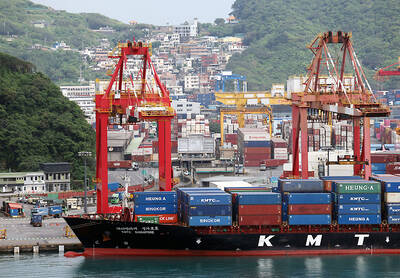
Taiwan’s economy grew far faster than expected in the first quarter, as booming demand for artificial intelligence (AI) applications drove a surge in exports, spilling over into investment and consumption, the Directorate-General of Budget, Accounting and Statistics (DGBAS) said yesterday. GDP growth was 13.69 percent year-on-year during the January-to-March period, beating the DGBAS’ February forecast by 2.23 percentage points and marking the most robust growth in nearly four decades, DGBAS senior official Chiang Hsin-yi (江心怡) told a news conference in Taipei. The result was powered by exports, which remain the backbone of Taiwan’s economy, Chiang said. Outbound shipments jumped 51.12 percent year-on-year to
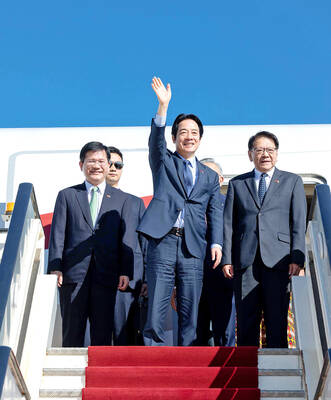
DELAYED BUT DETERMINED: The president’s visit highlights Taiwan’s right to international engagement amid regional pressure from China President Willaim Lai (賴清德) yesterday arrived in Eswatini, more than a week after his planned visit to Taiwan’s sole African ally was suspended because of revoked overflight permits. “The visit, originally scheduled for April 22, was postponed due to unforeseen external factors,” Lai wrote on social media. “After several days of careful arrangements by our diplomatic and national security teams, we successfully arrived today.” Lai said he looked forward to further deepening Taiwan-Eswatini relations through closer cooperation in the economy, agriculture, culture and education, as well as advancing the nation’s international partnerships. The president was initially scheduled to arrive in time to celebrate
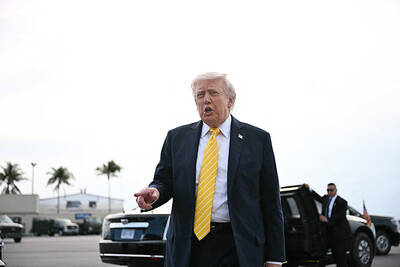
Iran’s Islamic Revolutionary Guard Corp (IRGC) yesterday said the US faced a choice between an “impossible” military operation or a “bad deal” with Tehran, after US President Donald Trump disparaged Iran’s latest peace proposal. Negotiations between the two countries have been deadlocked since a ceasefire came into effect on April 8, with only one round of direct peace talks held so far. Iran’s Tasnim and Fars news agencies reported that Tehran had submitted a 14-point proposal to mediator Pakistan, but Trump was quick to cast doubt on it. “I will soon be reviewing the plan that Iran has just sent to us, but


 RSS
RSS