


President Ma Ying-jeou (堜褙朐) said yesterday he hoped to see Washington sell F-16C/D fighter jets to Taiwan, emphasizing that improved cross-strait relations did not clash with Taipei*s relationship with the international community.
The president*s remark came after he stressed the need for Taiwan to continue acquiring weapons from the US in a videoconference call with China experts in Washington on April 23.
Ma, who is on a 10-day state visit to Central America, mentioned the need to purchase the advanced fighter planes in telephone conversations with US lawmakers from his hotel in Los Angeles before leaving for Belize.
Ma talked to Republican Senator John McCain and eight congressmen on the phone and was visited by Republican Representative David Dreier at the hotel.
In addition to urging Washington to sign an extradition agreement with Taiwan and extend visa-free privileges to Taiwanese visitors, Ma brought up the procurement of the F-16C/D jets.
Dreier told reporters after their meeting that Ma has made efforts to ease tensions in the Taiwan Strait and was an outstanding democratic leader.
Washington and Taipei should continue to strengthen 〝business ties as well as cooperation in other areas, he said.
At a dinner with overseas compatriots in Belize later yesterday, Ma said that he had told American Institute in Taiwan (AIT) Chairman Raymond Burghardt during their meeting in Los Angeles that the development of cross-strait ties and Taiwan*s relationship with the international community were not mutually exclusive.
Ma said that during the 1990s, for example, Taiwan purchased F-16s from the US and Mirage 2000-5 fighters from France, while at the same time reaching the ※1992 consensus§ with China, which paved the way for effectively handling the ※one China§ issue.
Following Washington*s approval of further arms sales to Taiwan in October last year, Ma said, China*s Association for Relations Across the Taiwan Strait Chairman Chen Yunlin (蠊磩釱) visited Taipei in November and former vice president Lien Chan (盓霝) attended the APEC summit on Ma*s behalf the same month.
The country*s participation in the World Health Assembly as an observer this year was another example, Ma said.
Although his administration has yet to negotiate with Beijing about his ※diplomatic truce§ proposal, both sides have extended goodwill gestures and made significant progress, Ma said.
He added that improving cross-strait relations was the right way to go, which was why he approved of Democratic Progressive Party (DPP) members visiting China.
Ma said he hoped these visits would continue despite criticism from pan-green camp supporters.
Improving cross-strait ties and developing a healthier and more normal relationship with China were not the sole responsibility of the Chinese Nationalist Party (KMT), Ma said.
It is essential that all parties reach out to one another for the sake of Taiwan*s survival, Ma said, adding that the time was ripe to rethink cross-strait and international relations because both sides now had more opportunities for exchanges and to build peace and prosperity on both sides of the Taiwan Strait.
※Improving cross-strait relations is beneficial to Taiwan,§ he said. ※All our policy decisions are guided by the principle that Taiwan is always the focus and that the public*s interests come first. We will never sell out Taiwan. On the contrary, we will protect its sovereignty and its people*s dignity because this is my presidential duty.§
Ma is leading a 159-member delegation to attend the inauguration of Salvadoran president-elect Mauricio Funes on Monday. He made a one-night stopover in Los Angeles on his way there and will also visit Guatemala before stopping in Seattle on his way back.
As this year marks the 20th anniversary of the establishment of diplomatic ties with Belize, Ma has been invited to speak at the parliament today and receive the key to the capital city of Belmopan.
The delegation is scheduled to leave for Guatemala today.
Also See: US to ignore Ma policy requests: sources
Also See: EDITORIAL: Aren*t we vulnerable enough?
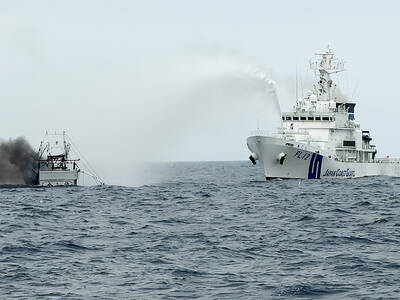
CREDIT-GRABBER: China said its coast guard rescued the crew of a fishing vessel that caught fire, who were actually rescued by a nearby Taiwanese boat and the CGA Maritime search and rescue operations do not have borders, and China should not use a shipwreck to infringe upon Taiwanese sovereignty, the Coast Guard Administration (CGA) said yesterday. The coast guard made the statement in response to the China Coast Guard (CCG) saying it saved a Taiwanese fishing boat. The Chuan Yu No. 6 (全漁6號), a fishing vessel registered in Keelung, on Thursday caught fire and sank in waters northeast of Diaoyutai Islands (釣魚台). The vessel left Keelung’s Badouzih Fishing Harbor (八斗子漁港) at 3:35pm on Sunday last week, with seven people on board — a 62-year-old Taiwanese captain surnamed Chang (張) and six

LEVERAGE: China did not ‘need to fire a shot’ to deny Taiwan airspace over Africa when it owns ‘half the continent’s debt,’ a US official said, calling it economic warfare The EU has raised concerns about overflight rights following the delay of President William Lai’s (賴清德) planned state visit to the Kingdom of Eswatini after three African nations denied overflight clearance for his charter at the last minute. Taiwanese allies Paraguay and Saint Kitts and Nevis, as well as several US lawmakers and the Inter-Parliamentary Alliance on China (IPAC) condemned China for allegedly pressuring the countries. Lai was scheduled to fly directly to Taiwan’s only African ally from yesterday to Sunday to celebrate the 40th anniversary of King Mswati III’s accession and his 58th birthday, but Seychelles, Mauritius and Madagascar suddenly revoked
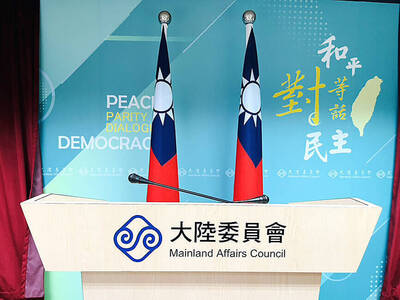
RISKY BUSINESS: The ‘incentives’ include initiatives that get suspended for no reason, creating uncertainty and resulting in considerable losses for Taiwanese, the MAC said China’s “incentives” failed to sway sentiment in Taiwan, as willingness to work in China hit a record low of 1.6 percent, a Ministry of Labor survey showed. The Directorate-General of Budget, Accounting and Statistics (DGBAS) also reported that the number of Taiwanese workers in China has nearly halved from a peak of 430,000 in 2012 to an estimated 231,000 in 2024. That marked a new low in the proportion of Taiwanese going abroad to work. The ministry’s annual survey on “Labor Life and Employment Status” includes questions respondents’ willingness to seek employment overseas. Willingness to work in China has steadily declined from
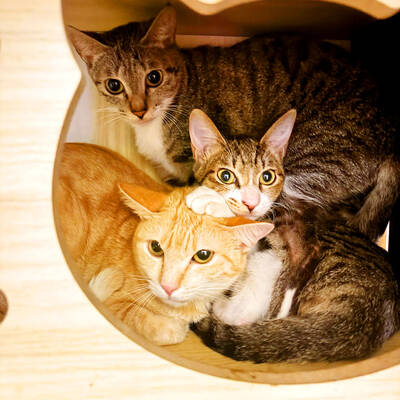
The number of pet cats in Taiwan surpassed that of pet dogs for the first time last year, reaching 1,742,033, a 32.8 percent increase from 2023, the Ministry of Agriculture said yesterday, citing a survey. By contrast, the number of pet dogs declined slightly by 1.2 percent over the same period to 1,462,528, the ministry said. Despite the shift, households with dogs still slightly outnumber those with cats by 1.2 percent. However, while the number of households with multiple dogs has remained relatively stable, households keeping more than two cats have increased, contributing to the overall rise in the feline population. The trend


 RSS
RSS