


North Korea reportedly fired two short-range missiles yesterday in a move set to heighten tensions after its latest nuclear weapons test drew global condemnation.
The UN Security Council held an emergency meeting to consider the options after Pyongyang’s test of a nuclear device on Monday, which some estimates said was almost as powerful as the atomic bombs that flattened Hiroshima and Nagasaki.
The Security Council called the test a “clear violation” of international law and immediately began working on a resolution that could impose new sanctions on the secretive North, which has now tested two nuclear bombs in three years.
“This resolution should include new sanctions in addition to those already adopted because such behavior should have a cost and a price to pay,” Deputy French Ambassador to the UN Jean-Pierre Lacroix said.
Following the UN condemnation, North Korea launched one ground-to-air missile and one ground-to-ship missile into the sea yesterday off its eastern coast near the city of Hamhung, South Korea’s Yonhap news agency reported.
“Intelligence authorities are analyzing the motives for the firing,” it quoted a South Korean government source as saying, adding that each missile had a range of 130km.
Last month, Pyongyang test-fired a long-range rocket that critics say was in fact a ballistic missile, and on Monday it test-fired three short-range missiles after the nuclear blast.
Russia estimated the force of Monday’s underground nuclear explosion at up to 20 kilotonnes, far more powerful than the October 2006 test.
North Korea said the latest test would “contribute to defending the sovereignty of the country and the nation and socialism, and ensuring peace and security on the Korean peninsula and the region.”
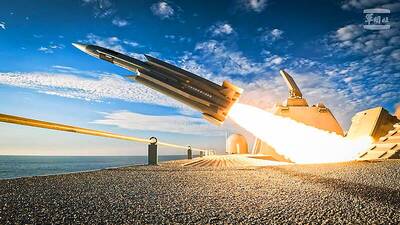
DETERRENCE: With 1,000 indigenous Hsiung Feng II and III missiles and 400 Harpoon missiles, the nation would boast the highest anti-ship missile density in the world With Taiwan wrapping up mass production of Hsiung Feng II and III missiles by December and an influx of Harpoon missiles from the US, Taiwan would have the highest density of anti-ship missiles in the world, a source said yesterday. Taiwan is to wrap up mass production of the indigenous anti-ship missiles by the end of year, as the Chungshan Institute of Science and Technology has been meeting production targets ahead of schedule, a defense official with knowledge of the matter said. Combined with the 400 Harpoon anti-ship missiles Taiwan expects to receive from the US by 2028, the nation would have
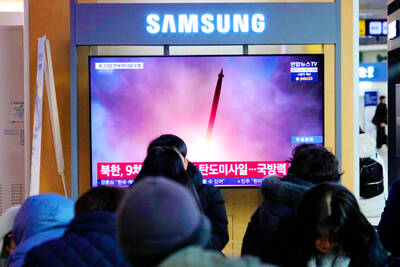
North Korea yesterday fired about 10 ballistic missiles to the sea toward Japan, the South Korean Joint Chiefs of Staff (JCS) said, days after Pyongyang warned of “terrible consequences” over ongoing South Korea-US military drills. Pyongyang recently dashed hopes of a diplomatic thaw with Seoul, Washington’s security ally, describing its latest peace efforts as a “clumsy, deceptive farce.” Seoul’s military detected “around 10 ballistic missiles launched from the Sunan area in North Korea toward the East Sea [Sea of Japan] at around 1:20pm,” JCS said in a statement, referring to South Korea’s name for the body of water. The missiles

‘UNWAVERING FRIENDSHIP’: A representative of a Japanese group that co-organized a memorial, said he hopes Japanese never forget Taiwan’s kindness President William Lai (賴清德) yesterday marked the 15th anniversary of the Tohoku earthquake and tsunami, urging continued cooperation between Taiwan and Japan on disaster prevention and humanitarian assistance. Lai wrote on social media that Taiwan and Japan have always helped each other in the aftermath of major disasters. The magnitude 9 earthquake struck northeastern Japan on March 11, 2011, triggering a massive tsunami that claimed more than 19,000 lives, according to data from Japanese authorities. Following the disaster, Taiwan donated more than US$240 million in aid, making it one of the largest contributors of financial assistance to Japan. In addition to cash donations and
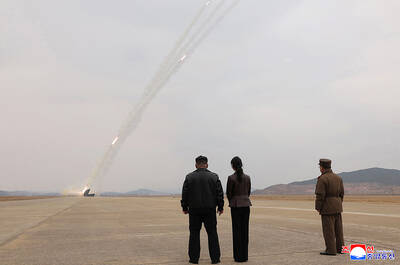
North Korea tested nuclear-capable rocket launchers, state media reported yesterday, a day after Seoul detected the launch of about 10 ballistic missiles. The test comes after South Korean and US forces launched their springtime military drills, due to run until Thursday. North Korean leader Kim Jong-un on Saturday oversaw the testing of the multiple rocket launcher system (MRLS), the Korean Central News Agency (KCNA) said. The test involved 12 600mm-caliber ultra-precision multiple rocket launchers and two artillery companies, it said. Kim said the drill gave Pyongyang’s enemies, within the 420km striking range, a sense of “uneasiness” and “a deep understanding


 RSS
RSS