

US President Barack Obama has revived Bush-era military tribunals for top Guantanamo Bay terror suspects that he once branded a “failure,” but proposed new rules on evidence and detainee rights.
Rights campaigners reacted angrily, warning the move would prolong the “injustice” of the “war on terror” camp, days after Obama dismayed some backers by opposing the release of photos of Iraq and Afghan prison abuse.
“This is the best way to protect our country, while upholding our deeply held values,” Obama said in a written statement on Friday, outlining his reasoning and a set of reforms to the military commissions.
“These reforms will begin to restore the commissions as a legitimate forum for prosecution, while bringing them in line with the rule of law,” Obama said.
Obama halted the Guantanamo tribunals pending a review after taking office in January, saying the system did not work, but did not rule out the use of a modified system in future.
Last year, however, Obama had called the military commissions “an enormous failure.”
The president said the Department of Defense would ask for extension of the suspension of military commissions to permit time for reforms.
Commissions were “appropriate for trying enemies who violate the laws of war, provided that they are properly structured and administered,” Obama said.
David Rivkin, a Washington lawyer who served in the administration of US president Ronald Reagan, told the New York Times the decision suggested that the Obama White House was coming to accept the George W. Bush administration’s thesis that terror suspects should be viewed as enemy fighters.
“I give them great credit for coming to their senses after looking at the dossiers,” Rivkin told the paper. However, several key amendments will be made to the commissions system.
Statements using CIA interrogation methods that are “cruel, inhumane and degrading” — since outlawed by Obama — will no longer be admitted as evidence.
The party that offers hearsay evidence must now prove its reliability. In Bush-era trials, the burden rested on the party that objected to it.
Furthermore, the accused will get greater latitude to choose his defense counsel and more protection if he refuses testify.
Military commission judges will now also be allowed to establish the jurisdiction of their own courts.
But the changes did not appease rights groups.
“The military commissions system is flawed beyond repair,” said Kenneth Roth, executive director of Human Rights Watch.
“By resurrecting this failed Bush administration idea, President Obama is backtracking dangerously on his reform agenda,” he said.
The American Civil Liberties Union (ACLU) bemoaned a “striking blow to due process and the rule of law.”
“President Obama would do well to remember his own infamous words during his presidential campaign: ‘You can’t put lipstick on a pig,’” ACLU executive director Anthony Romero said..
Despite the improvements, the commissions “do not address fundamental concerns about the flawed nature of such tribunals,” Human Rights Watch said.
“The very purpose of the commissions was to permit trials that lacked the full due process protections available to defendants in federal courts,” it said.
Obama spokesman Robert Gibbs denied the president was retooling a discredited Bush-era system.
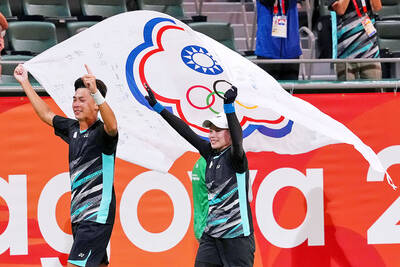
SOFT TENNIS: Yu Kai-wen and Huang Shih-yuan narrowly defeated their Japanese rivals to capture Taiwan’s first gold at the Asian Games in Nagoya Yu Kai-wen (余凱文) and Huang Shih-yuan (黃詩媛) won Taiwan’s first gold of this year’s Asian Games, defeating a Japanese duo in a nail-biter in the soft tennis mixed doubles final in Nagoya, Japan, while Johnny Sun (孫家閎) won silver in wushu and Shih Cheng-chung (石政中) won bronze in men’s kumite. Yu and Huang narrowly defeated Japan’s Toshiki Uematsu and Rena Temma 5-4 (2-4, 5-3, 4-2, 1-4, 1-4, 4-0, 1-4, 4-1, 7-5) to give Taiwan its first gold in soft tennis mixed doubles at an Asian Games since 2018. Sun secured Taiwan’s first wushu medal at this year’s game, with a combined score
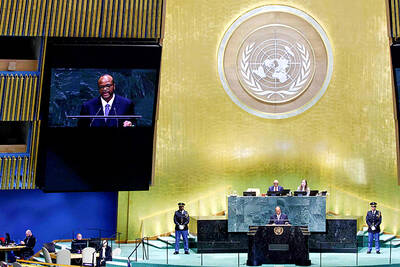
UNITY: Lai thanked the nations who spoke up for Taiwan, saying that democracies must stand together to face global authoritarian expansion Taiwan yesterday thanked eight European and Indo-Pacific countries for opposing unilateral changes to the “status quo” in the Taiwan Strait in a joint statement earlier this week, as well as three of Taiwan’s allies for speaking up for the nation’s participation in the UN at the body’s General Assembly in New York. Minister of Foreign Affairs Lin Chia-lung (林佳龍) welcomed the support and expressed his appreciation for the countries’ stance, the Ministry of Foreign Affairs said in a statement. Foreign ministers and senior representatives of Australia, France, Germany, Japan, New Zealand, Poland, South Korea and the UK issued a statement on Tuesday
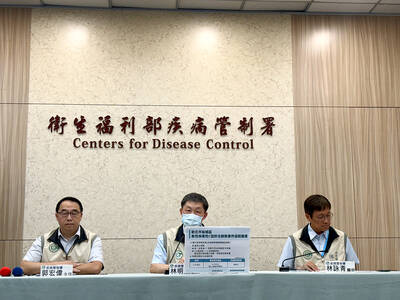
AT-RISK GROUPS: Of the accumulated 1,586 severe cases and 304 related deaths in this flu season, 65.8% were older people and 83.2% had chronic diseases, an official said The Centers for Disease Control (CDC) yesterday said that 165 severe flu cases and 30 flu-related deaths were reported last week, the highest weekly numbers in this flu season, and that cases might continue to increase, urging people to take precautions. Medical visits for flu-like illnesses increased by 1.4 percent to 141,374 last week, with 11.8 percent being emergency visits, showing that the seasonal flu is still in its epidemic period, CDC Epidemic Intelligence Center Director Guo Hung-wei (郭宏偉) said. From Tuesday last week to Monday, 165 severe flu cases and 30 flu-related deaths were confirmed, the highest weekly numbers
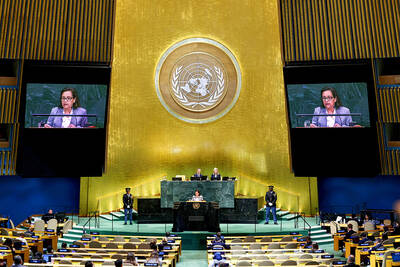
PLEA: How the UN addresses Taiwan’s security issue would be a test of its strength and relevance, Marshall Islands President Hilda Heine told the UN General Assembly Only Taiwan’s elected government can represent the people of Taiwan, Marshall Islands President Hilda Heine said on Friday at the UN General Assembly, calling for the nation’s inclusion in the UN. Taiwan and its 23 million people are a reality, and only its democratically elected government can represent it, Heine said when addressing the 81st session of the UN General Assembly General Debate. Appropriate ways must be found for Taiwan’s substantive participation in UN meetings if the UN is to be truly inclusive and effective in years to come, she said. UN member states would experience pressure to accept a


 RSS
RSS