

A wooden boat modeled on a 15th century Ming dynasty warship was hit by a cargo vessel and sank 30 nautical miles (55.5km) off Ilan County just one day before it was due to complete a historic roundtrip crossing of the Pacific.
The Princess Taiping departed Keelung last June and arrived in San Fransico last October via Japan and Hawaii. It was due to arrive in Keelung today.
Early yesterday, however, it collided with a vessel identified as the Liberian-registered Champion Express.
Although Princess Taiping broke up and sank, all 11 crewmembers were rescued in a joint effort by the military, the police and the Coast Guard Administration. They suffered minor injuries.
The 62-year-old captain, Nelson Liu (劉寧生), decided to build the boat in the style of Ming warship because he wanted to challenge the records set by Ming Admiral Zheng He (鄭和), who had sailed as far as the East African coast in the 15th century.
The Princess Taiping, 16m in length and 4.5m wide, was built with traditional materials and using traditional methods.
“I feel worse than the word ‘regret’ can describe, that I’ve completed 99 percent of the trip but failed to finish the last 1 percent,” Liu told reporters after being rescued. “I feel sorry for all the people who have supported me along the way.”
Liu said that he had communicated with the Champion Express before the accident, but it didn’t have enough time to avoid a collision.
The Coast Guard asked the Champion Express to sail to Taiwan for further investigation, but its captain refused and continued northward after finding out that no one had been killed in the incident. The Coast Guard could not force the Champion Express to sail to Taiwan because the collision occurred in international waters, but officials said that information on the collision would be provided to the Princess Taiping’s insurance company.
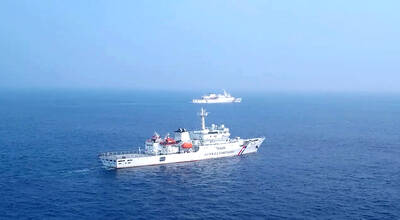
PATROL PARTNERS: The ‘Chiayi’ and the ‘Penghu’ departed for a two-day joint patrol of Palau’s exclusive economic zone, the CGA’s second diplomatic visit to the country The Coast Guard Administration (CGA) set a record for its southernmost deployment of a coast guard vessel as the vessels Chiayi and the Penghu reached Palau’s Pulo Anna Island on Saturday in a cooperative exercise between the two countries. The island, about 217 nautical miles (401km) southwest of Koror in the Palauan state of Sonsorol and 1,220 nautical miles from Taiwan’s southernmost point, Oluanpi (鵝鑾鼻), is the furthest south a CGA vessel has sailed. The two vessels are in Palau for the coast guard’s second diplomatic visit to the country. They docked at Malakal Harbor on Tuesday last week. The coast guard

The government is monitoring online rumors that a pneumonic plague outbreak has spread from Russia into China, and it might enhance quarantine measures, Premier Cho Jung-tai (卓榮泰) said yesterday. During a legislative meeting, Democratic Progressive Party Legislator Wang Ting-yu (王定宇) said that rumors had circulated that the disease had spread across several Chinese provinces. He asked Cho whether the government was prepared to prevent the disease spreading to Taiwan, given the volume of traffic between the two sides, and how concerned the government was about the alleged outbreak. The Ministry of Health and Welfare had implemented border quarantine measures after briefing the Executive
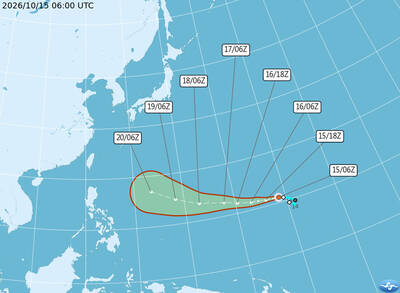
EAST OF GUAM: Tropical Storm Champi is forecast to strengthen into a typhoon, but its effect on Taiwan is uncertain due to the presence of a high-pressure system Tropical Storm Champi formed yesterday and has the potential to increase in strength, the Central Weather Administration (CWA) said yesterday. Forecasters are closely monitoring a Pacific high-pressure system that would dictate whether the storm turns north or moves toward Taiwan next week, the CWA said. The most likely scenario is that it turns northward after passing the Ryukyu Islands, CWA forecaster Cheng Chieh-jen (鄭傑仁) said. As of 8pm yesterday, Champi was east of Guam moving west-northwest at 20kph, CWA data showed. It had maximum sustained winds near the center of 72kph and gusts of up to 101kph, the data showed. If the Pacific high-pressure system
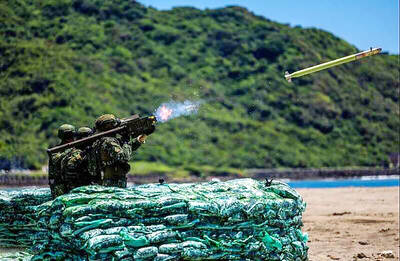
BATCH 1: The military has plans to assign the weapons to the army to defend Taiwan proper, as well as outlying islands and the navy for the Marine Corps, the official said Taiwan is to receive 500 Stinger missiles and 178 launchers from the US by the end of the year, the first batch under a planned two-stage acquisition totaling 2,621 missiles and 763 launchers, a defense official said yesterday on condition of anonymity. The portable missiles would play a vital role in the nation’s air defense capabilities, the source said. The army plans to deploy 2,235 missiles and 657 launchers to defend Taiwan proper and outlying islands, they said, citing military documents. The navy is allotted 295 missiles and 85 launchers to arm the Marine Corps and some surface vessels that lack air defense


 RSS
RSS