


President Ma Ying-jeou (馬英九) yesterday met Chinese Nationalist Party (KMT) Chairman Wu Poh-hsiung (吳伯雄) amid speculation that Ma intends to take over as party chairman.
Ma said a final decision would not be made until June.
However, he did not deny the possibility that he would run in the election for party chairman, scheduled to be held in July.
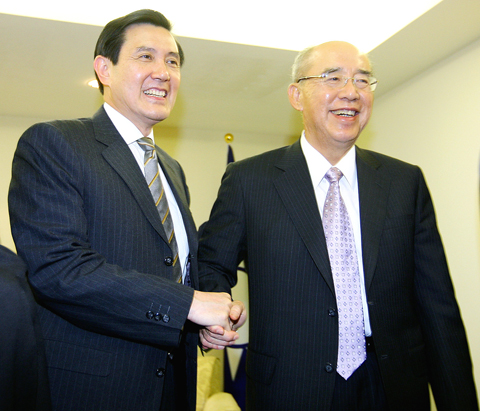
PHOTO: CNA
“I reached a consensus with Chairman Wu in September last year that we would not discuss the matter until June,” Ma said at KMT headquarters yesterday.
The pair held a private meeting for about 20 minutes.
“Please do not overinterpret the matter and allow us to focus our efforts on improving the economy,” Ma told reporters after the meeting.
Ma’s remarks were his first public comments about speculation that he was considering taking over the party chairmanship to better control party legislators and other party affairs.
The president commended Wu for his work in helping the KMT win the legislative election last year and pushing for cross-strait exchanges as party chairman, while rebutting allegations about tensions between the government and the party.
Wu said the list of candidates for the party chairman election would not be announced until June 15, when contenders are required to collect a registration form.
“If I choose to run in the election in June, it will not be for myself. Supporting Ma has been my goal for the past 10 years and the goal will not change,” Wu said.
Ma held an unscheduled press conference at KMT headquarters last Friday to thank party legislators for their cooperation in approving the government budget at the legislature.
There was speculation that Ma had visited Wu to show his intention of running in the election for party chairman.
Earlier yesterday, Presidential Office Spokesman Wang Yu-chi (王郁琦) said it was too early to tell whether Ma was interested in the position because the president’s top priority was to revive the economy.
“The president has not spent much time thinking about it,” Wang said. “He won’t have a clear answer until the middle of June.”
Wu’s term ends in August.
In a recent TV interview, Ma agreed that it would be easier for him to push policies through if he were party chairman. If the president doubles as party chairman, Ma said, the KMT would “of course” remain a democratic party.
Wang said that Ma was merely making an “objective analysis” and that it was not his “personal wish” to become party chairman.
Admitting that it had taken some time before the party and government managed to work well together, Wang said that communication between the Presidential Office, the Executive Yuan and the KMT was good.
Wang said Ma appreciated Wu’s handling of party affairs and that many bills recently cleared by the legislature had required the cooperation of both the party and the KMT caucus.
“The party and the government have worked closely and smoothly together,” Wang said. “There is no problem at all.”
Asked whether Ma would break his promise that he would not double as party chairman, Wang said he had never heard Ma make such a remark.
The Chinese-language China Times has reported that many “Ma troops” in the legislature supported the idea of Ma taking over the party. Wang, however, said there was no such thing as a “Ma troop,” only KMT legislators.
Legislative Speaker Wang Jin-pyng (王金平) confirmed that he had learned of the possibility of the president doubling as party chairman, but did not name his sources.
Wang said the president doubling as party chairman would make it easier for Ma to push through his policies.
“Therefore, I am in favor of having him take over,” Wang said, adding that having Ma serve as KMT chairman would benefit the country.
But Wang said he did not want to see a competition between Wu and Ma, adding that the candidate for the chairmanship should be determined through negotiation rather than an election.
Meanwhile, KMT caucus whip Lin Yi-shih (林益世) dismissed speculation that Ma had difficulty communicating with party officials.
Lin said that although it was not easy for the president and legislators to reach a consensus on legislative proposals, “The government’s administrative achievements over the past year prove that we communicated well.”
KMT Legislator Shuai Hua-ming (帥化民) said it would be meaningless for the president to have “one more title.”
He said Ma and Wu should consider whether changing party chairman ahead of the city and county chief elections later this year was a good idea.
KMT Legislator Lo Shu-lei (羅淑蕾) also voiced her opposition to Ma serving as party chairman, saying that the president should instead focus on the economy.
Democratic Progressive Party (DPP) Spokesman Cheng Wen-tsang (鄭文燦) told a press conference that Ma and the KMT must clear up the controversy involving the KMT’s three-in-one sale of the Broadcasting Corporation of China, China Television Co and the Central Motion Picture Corp to China Times Group subsidiary Jungli Investment Co before Ma could take over as KMT chairman.
The NT$9.3 billion (US$286.7 million) selloff took place while Ma was party chairman in 2005. The party’s sale of the Institute of Policy Research and Development building to Yuan Lih Construction Corp for NT$4.3 billion also took place when Ma was chairman.
“The judiciary would likely stop investigating these deals once Ma became chairman. As such, Ma, the party and the judiciary must first conclude the case,” Cheng said.
Cheng said the judiciary was to be blamed for the long delays in the investigations involving Ma and the KMT.
At a separate setting, DPP Chairperson Tsai Ing-wen (蔡英文) said that if Ma became KMT chairman, the country would risk moving from the current one-party politics to one-man politics, which would not be healthy for the government or the country.
ADDITIONAL REPORTING BY RICH CHANG
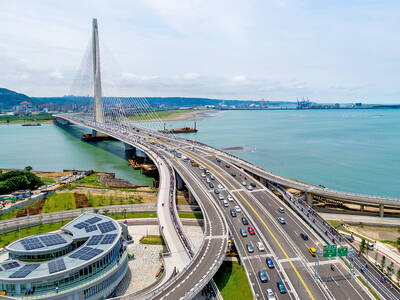
The Ministry of Transportation and Communications yesterday inaugurated the Danjiang Bridge across the Tamsui River in New Taipei City, saying that the structure would be an architectural icon and traffic artery for Taiwan. Feted as a major engineering achievement, the Danjiang Bridge is 920m long, 211m tall at the top of its pylon, and is the longest single-pylon asymmetric cable-stayed bridge in the world, the government’s Web site for the structure said. It was designed by late Iraqi-British architect Zaha Hadid. The structure, with a maximum deck of 70m, accommodates road and light rail traffic, and affords a 200m navigation channel for boats,
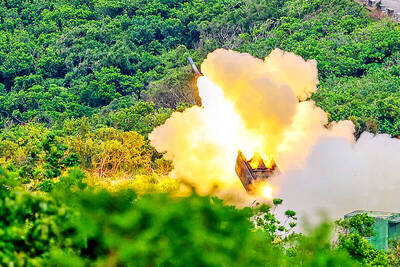
PRECISION STRIKES: The most significant reason to deploy HIMARS to outlying islands is to establish a ‘dead zone’ that the PLA would not dare enter, a source said A High Mobility Artillery Rocket System (HIMARS) would be deployed to Penghu County and Dongyin Island (東引) in Lienchiang County (Matsu) to force the Chinese military to retreat at least 100km from the coastline, a military source said yesterday. Taiwan has been procuring HIMARS and Army Tactical Missile Systems (ATACMS) from the US in batches. Once all batches have been delivered, Taiwan would possess 111 HIMARS units and 504 ATACMS, which have a range of 300km. Considering that “offense is the best defense,” the military plans to forward-deploy the systems to outlying islands such as Penghu and Dongyin so that
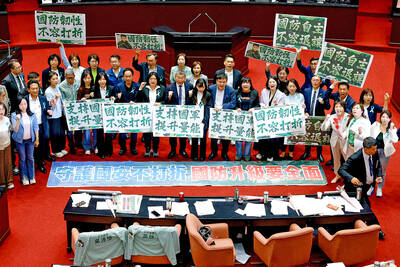
WHAT WAS ALL THAT FOR? Jaw Shaw-kong said that Cheng Li-wen had pushed for more drastic cuts and attacked him, just for the outcome to be nearly identical to his bill The legislature yesterday passed a supplementary budget bill to fund the purchase of separate packages of US military equipment, with the combined amount of spending capped at NT$780 billion (US$24.8 billion). The Chinese Nationalist Party (KMT) and Taiwan People’s Party (TPP) used their legislative majority to pass the bill, which runs until 2033 and has two main funding provisions. One was for NT$300 billion of arms sales already approved by the US for Taiwan on Dec. 17 last year, the other was for NT$480 billion for another arms package expected to be announced by Washington. The bill, which fell short of the NT$1.25
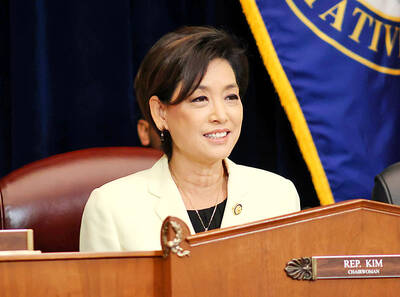
‘CLEAR MESSAGE’: The bill would set up an interagency ‘tiger team’ to review sanctions tools and other economic options to help deter any Chinese aggression toward Taiwan US Representative Young Kim has introduced a bill to deter Chinese aggression against Taiwan, calling for an interagency “tiger team” to preplan coordinated sanctions and economic measures in response to possible Chinese military or political action against Taiwan. “[Chinese President] Xi Jinping [習近平] has directed the People’s Liberation Army to be ready to invade Taiwan by 2027. China has a plan. America should have one too,” Kim said in a news release on Thursday last week. She introduced the “Deter PRC [People’s Republic of China] aggression against Taiwan act” to “ensure the US has a coordinated sanctions strategy ready should


 RSS
RSS