


Taiwan’s longest running criminal case, marred by evidence of grievous violations by police and an apparent lack of forensic evidence, was headed again for the Supreme Court after the Taiwan High Court in Taipei yesterday convicted three defendants in a kidnapping and murder case for the 11th time.
Chiou Ho-shun (邱和順) was sentenced to death for the 11th time, while Wu Shu-chen (吳淑貞) and Lin Kun-ming (林坤明) were sentenced to 11 and 17 years respectively in the latest retrial of the 22-year-old case.
After hearing the sentence in detention yesterday, a distraught Chiou shouted: “I didn’t do it. You didn’t investigate and sentenced me to death instead.”
The Supreme Court has rejected the High Court’s ruling every time in a case that lawyers say is riddled with problems, including the submission as evidence of recorded confessions, despite evidence that the defendants were tortured by police. In 1994, the Control Yuan impeached two prosecutors and 10 police officers involved in the case for using violence and threats when interrogating the suspects.
In addition, the body of the victim, Lu Cheng (陸正), was never found and the defense counsel says there is no forensic evidence against the defendants.
On Dec. 21, 1987, the 10-year-old Lu went missing after school in Hsinchu City. A kidnapper telephoned his home and demanded a ransom of NT$5 million (US$148,000). The family paid NT$1 million in ransom nine days later, but Lu was never released.
In September of the following year the police received a tip-off and arrested three juveniles, who confessed to the crime and to murdering an insurance agent, Ko Hung Yu-lan (柯洪玉蘭), in a separate case. They implicated Chiou Ho-shun (邱和順), who was in detention for another case at the time, as the head of the criminal ring.
In total, 12 suspects were charged. All but one confessed.
As more details surfaced, however, discrepancies emerged in the defendants’ accounts of the crime.
This included contradictions on where the kidnappers had disposed of the body.
Twenty-two years after the murder, Chiou, Lin and Wu are the only defendants still at court.
One defendant in the case, also sentenced to death, died of illness in prison, while the others, who received prison sentences, eventually dropped their right to appeal after losing hope of being acquitted.
Speaking at the High Court yesterday, Chiou’s lawyer Lee Sheng-hsiung (李勝雄) said justice had not been served.
“The defendant was threatened and tortured [during interrogation] and the entire case is riddled with holes,” he said.
Lu’s father Lu Chin-te (陸晉德), however, said he hoped the Supreme Court would finally approve the High Court’s sentence.
Lu said he believed the defendants were guilty and that he hoped the courts would put an end to the ordeal because he was “very tired, physically and emotionally.”
The Judicial Reform Foundation yesterday said that the court system had failed to give the defendants a speedy trial and that the courts had violated Article 156 of the Code of Criminal Procedure (刑事訴訟法) by accepting the defendant’s confessions as evidence.
Article 156 stipulates that confessions may be submitted as evidence if they are “not extracted by violence, threat, inducement, fraud, exhausting interrogation, unlawful detention or other improper means.”
Judicial Reform Foundation executive director Lin Feng-jeng (林峰正) said: “This case has dragged on for 22 years. The lack of efficiency is unacceptable.”
ADDITIONAL REPORTING BY CELIA LLOPIS-JEPSEN

‘NO SECURITY RISK’: The Railway Bureau reassured the public that the technicians’ activities were limited to technical guidance and did not involve sensitive systems The Railway Bureau yesterday said it had invited eight Chinese technicians to assist with an airport MRT construction project. The bureau issued the confirmation after an Internet user said Chinese nationals had entered the construction zone of Taiwan Taoyuan International Airport’s Terminal 3 project. They asked why “individuals from an enemy state” were allowed access to such a major national infrastructure project, which raised serious concerns over Taiwan’s industrial safety, sensitive systems and information security. The bureau’s Northern Region Engineering Branch Office said subcontractor Taiwan Handle Industrial Co (台灣手把工業) of the Taoyuan airport MRT’s “Contract No. CU05 Project A14 Station Civil, MEP &

A US uncrewed surface vessel (USV) encountered multiple Chinese warships during an autonomous transit of the Taiwan Strait, US defense company Seasats said in a statement on Wednesday. Seasats announced that a Lightfish USV had completed the first autonomous transit of the Taiwan Strait. Over five days, the USV traversed the entire length of the Strait while constantly monitoring surface vessel traffic, the company said. The Lightfish encountered multiple Chinese warships, one of which was a Chinese People’s Liberation Army Navy (PLAN) Type 056 corvette, it said. The Chinese vessels were operating “well within Taiwan’s exclusive economic zone without transmitting their identity via the
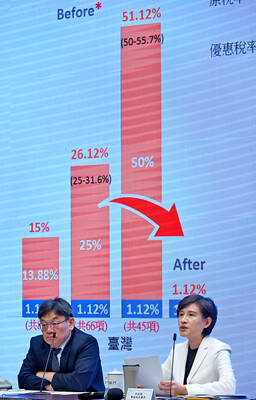
GREATER REACH? Auto parts and wood products would face tariffs of up to 15%, matching those targeting the EU, Japan and South Korea, Vice Premier said The US has announced that preferential tariff treatment for Taiwan’s non-semiconductor Section 232 goods would take effect retroactively from May 1, the Executive Yuan said yesterday. The US government yesterday posted a notice on the Federal Register’s public inspection Web site previewing tariff concessions for Taiwan under a memorandum of understanding (MOU) on Taiwan-US investment after two months of negotiations. The MOU signed on Jan. 15 stipulated three major preferential tariff arrangements: a 15 percent “reciprocal” tariff rate for Taiwan without stacking most-favored nation (MFN) rates; preferential Section 232 treatment for semiconductors and related products; and preferential Section 232 treatment for non-semiconductor

TIT-FOR-TAT: The US allegedly revoked the visa of a Chinese national working at Xinhua News Agency in the US in response to Beijing’s expulsion of Vivian Wang The Presidential Office yesterday condemned China for expelling a New York Times correspondent from Beijing following the newspaper’s interview with President William Lai (賴清德), saying the move highlighted Beijing’s suppression of press freedom and its threat to international news media. Taiwan has noted a series of recent incidents in which Beijing used similar tactics to “threaten and pressure international media outlets and journalists,” Presidential Office spokeswoman Karen Kuo (郭雅慧) said in a statement. “This concerns not only press freedom and freedom of expression, but also the safety of journalists, and Taiwan and relevant partners are paying close attention to the situation,” she


 RSS
RSS