


The legislature yesterday approved an amendment that will bring criminal charges against civil servants who fail to account for the origins of abnormal increases in their assets.
While the Chinese Nationalist Party (KMT) hailed the passage of the amendment to the Act for the Punishment of Corruption (貪污治罪條例) as a “sunshine” measure, the Democratic Progressive Party (DPP) lamented it as a “dark cloud.”
The amendment, proposed by the KMT caucus, stated that prosecutors can demand a defendant found guilty of corruption to declare the origins of his or her assets if the increase in the total assets of the defendant, his or her spouse and their minor children in the three years following the crime exceeds the total he or she declared under the Public Functionary Disclosure Act (公職人員財產申報法) in the latest year of declaration.
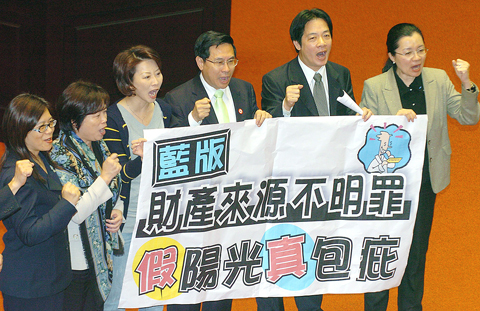
PHOTO: CHIEN JUNG-FONG, TAIPEI TIMES
The version was a revision to the initial version proposed by the Executive Yuan, the scope of which is restricted to civil servants under investigation for suspected corruption.
If a defendant refuses to offer an explanation or if the explanation proves false, that would result in a prison sentence of up to three years, or a fine of no more than the value of the assets of undeclared origin, or both, the amendment states. Failure to explain the origins of assets would lead to a presumption of corruption, under which the property could be seized or confiscated, while officials could be asked to pay compensation.
“The passage of the amendment proves the KMT’s determination to fight corruption. We have stepped out to establish a sunshine system for politics,” KMT Legislator Yang Chiung-ying (楊瓊瓔) said.
A stricter DPP version, which was voted down, would have applied retroactively to all civil servants who are required to declare assets under the Public Functionary Disclosure Act and not just defendants found guilty of corruption.
“The KMT version that passed does not help clean politics. The KMT lied to Taiwanese people. It is redundant to demand that defendants guilty of corruption account for their assets. Of course they have to explain that under judicial investigation. The DPP’s version, on the other hand, treated all civil servants equally without discrimination,” DPP Legislator Chai Trong-rong (蔡同榮) said.
Chai said that the phenomenon of prosecutors only probing cases involving pan-green politicians and not pan-blue politicians would only get worse without the retroactive clause.
President Ma Ying-jeou (馬英九) has advocated punishing corruption and criminal sources of property since 2005 when he was running for KMT chairman, which earned him a reputation for integrity that helped him win the presidency last year, but the version of the amendment that passed proved that Ma’s appeal was nothing but empty words, DPP Legislator William Lai (賴清德) said.
“The sunshine did not come. It is now even further away. Instead, what is approaching is a dark cloud … Reform is too far to reach,” Lai said.
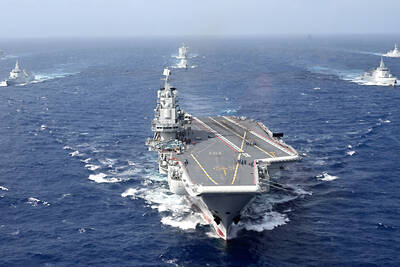
PROVOCATIVE: Chinese Deputy Ambassador to the UN Sun Lei accused Japan of sending military vessels to deliberately provoke tensions in the Taiwan Strait China denounced remarks by Japan and the EU about the South China Sea at a UN Security Council meeting on Monday, and accused Tokyo of provocative behavior in the Taiwan Strait and planning military expansion. Ayano Kunimitsu, a Japanese vice foreign minister, told the Council meeting on maritime security that Tokyo was seriously concerned about the situation in the East China and South China seas, and reiterated Japan’s opposition to any attempt to change the “status quo” by force, and obstruction of freedom of navigation and overflight. Stavros Lambrinidis, head of the EU delegation to the UN, also highlighted South China Sea
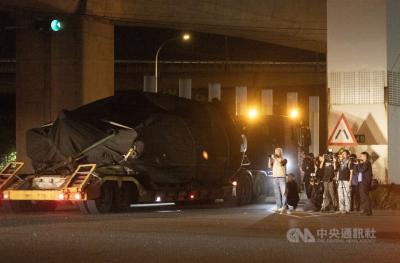
The final batch of 28 M1A2T Abrams tanks purchased from the US arrived at Taipei Port last night and were transported to the Armor Training Command in Hsinchu County’s Hukou Township (湖口), completing the military’s multi-year procurement of 108 of the tanks. Starting at 12:10am today, reporters observed more than a dozen civilian flatbed trailers departing from Taipei Port, each carrying an M1A2T tank covered with black waterproof tarps. Escorted by military vehicles, the convoy traveled via the West Coast Expressway to the Armor Training Command, with police implementing traffic control. The army operates about 1,000 tanks, including CM-11 Brave Tiger
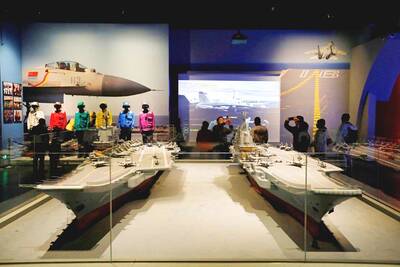
China on Wednesday teased in a video an aircraft carrier that could be its fourth, and the first using nuclear power, while making an allusion to Taiwan and vowing to further build up its islands, as it looks to boost maritime power, secure resources and bolster territorial claims. The video, issued on the eve of the 77th founding anniversary of the Chinese People’s Liberation Army Navy, featured fictional officers with names that are homophones of three commissioned aircraft carriers, the Liaoning (遼寧), Shandong (山東) and Fujian (福建). Titled Into the Deep, it showed a 19-year-old named “Hejian” (何劍) joining the group, sparking
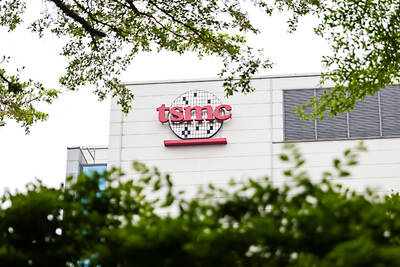
Taiwan Semiconductor Manufacturing Co (TSMC, 台積電), the world’s largest contract chipmaker, said it expects its 2-nanometer (2nm) chip capacity to grow at a compound annual rate of 70 percent from this year to 2028. The projection comes as five fabs begin volume production of 2-nanometer chips this year — two in Hsinchu and three in Kaohsiung — TSMC senior vice president and deputy cochief operating officer Cliff Hou (侯永清) said at the company’s annual technology symposium in Silicon Valley, California, last week. Output in the first year of 2-nanometer production, which began in the fourth quarter of last year, is expected to


 RSS
RSS