


North Korea has scheduled a satellite launch for early next month, South Korean officials said yesterday, as Washington and Seoul told Pyongyang to scrap what they see as a disguised missile test.
Pyongyang has informed the International Maritime Organization (IMO) that it will fire a rocket to launch the satellite between April 4 and April 8, an official at Seoul’s maritime affairs ministry said.
Citing information from the IMO, the official said the North had told the UN regulatory agency of two risk areas, one in the Pacific Ocean and the other in the Sea of Japan (East Sea).
“The IMO is currently working on an official safety notice, which it will soon hand out to its member countries,” the official said on condition of anonymity.
Earlier yesterday, the North said it had provided “necessary information for the safe navigation of planes and ships” as part of preparations for launching “an experimental communications satellite.”
South Korean and US officials believe the real intention is to test a Taepodong-2 missile that could theoretically reach Alaska.
The nuclear-armed North has asserted its right to peaceful space research and says any attempt to shoot down its rocket will be seen as an act of war.
There have been reports for weeks that the North is preparing to test-fire the Taepodong-2 from a base at Musudan-ri on the northeast coast.
The missile failed after 40 seconds when first launched in July 2006, and the UN Security Council passed a resolution calling for a halt to such tests.
Three months after that, the North staged an atomic weapons test. It is unclear whether it has the capability to manufacture a nuclear warhead.
Seoul’s Yonhap news agency said a missile has not been set upright at Musudan-ri, but launch preparations could be completed within two weeks.
Tensions are already high after Pyongyang ordered its military on combat alert and banned South Korean airlines from its airspace. It was protesting an ongoing US-South Korean military exercise, which it sees as a rehearsal for invasion.
North Korea also announced it had joined an international treaty and convention on the peaceful use of space. South Korea’s foreign ministry confirmed that Pyongyang this month sent relevant documents to Russia’s foreign ministry and to the UN.
“The North’s accession to the treaty is aimed at paving the way for claiming that the launch, which may come in the future, is to put a satellite in orbit,” spokesman Moon Tae-young said. “Irrespective of those moves, such a launch would be a breach of UN Resolution 1718.”
Japan’s government said it “would not tolerate” any North Korean act that raises regional tensions.
Russia’s chief nuclear negotiator, Alexei Borodavkin, urged restraint.
“There should be restraint, there should be an evading of any actions which could undermine security and stability on the peninsula,” he told reporters after talks with his Seoul counterpart, Wi Sung-lac.
Asked whether any launch would violate a UN resolution, Borodavkin replied: “Let us wait and see what will be the real technical parameters of this launch.”
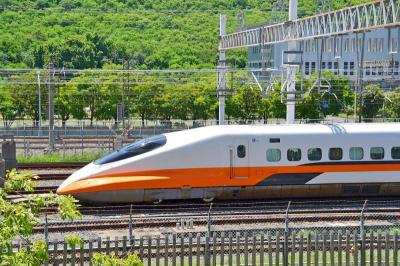
A signaling system malfunction disrupted high-speed rail (HSR) services beginning at 8am today, with trains temporarily reduced to three northbound and three southbound trains per hour as authorities conduct inspections. The malfunction occurred on a section of track in Miaoli County during pre-operation checks early this morning, forcing northbound and southbound trains to use a single track, the HSR operator said. The regular schedule has been replaced with three hourly trains offering only nonreserved seating in each direction, stopping at every station, it said, adding that business class cars would still have reserved seating. Departures from terminal stations are scheduled at the top

Taiwan is still in the process of assessing the possibility of recruiting workers from Eswatini, the Ministry of Foreign Affairs said yesterday, adding that its goal is to help Eswatini upgrade its vocational training centers. If there are plans to recruit workers from Eswatini, safeguarding national security, protecting public health and ensuring the employment rights of Taiwanese would be prerequisites, Department of West Asian and African Affairs Director-General Yen Chia-liang (顏嘉良) told a news conference. Key considerations would also include filling labor shortages in specific industries, and fostering bilateral professional and technical exchanges, he said. Yen was asked about the progress of labor
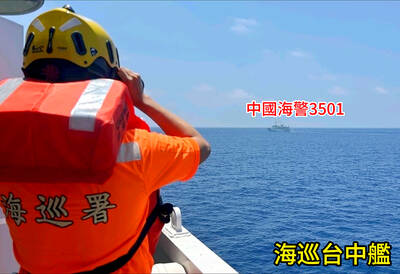
VERBOSE VESSELS: A CGA cutter and a China Coast Guard exchanged verbal barbs for more than a day in Taiwanese-controlled waters before the Chinese vessel left The Taiwanese and Chinese coast guards had a standoff near the strategically located Pratas Islands (Dongsha Islands, 東沙群島) in the north of the South China Sea, the Coast Guard Administration (CGA) said yesterday. The two sides engaged in intense radio exchanges over sovereignty claims during the 33-hour standoff. China Coast Guard vessel 3501 eventually left the restricted waters, 26.6 nautical miles (49.2km) west of the Pratas Islands, at 5pm yesterday, the CGA said. Lying approximately between southern Taiwan and Hong Kong, the Taiwan-controlled Pratas are seen by some security experts as vulnerable to Chinese attack due to their distance — more than

A US uncrewed surface vessel (USV) encountered multiple Chinese warships during an autonomous transit of the Taiwan Strait, US defense company Seasats said in a statement on Wednesday. Seasats announced that a Lightfish USV had completed the first autonomous transit of the Taiwan Strait. Over five days, the USV traversed the entire length of the Strait while constantly monitoring surface vessel traffic, the company said. The Lightfish encountered multiple Chinese warships, one of which was a Chinese People’s Liberation Army Navy (PLAN) Type 056 corvette, it said. The Chinese vessels were operating “well within Taiwan’s exclusive economic zone without transmitting their identity via the


 RSS
RSS