


Kidnappers threatened on Friday to kill an American employee of the UN within 72 hours and issued a grainy video of the blindfolded captive saying he was “sick and in trouble.”
A letter accompanying the video delivered to a Pakistani news agency said the hostage, John Solecki, would be killed unless authorities released 141 women it said were being held in Pakistan.
The video and the demands indicated that Solecki, the head of the UN refugee agency in Quetta, a city near the Afghan border, was alive and that his captors wanted to negotiate.
Solecki, who appeared blindfolded and with a shawl draped over his shoulders in the 20 second clip, said his message was addressed to the UN.
“I am not feeling well. I am sick and in trouble. Please help solve the problem soon so that I can gain my release,” he said.
The kidnappers have identified themselves as the Baluchistan Liberation United Front, suggesting a link to local separatists who have waged a long insurgency against Pakistan’s government, rather than to the Taliban or al-Qaeda, which are fighting US forces in Afghanistan.
Still, the death threat heightened fears for Solecki’s safety, coming just a week after Taliban militants apparently beheaded a Polish geologist abducted in another border area of Pakistan after the government failed to respond to demands for a prisoner release.
The Pole’s slaying, if confirmed, would be the first killing of a Western hostage in Pakistan since US journalist Daniel Pearl was beheaded in 2002.
Gunmen seized Solecki on Feb. 2, after shooting his driver to death as they drove to work in Quetta.
Days later, the previously unknown Baluchistan Liberation United Front claimed responsibility for the kidnapping in a telephone call to the Quetta office of Online International News Network, a Pakistan-based news agency.
Online said it received an anonymous telephone call on Friday telling it to collect a parcel from the post office, in which it found a memory card from a mobile phone containing the video of Solecki as well as the letter.
It supplied a copy of the video to Associated Press Television News and allowed an AP reporter to see the letter.
The letter demanded the release of 141 women from Pakistani custody and said the group would issue another list of hundreds of alleged male prisoners.
“We will issue this list very soon. If our demands are not met, we will murder John Solecki,” it said.
The commander of a government paramilitary unit in Quetta dismissed the claim of female prisoners as fiction.
“Who are these 141 women? Who knows who they are? This is just attention-seeking. This is just terrorism,” Major General Salim Nawaz told the Aaj television network.
Nawaz said that “powers who want to destabilize Pakistan” were manipulating ethnic Baluch separatist groups — language usually used by Pakistani officials to mean archrival India.
Maki Shinohara, a spokeswoman for the UN, said it had not been able to establish contact with the kidnappers. She said officials were scrambling to work out how to respond to the threat and the demands.
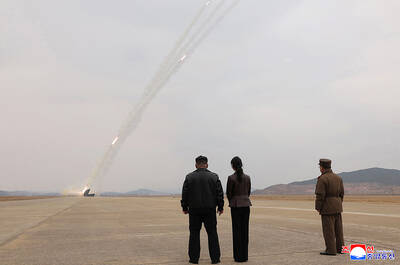
North Korea tested nuclear-capable rocket launchers, state media reported yesterday, a day after Seoul detected the launch of about 10 ballistic missiles. The test comes after South Korean and US forces launched their springtime military drills, due to run until Thursday. North Korean leader Kim Jong-un on Saturday oversaw the testing of the multiple rocket launcher system (MRLS), the Korean Central News Agency (KCNA) said. The test involved 12 600mm-caliber ultra-precision multiple rocket launchers and two artillery companies, it said. Kim said the drill gave Pyongyang’s enemies, within the 420km striking range, a sense of “uneasiness” and “a deep understanding

RECOGNITION: Former Fijian prime minister Mahendra Chaudhry said that Taiwan’s New Southbound Policy serves as a stabilizing force in the Indo-Pacific region Taiwan can lead the unification of the Chinese people, Nobel Peace Prize laureate and former Polish president Lech Walesa said in Taipei yesterday, adding that as the world order is changing, peaceful discussion would find good solutions, and that the use of force and coercion would always fail. Walesa made the remarks during his keynote address at a luncheon of the Yushan Forum in Taipei, titled “Indo-Pacific Partnership Prospects: Taiwan’s Values, Technology and Resilience,” organized by the Taiwan-Asia Exchange Foundation with the Ministry of Foreign Affairs. Walesa said that he had been at the forefront of a big peaceful revolution and “if

North Korea yesterday fired about 10 ballistic missiles to the sea toward Japan, the South Korean Joint Chiefs of Staff (JCS) said, days after Pyongyang warned of “terrible consequences” over ongoing South Korea-US military drills. Pyongyang recently dashed hopes of a diplomatic thaw with Seoul, Washington’s security ally, describing its latest peace efforts as a “clumsy, deceptive farce.” Seoul’s military detected “around 10 ballistic missiles launched from the Sunan area in North Korea toward the East Sea [Sea of Japan] at around 1:20pm,” JCS said in a statement, referring to South Korea’s name for the body of water. The missiles

‘UNWAVERING FRIENDSHIP’: A representative of a Japanese group that co-organized a memorial, said he hopes Japanese never forget Taiwan’s kindness President William Lai (賴清德) yesterday marked the 15th anniversary of the Tohoku earthquake and tsunami, urging continued cooperation between Taiwan and Japan on disaster prevention and humanitarian assistance. Lai wrote on social media that Taiwan and Japan have always helped each other in the aftermath of major disasters. The magnitude 9 earthquake struck northeastern Japan on March 11, 2011, triggering a massive tsunami that claimed more than 19,000 lives, according to data from Japanese authorities. Following the disaster, Taiwan donated more than US$240 million in aid, making it one of the largest contributors of financial assistance to Japan. In addition to cash donations and


 RSS
RSS