


Five protesters were arrested on Sunday ahead of talks between Chinese Premier Wen Jiabao (溫家寶) and British Prime Minister Gordon Brown in London yesterday. The meeting marked the end of the Chinese leader’s tour to strengthen European ties.
Wen’s first trip to Britain since 2006 concluded a high-profile visit to Europe that included Germany, Spain, the EU headquarters in Brussels and the World Economic Forum in Davos, Switzerland.
One of his aims was to mend relations strained over the Dalai Lama, Tibet’s exiled spiritual leader whom Beijing accuses of seeking independence from Chinese rule for the Himalayan region, as well as to boost trade ties.
Brown has stressed the importance of Britain’s relationship with China, although human rights activists have warned against getting too close.
PROTESTERS
Pro-Tibet protesters staged a noisy demonstration outside the Chinese embassy on Sunday as Wen visited, and five people were arrested as they leapt over security barriers and tried to run toward the building.
A rival pro-China demonstration of about 100 people faced them, while further pro-Tibet protests were planned yesterday.
Among the items being discussed by Brown and Wen yesterday was the G20 meeting in London.
The April summit will be dominated by the financial crisis and Brown has argued that Beijing’s increasing power — it is the third-biggest economy in the world — makes it a “vital” partner in restoring economic stability.
In a strategy document published last week, his government made Britain’s relationship with China a top priority, saying its rise was “one of the most significant developments of our time.”
Brown has argued for an international approach to the financial crisis, and in Davos, Wen also backed the British leader’s call for greater cooperation and against a retreat into protectionism in response to the downturn.
WESTERN PROBLEMS
But Wen was outspoken about the role of Western countries in the crisis, blaming “inappropriate macroeconomic policies of some economies” and “prolonged low savings and high consumption” in a lightly veiled attack on Washington.
He also said rich countries must “assume their responsibilities” and minimize the impact of the crisis on developing countries, saying it had “fully exposed the deficiencies in the existing international financial system.”
In an interview with the Financial Times yesterday, he played down hopes in London that China would help bolster global institutions to meet the challenge.
Brown has pressed China and the Gulf states to contribute more to global bodies like the IMF, but Wen signaled that China was still growing and needed its reserves for itself.
He used a similar argument following pressure on signing up to mandatory cuts in carbon emissions when a new global deal is agreed to follow the Kyoto Protocol on climate change.
While China would continue to set itself targets to improve energy efficiency, it would be difficult for a developing country “to undertake quantified quotas to reduce our emissions,” the premier said.
He met the leader of the main opposition Conservatives, David Cameron, on Sunday, discussing topics including the economic crisis and combating climate change.
Cameron also raised human rights issues and stressed the need for “greater participation” in China’s political process, his office said.

NO-LIMITS PARTNERSHIP: ‘The bottom line’ is that if the US were to have a conflict with China or Russia it would likely open up a second front with the other, a US senator said Beijing and Moscow could cooperate in a conflict over Taiwan, the top US intelligence chief told the US Senate this week. “We see China and Russia, for the first time, exercising together in relation to Taiwan and recognizing that this is a place where China definitely wants Russia to be working with them, and we see no reason why they wouldn’t,” US Director of National Intelligence Avril Haines told a US Senate Committee on Armed Services hearing on Thursday. US Senator Mike Rounds asked Haines about such a potential scenario. He also asked US Defense Intelligence Agency Director Lieutenant General Jeffrey Kruse
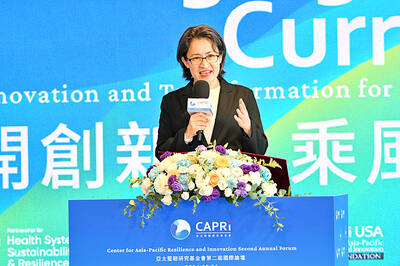
INSPIRING: Taiwan has been a model in the Asia-Pacific region with its democratic transition, free and fair elections and open society, the vice president-elect said Taiwan can play a leadership role in the Asia-Pacific region, vice president-elect Hsiao Bi-khim (蕭美琴) told a forum in Taipei yesterday, highlighting the nation’s resilience in the face of geopolitical challenges. “Not only can Taiwan help, but Taiwan can lead ... not only can Taiwan play a leadership role, but Taiwan’s leadership is important to the world,” Hsiao told the annual forum hosted by the Center for Asia-Pacific Resilience and Innovation think tank. Hsiao thanked Taiwan’s international friends for their long-term support, citing the example of US President Joe Biden last month signing into law a bill to provide aid to Taiwan,
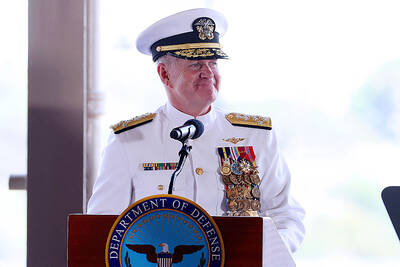
China’s intrusive and territorial claims in the Indo-Pacific region are “illegal, coercive, aggressive and deceptive,” new US Indo-Pacific Commander Admiral Samuel Paparo said on Friday, adding that he would continue working with allies and partners to keep the area free and open. Paparo made the remarks at a change-of-command ceremony at Joint Base Pearl Harbor-Hickam in Hawaii, where he took over the command from Admiral John Aquilino. “Our world faces a complex problem set in the troubling actions of the People’s Republic of China [PRC] and its rapid buildup of forces. We must be ready to answer the PRC’s increasingly intrusive and
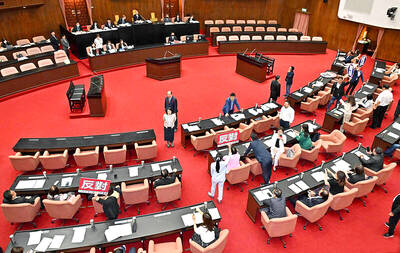
STATE OF THE NATION: The legislature should invite the president to deliver an address every year, the TPP said, adding that Lai should also have to answer legislators’ questions The Chinese Nationalist Party (KMT) yesterday proposed inviting president-elect William Lai (賴清德) to make a historic first state of the nation address at the legislature following his inauguration on May 20. Lai is expected to face many domestic and international challenges, and should clarify his intended policies with the public’s representatives, KMT caucus secretary-general Hung Meng-kai (洪孟楷) said when making the proposal at a meeting of the legislature’s Procedure Committee. The committee voted to add the item to the agenda for Friday, along with another similar proposal put forward by the Taiwan People’s Party (TPP). The invitation is in line with Article 15-2


 RSS
RSS