


President Ma Ying-jeou (馬英九) said yesterday he hoped the economy would improve this year, but acknowledged that it would not be easy.
“It will take a lot of effort and maybe some luck, because much of it cannot be changed by our efforts alone,” Ma said while speaking at the Presidential Office’s Lunar New Year greetings ceremony yesterday morning.
Ma said the public might have the impression that he did not jump to the “front line” in responding to public concerns, but that was because his constitutional duty is to set policy for cross-strait relations, national defense and foreign affairs.
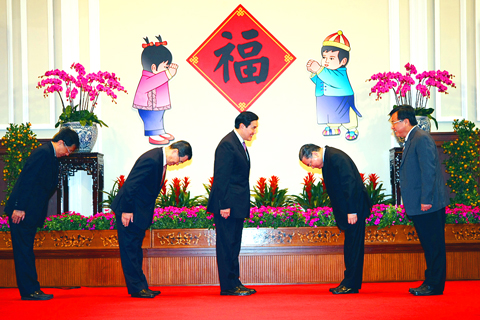
PHOTO: CNA
There is no such thing as a “front line” or “second line,” Ma said, because he and Vice President Vincent Siew (蕭萬長) participated in the decision-making process for major government policies, such as providing 100 percent guarantees on bank deposits, issuing consumer vouchers, implementing economic stimulus measures and creating jobs.
Ma also lauded his policies on national defense, cross-strait affairs and other foreign affairs, saying his approach had yielded positive effects and received “universal welcome” from the international community.
Ma said Beijing’s gift of two giant pandas demonstrated the improved atmosphere in the Taiwan Strait. What mattered was not that the public had the opportunity to see the rare animals, he said, but that Taiwan had reached the global standard in conserving endangered species.
“First, the Convention on International Trade in Endangered Species [CITES] was not against the matter,” Ma said. “And second, both sides of the Taiwan Strait look at the pandas from a humane point of view, rather than from a political viewpoint.”
The secretariat of CITES considered the importation of the pandas from China as “domestic trade” and as such did not need to be reported to CITES.
Ma said that eased cross-strait tensions not only took a lot of pressure off his administration, but also “pushed forward government policies in the right direction.”
“There won’t be any unexpected or strange situation,” he said. “That is the normal thing that a normal country and a normal government should do.”
Ma said that he expected to see a challenge on the economic front, but that a clean, efficient, proactive and friendly government would help resolve the problem.
Later, speaking at the Chinese Nationalist Party (KMT) Lunar New Year greeting ceremony, Ma said the direction of government policy to combat the global financial crisis was correct and that the Executive Yuan deserved recognition for formulating good policies, including the consumer vouchers.
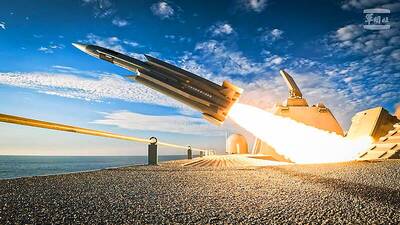
DETERRENCE: With 1,000 indigenous Hsiung Feng II and III missiles and 400 Harpoon missiles, the nation would boast the highest anti-ship missile density in the world With Taiwan wrapping up mass production of Hsiung Feng II and III missiles by December and an influx of Harpoon missiles from the US, Taiwan would have the highest density of anti-ship missiles in the world, a source said yesterday. Taiwan is to wrap up mass production of the indigenous anti-ship missiles by the end of year, as the Chungshan Institute of Science and Technology has been meeting production targets ahead of schedule, a defense official with knowledge of the matter said. Combined with the 400 Harpoon anti-ship missiles Taiwan expects to receive from the US by 2028, the nation would have
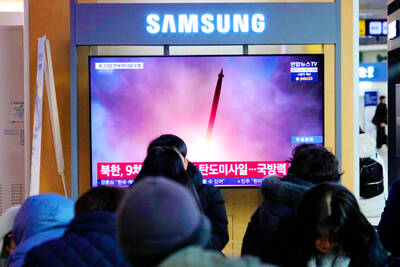
North Korea yesterday fired about 10 ballistic missiles to the sea toward Japan, the South Korean Joint Chiefs of Staff (JCS) said, days after Pyongyang warned of “terrible consequences” over ongoing South Korea-US military drills. Pyongyang recently dashed hopes of a diplomatic thaw with Seoul, Washington’s security ally, describing its latest peace efforts as a “clumsy, deceptive farce.” Seoul’s military detected “around 10 ballistic missiles launched from the Sunan area in North Korea toward the East Sea [Sea of Japan] at around 1:20pm,” JCS said in a statement, referring to South Korea’s name for the body of water. The missiles

‘UNWAVERING FRIENDSHIP’: A representative of a Japanese group that co-organized a memorial, said he hopes Japanese never forget Taiwan’s kindness President William Lai (賴清德) yesterday marked the 15th anniversary of the Tohoku earthquake and tsunami, urging continued cooperation between Taiwan and Japan on disaster prevention and humanitarian assistance. Lai wrote on social media that Taiwan and Japan have always helped each other in the aftermath of major disasters. The magnitude 9 earthquake struck northeastern Japan on March 11, 2011, triggering a massive tsunami that claimed more than 19,000 lives, according to data from Japanese authorities. Following the disaster, Taiwan donated more than US$240 million in aid, making it one of the largest contributors of financial assistance to Japan. In addition to cash donations and
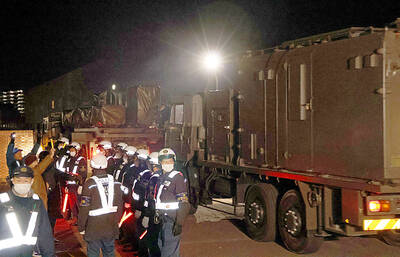
CLOSER TO CHINA: The upgraded Type-12 missile has a range of about 1,000km, compared with the original model’s range of 200km, and can reach mainland China Japan is preparing to deploy its first batch of domestically developed long-range missiles, with their launchers arriving at an army camp yesterday, as the country accelerates its offensive capability in response to rising challenges in the region. The upgraded Type-12 land-to-ship missiles are to be deployed at Camp Kengun in Japan’s southwestern prefecture of Kumamoto by the end of this month, completing the process of deployment, Japanese Chief Cabinet Secretary Minoru Kihara said without giving details. Army vehicles carrying the launchers and other equipment arrived past midnight in a highly secretive mission criticized by residents. Dozens of people stood outside of the


 RSS
RSS