


US Secretary of State Hillary Clinton is expected to visit Japan and China on her first foreign trip in her new position, with a senior congressional source saying Clinton would be certain to discuss Taiwan with the Chinese leadership.
The source said the discussions would probably lead, on Clinton’s return, to an informal State Department review of US-Taiwan relations.
Last week, professor Robert Sutter of Georgetown University’s School of Foreign Service said the US should reassess its Taiwan policy and consider what it would do if Taiwan chose to align itself with China.
Sutter said that while President Ma Ying-jeou’s (馬英九) policies had won some progress in cross-strait economic and trade development, there had been no concessions of substance from China on its military, diplomatic or economic policies.
US State Department officials declined to confirm Clinton’s trip to China, but officials said in private that she was “leaning” toward visiting Asia at some point before US President Barack Obama meets Chinese President Hu Jintao (胡錦濤) at a London summit in April.
The New York Times reported over the weekend on speculation that Clinton would visit Japan and China and possibly South Korea. The trip would allow her to check in with Japan, a staunch ally, and take stock of an economic rival, China, the paper said.
The paper quoted an experienced State Department hand as saying: “Besides, if no one of her stature shows up in Tokyo by April or so, the Japanese will wonder what is wrong with the relationship.”
“A secretary of state’s first foreign trip is always an event — steeped in symbolism and parsed for clues about how the new boss will conduct diplomacy,” the paper wrote.
“Mrs Clinton’s celebrity lends the maiden voyage added glitter, but also the burden of great expectations,” it said.
Obama and Hu spoke on Friday morning, US time, in their first telephone call since the US leader came to power.
“President Obama told President Hu that he looked forward to meeting with him and to early contacts and exchanges between senior officials of our two countries,” White House spokesman Robert Gibbs said.
Gibbs would not say whether Taiwan had been discussed in the telephone conversation, but China’s Xinhua new agency said the two leaders had agreed to meet at the G20 economic summit in London in April.
It also said the leaders exchanged invitations to visit each other’s country.
Clinton said earlier that she would pursue a “comprehensive” dialogue with China that went beyond the economic focus of the administration of former US president George W. Bush.
The senior congressional source said Clinton had made it clear to her staff that on foreign visits she would only deal with substantive issues and issues in which she could make a difference.
“That being the case, it would be impossible for her to visit China without discussing Taiwan,” the source said.
He said that last month China issued a 105-page White Paper on national defense stating that “the United States continues to sell arms to Taiwan,” which leads to “serious harm to Sino-US relations as well as peace and stability across the Taiwan Straits.”
David Rothkopf, an academic at the Carnegie Endowment for International Peace and a member of the Council on Foreign Relations, said: “The critical relationship that requires the most attention right now that has gotten the least is that with China.”
“They are a critical strategic partner in every area of international priority for the US. Because they are also a potential rival, we need a dialogue open and constant enough to manage the relationship through those times when there are, as there inevitably will be, disagreements,” Rothkopf said.
“The foundation for that relationship needs to be laid in an early high-level visit by her, followed by an early state visit by President Obama,” he said.

‘NO SECURITY RISK’: The Railway Bureau reassured the public that the technicians’ activities were limited to technical guidance and did not involve sensitive systems The Railway Bureau yesterday said it had invited eight Chinese technicians to assist with an airport MRT construction project. The bureau issued the confirmation after an Internet user said Chinese nationals had entered the construction zone of Taiwan Taoyuan International Airport’s Terminal 3 project. They asked why “individuals from an enemy state” were allowed access to such a major national infrastructure project, which raised serious concerns over Taiwan’s industrial safety, sensitive systems and information security. The bureau’s Northern Region Engineering Branch Office said subcontractor Taiwan Handle Industrial Co (台灣手把工業) of the Taoyuan airport MRT’s “Contract No. CU05 Project A14 Station Civil, MEP &

A US uncrewed surface vessel (USV) encountered multiple Chinese warships during an autonomous transit of the Taiwan Strait, US defense company Seasats said in a statement on Wednesday. Seasats announced that a Lightfish USV had completed the first autonomous transit of the Taiwan Strait. Over five days, the USV traversed the entire length of the Strait while constantly monitoring surface vessel traffic, the company said. The Lightfish encountered multiple Chinese warships, one of which was a Chinese People’s Liberation Army Navy (PLAN) Type 056 corvette, it said. The Chinese vessels were operating “well within Taiwan’s exclusive economic zone without transmitting their identity via the
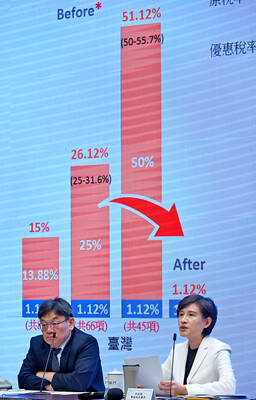
GREATER REACH? Auto parts and wood products would face tariffs of up to 15%, matching those targeting the EU, Japan and South Korea, Vice Premier said The US has announced that preferential tariff treatment for Taiwan’s non-semiconductor Section 232 goods would take effect retroactively from May 1, the Executive Yuan said yesterday. The US government yesterday posted a notice on the Federal Register’s public inspection Web site previewing tariff concessions for Taiwan under a memorandum of understanding (MOU) on Taiwan-US investment after two months of negotiations. The MOU signed on Jan. 15 stipulated three major preferential tariff arrangements: a 15 percent “reciprocal” tariff rate for Taiwan without stacking most-favored nation (MFN) rates; preferential Section 232 treatment for semiconductors and related products; and preferential Section 232 treatment for non-semiconductor

The National Chungshan Institute of Science and Technology yesterday showcased its locally developed variants of the Vision 60 robotic patrol dog, which it plans to deploy on the nation’s outlying territories in the South China Sea. The variants were produced under the Joint Lab project — created by the institute and domestic companies — and assembled with domestically produced motors, lenses and artificial intelligence (AI) systems alongside licensed tech from the US, Missile and Rocket Systems Research Division deputy director Jen Kuo-kang (任國光) told the media event at a military base in Taipei’s Dazhi (大直) area. Taiwan has built up its strengths


 RSS
RSS