


The IMF slashed its economic outlook on Wednesday, predicting the global financial crisis would slam growth to a virtual standstill this year.
“World growth is projected to fall to 0.5 percent in 2009, its lowest rate since World War II,” the IMF said in a sharp 1.75-point downward revision of November forecasts.
“The world economy is facing a deep recession,” the 185-nation institution warned.
The advanced economies were expected to contract by 2 percent, their first annual contraction in the postwar period and far more than the negative 0.3 percent the IMF estimated about three months ago.
The financial problems that emerged in August 2007, stemming from a US subprime mortgage crisis, grew into a firestorm in September after the collapse of Wall Street investment bank Lehman Brothers, which has hammered growth and trade worldwide.
“Despite wide-ranging policy actions, financial strains remain acute, pulling down the real economy,” it said.
Noting a “highly uncertain outlook,” the IMF said that “the timing and pace of the recovery depend critically on strong policy actions.”
“A sustained economic recovery will not be possible until the financial sector’s functionality is restored and credit markets are unclogged,” it said.
The US, the epicenter of the financial crisis, would endure a 1.6 percent contraction this year, slashing its prior estimate of 0.9 percent.
The world’s biggest economy, nonetheless, would weather the financial storm better than most other major advanced economies.
Japan’s economy would shrink by 2.6 percent this year instead of the 0.2 percent seen previously. The world’s second-largest economy would be mired in recession for a second consecutive year, after shrinking 0.3 percent last year.
The 27-member eurozone economy would hit a wall, suffering a 2 percent contraction after growing 1 percent last year. The previous estimate for this year was a 0.5 percent contraction.
IMF managing director Dominique Strauss-Kahn called for the European Central Bank to “give more gas” to the eurozone economy by cutting interest rates again, the German weekly Die Zeit said.
Germany, Europe’s biggest economy, would shrink by 2.5 percent this year after a 1.3 percent expansion last year, IMF figures published six days ago showed.
Britain, outside the eurozone, would suffer the most, with GDP contracting 2.8 percent, after 0.7 percent growth last year.
Developing countries were forecast to expand 3.3 percent thsi year, about half the 6.3 percent expansion of last year.
China would remain the world’s fastest-growing economy, putting in a relatively fast 6.7 percent pace, down from 9 percent last year.
India’s GDP growth would slow to 5.1 percent after 7.3 percent.
The IMF held out hope for a gradual economic recovery in 2010, with global growth of 3.0 percent spurred by “continued efforts to ease credit strains as well as expansionary fiscal and monetary policies.”
But the institution cautioned that “the uncertainty surrounding the outlook is unusually large.”
“Downside risks continue to dominate, as the scale and scope of the current financial crisis have taken the global economy into uncharted waters,” it said.
“The main risk is that unless stronger financial strains and uncertainties are forcefully addressed, the pernicious feedback loop between real activity and financial markets will intensify, leading to even more toxic effects on global growth,” it said.
In a separate report on global financial stability, the IMF raised its estimate of potential losses in US-originated asset writedowns to US$2.2 trillion, up from US$1.4 trillion.
“More aggressive actions by both policymakers and market participants are needed to ensure that the necessary deleveraging process is less disorderly,” it said, underscoring that international cooperation was key to re-establishing financial stability.
It prescribed a broad three-pronged approach — including liquidity provision, capital injections and disposal of problem assets — “that should be implemented fully and quickly so as to encourage balance sheet cleansing.”
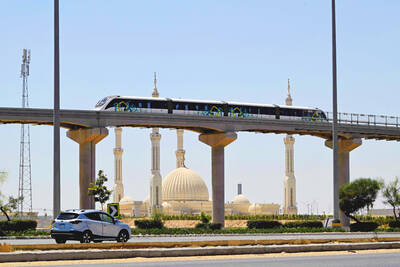
Cairo’s new monorail slices across the city skyline, running above the familiar chaos of blaring horns and aging buses’ exhaust fumes that mark rush hour below. The US$4.5 billion monorail, opened this month, is among Egypt’s most prominent new transport projects, part of a debt-funded infrastructure drive criticized for sapping state finances while bringing limited benefits to most of the country’s 109 million people. “It feels like you’re in a different country,” said Ramy Sayed, a restaurant manager, aboard a driverless Innovia 300 train. “No noise, no traffic, we’re not used to this.” The eastern line runs 56km from the bustling middle-class

Taiwanese firms have increased investment in the Philippines in recent years as Manila’s ties with Washington deepen and global supply chains continue to shift away from China, an expert at the Chung-Hua Institution for Economic Research (CIER, 中華經濟研究院) said yesterday. The Philippines had not been among Taiwanese investors’ top choices in Southeast Asia, CIER Taiwan ASEAN Studies Center director Kristy Hsu (徐遵慈) said at a seminar in Taipei. However, Taiwan’s investment in the country has grown significantly since the COVID-19 pandemic, reaching US $257 million last year, a high in recent years, she said. Although Taiwan’s total investment in the Philippines still lags

Intel Corp regards Taiwan Semiconductor Manufacturing Co (TSMC, 台積電) as a longstanding partner, as the US chipmaker would continue outsourcing production of advanced chips to TSMC, Intel chief executive officer Lip-Bu Tan (陳立武) said yesterday. “I don’t look at people as competitors. I look at the collaboration... Nvidia is also, you know, a good friend,” Tan told a news conference following his keynote speech at the Computex trade show in Taipei. “It’s a very trusted partnership for us... We are a big, top customer for them, and we’re going to continue doing that,” he said, referring to TSMC, the world’s largest foundry

Artificial intelligence (AI) agents would supplant smartphones as the center of people’s digital lives, fundamentally reshaping personal devices and driving a major computing upgrade cycle, Qualcomm Inc CEO Cristiano Amon said yesterday. In his keynote speech for this year’s Computex trade show in Taipei, Amon said that the rise of "agentic AI" — AI systems capable of reasoning, planning and carrying out tasks autonomously — would transform how people interact with technology across phones, PCs, vehicles and wearable devices. Describing the technology as the next major evolution in computing, Amon said that "2026 is the year of agents.” For decades, smartphones have sat


 RSS
RSS