


Former president Chen Shui-bian (陳水扁) yesterday became the first former president in the country’s history to be indicted when the Supreme Prosecutor’s Office’s Special Investigation Panel (SIP) charged him with money laundering, corruption and forgery. Thirteen others were also charged.
Prosecutors did not recommend specific sentences for any of the defendants, but suggested that judges “consider the most severe punishment” for the former president, his wife, their son and daughter-in-law.
Prosecutor Lin Che-hui said the former leader could be given a life sentence in prison if found guilty of all charges.
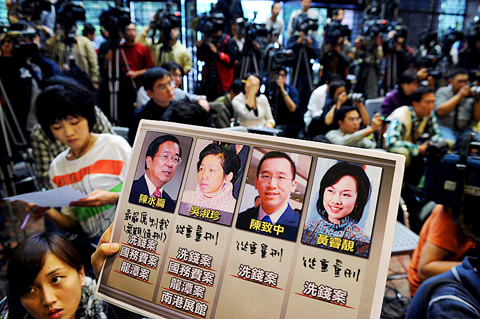
PHOTO: AFP
His wife Wu Shu-jen (吳淑珍), son Chen Chih-chung (陳致中), daughter-in-law Huang Jui-ching (黃睿靚) and 10 former presidential aides, associates and family members were also indicted on a range of charges.
Chen Shui-bian, 57, has been held incommunicado at the Taipei Detention Center in Taipei County’s Tucheng (土城) since Nov. 12, pending results of the investigation.
Chen Shui-bian has repeatedly denied all the charges, saying he is the victim of political persecution.
The indictment charged Chen Shui-bian and his wife of illegally receiving or embezzling NT$490 million (US$14.7 million), some of which was sent overseas.
Of that total, the indictment read, NT$104.15 million was embezzled from the “state affairs” fund during his eight years in office from 2000 until earlier this year.
Prosecutors charge that more than NT$27 million of that was obtained by using inappropriate receipts to claim reimbursements from the fund — nearly double the NT$14.8 million Wu was originally indicted for in 2006.
The balance, or more than NT$76 million, was claimed by former Presidential Office treasurer Chen Chen-hui (陳鎮慧) as “secret funds” from the state affairs fund and handed over to Wu Shu-jen to pay for the family’s living expenses and other uses, the indictment alleges.
The former first family allegedly received another NT$100 million and US$6 million in kickbacks from a total payoff of US$11.98 million by a development company called “Dayu” to pave the way for the Hsinchu Science Park by purchasing a plot of land in Taoyuan County from Dayu at a price prosecutors believe was unreasonably high.
The balance of the bribe money was pocketed by James Lee (李界木), then-chief of the Hsinchu Science Park, and a friend of the former first family, Tsai Ming-che (蔡銘哲), who transferred the kickback to accounts held by former first family members, prosecutors charged.
The indictment accuses the former first family of collecting another US$2.73 million in bribes from contractor Kuo Chuan-ching (郭銓慶) to help him win a tender to build the Nangang Exhibition Hall between 2002 and 2003.
Prosecutors believe Kuo won the contract by bribing members of a panel organized by the Ministry of Interior to assess the bidding after then-interior minister Yu Cheng-hsien (余政憲) revealed the list of panel members to Kuo at the request of Wu Shu-jen.
Yu was also indicted last night for allegedly leaking secrets.
Prosecutors asked the court to hand down lenient punishments to the other 10 defendants because they had shown remorse and cooperated with prosecutors investigating their roles in the case.
The Taipei District Court later held a hearing to decide whether Chen Shui-bian’s detention would continue now that he has been indicted. At press time yesterday, the hearing was ongoing.
In response to the indictment, Chen Shui-bian’s attorney, Cheng Wen-lung (鄭文龍), expressed his disappointment and reiterated his condemnation of the prosecutors for violating procedural justice by taking Chen into custody.
“The evidence and conclusions of the prosecution are contradictory and not solid ... Detaining people is a violation of procedural justice and personal freedoms,” Cheng told a press conference yesterday at Chen’s office.
Cheng, accompanied by Cheng Sheng-chu (鄭勝助) and two other lawyers, said he would help Chen Shui-bian fight the case until his innocence was proven.
Wu Shu-jen (吳淑珍) issued a statement yesterday lashing out at the prosecutors for having preconceived ideas and vowed to establish her innocence in court.
“The prosecutors abused their rights in detaining suspects and obtained confessions that were unfavorable to me. The way they handled the cases was illegitimate,” she said.
Meanwhile, the Presidential Office yesterday said it would not comment on the indictment as it respected the independence of the judiciary.
KMT Legislator Chang Hsien-yao (張顯耀) said that the indictment had proved that there was solid evidence against Chen Shui-bian and urged the DPP to refrain from making accusations of political repression.
KMT legislators Hung Hsiu-chu (洪秀柱) and Wu Yu-sheng (吳育昇) both suggested suspending all preferential treatment that Chen Shui-bian now receives in his capacity of a former president.
KMT Legislator Hsieh Kuo-liang (謝國樑) said that all politicians should take Chen Shui-bian’s case as a warning to avoid corruption.
Democratic Progressive Party (DPP) Chairperson Tsai Ing-wen (蔡英文) warned against political intervention in the upcoming trial.
“The case will have a huge impact on society and the DPP ... We urge the court to conduct a fair trial and to protect Chen [Shui-bian’s] legal rights,” Tsai said. “It would provoke confrontation if the case was overshadowed by political forces.”
DPP caucus whip Ker Chien-ming (柯建銘) condemned the Ministry of Justice for interfering with the case by holding a press conference.
“Every day, the Special Investigation Panel lets confidential information leak out,” he said. “They should be kept under close watch.”
“The fact that whenever Chen Shui-bian meets with his lawyer, the meeting has to be taped from beginning to end is a violation of his judicial rights,” he said.
The court should let Chen Shui-bian focus on the lawsuit and ensure a fair trial, he said.
Ker said political pundits and the media should not over-report the matter. He said he hoped Taiwan could return to normal as soon as possible and urged the public to “stop living in the shadow of Chen’s case.”
Taiwanese should “focus on the economy” instead of politics, he said.
ADDITIONAL REPORTING BY SHIH HSIU-CHUAN AND SHELLEY HUANG
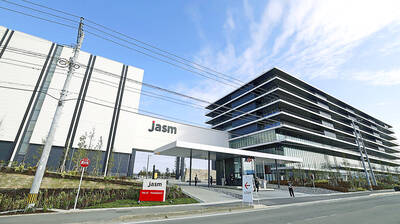
The subsidiary of Taiwan Semiconductor Manufacturing Co (TSMC, 台積電) in Kumamoto, Japan, turned a profit in the first quarter of this year, marking the first time the first fab of the unit has become profitable since mass production started at the end of 2024. According to the contract chipmaker’s financial statement released on Friday, Japan Advanced Semiconductor Manufacturing Inc (JASM), a joint venture running the fab in Kumamoto, posted NT$951 million (US$30.19 million) in profit in the January-to-March period, compared with a loss of NT$1.39 billion in the previous quarter, and a loss of NT$3.25 billion in the first quarter of
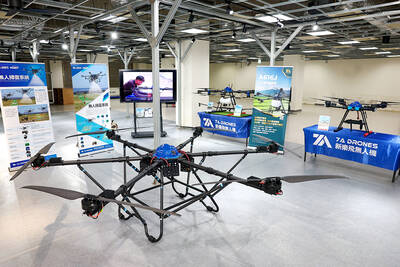
DRONE CENTRAL: Taiwan aims to become Asia’s democratic hub for drones, with most exports focused on high-quality military-grade models, an official said Taiwan’s drone industry is expected to expand significantly by 2030, producing 100,000 units per month and exporting half of them, the Ministry of Economic Affairs said yesterday. Current drone production capacity is about 15,000 units per month, but the industry can quickly scale up as demand increases, Industrial Development Administration Director-General Chiou Chyou-huey (邱求慧) told a news conference in Taipei. Taiwan’s drone output grew 2.5-fold last year to NT$12.9 billion (US$408.3 million) under a government program to develop the uncrewed vehicle sector, he said. The Executive Yuan in October last year approved plans to invest NT$44.2 billion into domestic production of uncrewed aerial
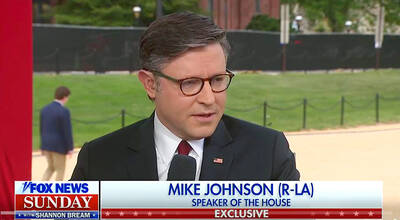
RESOLUTE BACKING: Two Republican senators are planning to introduce legislation that would impose immediate sanctions on China if it attempts to invade Taiwan US House of Representatives Speaker Mike Johnson on Sunday reaffirmed US congressional support for Taiwan, saying the US and “all freedom-loving people” have a stake in preventing China from seizing Taiwan by force. Johnson made the remarks in an interview with Fox News Sunday on US President Donald Trump’s summit with Chinese President Xi Jinping (習近平) last week. In an interview that aired on Friday on Fox News, just as Trump wrapped up a high-stakes visit to China, he said he has yet to green-light a new US$14 billion arms package to Taiwan and that it “depends on China.” “It’s a very good
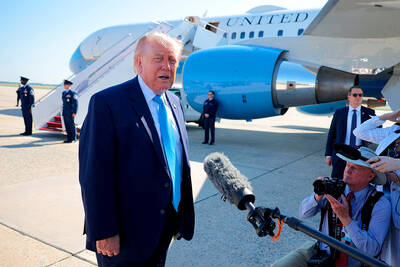
US President Donald Trump yesterday said he would speak to President William Lai (賴清德) as his administration considers whether to move ahead with a US$14 billion weapons sale to Taiwan — a potential arms deal that has drawn criticism from China. “Well, I’ll speak to him. I speak to everybody,” Trump told reporters yesterday when asked if he had any plans to call his counterpart, although he did not offer a time frame for when such a conversation could take place. Trump previously said he would speak to the person “that’s running Taiwan,” without specifying who he meant. “We have that situation very


 RSS
RSS