


Anti-government protesters blockading the Thai prime minister’s temporary offices and Bangkok’s main airport opened fire on rival activists yesterday, wounding at least five people, police said.
The violence erupted on the road to a disused air terminal where thousands of demonstrators behind a six-month street campaign have surrounded the makeshift headquarters of Thai Prime Minister Somchai Wongsawat.
Separately, anti-government protesters clad in yellow clothes that symbolize their loyalty to the monarchy tried to blockade the main Suvarnabhumi International Airport ahead of Somchai’s return from a trip abroad.
“Five supporters of the government have been wounded from gun shots by PAD [People’s Alliance for Democracy] who were on a pickup truck,” a senior Metropolitan police officer told reporters on condition of anonymity.
Television footage showed at least one man in a pickup truck opening fire on an unarmed group, before men in yellow shirts got out and beat them with white poles, as fires burned in the background.
The PAD — a coalition of royalists, Bangkok’s old elite and the middle class — accuses the government of being a corrupt puppet of exiled former Thai prime minister Thaksin Shinawatra. Thaksin, who is Somchai’s brother-in-law, was ousted in a 2006 coup.
Somchai has rejected calls to quit, while the government insisted that a key Cabinet meeting would go ahead today at an undisclosed location to prevent further protests.
“Anyone who wants to overthrow or resist the government is attempting a rebellion,” Somchai told the Thai National News Agency on board a flight from an APEC summit in Peru.
The Thai army chief meanwhile dismissed protesters’ calls for the military to step in as it did two years ago.
“The armed forces have agreed that a coup cannot solve our country’s problems and we will try to weather the current situation and pass this critical time,” army chief General Anupong Paojinda told reporters.
A day after PAD protests forced the cancellation of a parliamentary joint sitting, about 10,000 demonstrators moved to the old Don Mueang International Airport early on Monday to shut off Somchai’s current base.
Protesters have occupied the prime minister’s official office and Cabinet headquarters at Government House in Bangkok since August.
Riot police largely withdrew on Monday amid fears of a repeat of clashes between protesters and police on Oct. 7 that left two people dead and 500 injured, the worst political violence in Thailand for 16 years.
“There are more than 10,000 of us here and we are prepared for a long siege like at Government House,” said Sawit Kaoewan, a PAD leader. Police confirmed the figure.
About 1,000 demonstrators later moved to the Suvarnabhumi international airport in a bid to block Somchai’s return from a trip abroad, airport authorities told reporters
They said there was no disruption to the handful of domestic flights that operate from Don Mueang or to services at Suvarnabhumi, which took over as Bangkok’s main airport two years ago.
Hundreds of PAD supporters also went to the nearby military headquarters after speculation that the cabinet would meet there with Somchai today.
Government-run corporations said there was no response to a strike call by Thailand’s main public sector union.
The protests spread a day after the PAD blockaded parliament in what they called a “final battle” in their six-month campaign against the administration.
The PAD, which also launched huge street protests in 2006 that led to the Thaksin coup, called this week’s rallies in response to a grenade attack on Thursday that killed one protester.
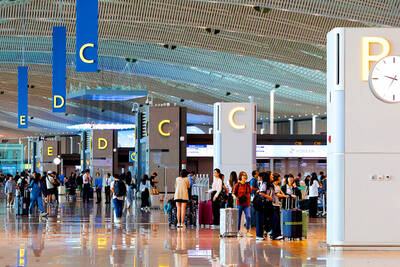
South Korea has adjusted its electronic arrival card system to no longer list Taiwan as a part of China, a move that the Ministry of Foreign Affairs said would help facilitate exchanges between the two sides. South Korea previously listed “Taiwan” as “Taiwan (China)” in the drop-down menus of its online arrival card system, where people had to fill out where they came from and their next destination. The ministry had requested South Korea make a revision and said it would change South Korea’s name on Taiwan’s online immigration system from “Republic of Korea” to “Korea (South),” should the issue not be

Tainan, Taipei and New Taipei City recorded the highest fines nationwide for illegal accommodations in the first quarter of this year, with fines issued in the three cities each exceeding NT$7 million (US$220,639), Tourism Administration data showed. Among them, Taipei had the highest number of illegal short-term rental units, with 410. There were 3,280 legally registered hotels nationwide in the first quarter, down by 14 properties, or 0.43 percent, from a year earlier, likely indicating operators exiting the market, the agency said. However, the number of unregistered properties rose to 1,174, including 314 illegal hotels and 860 illegal short-term rental
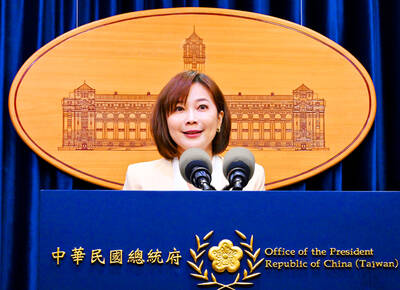
ECONOMIC COERCION: Such actions are often inconsistently applied, sometimes resumed, and sometimes just halted, the Presidential Office spokeswoman said The government backs healthy and orderly cross-strait exchanges, but such arrangements should not be made with political conditions attached and never be used as leverage for political maneuvering or partisan agendas, Presidential Office spokeswoman Karen Kuo (郭雅慧) said yesterday. Kuo made the remarks after China earlier in the day announced 10 new “incentive measures” for Taiwan, following a landmark meeting between Chinese President Xi Jinping (習近平) and Chinese Nationalist Party (KMT) Chairwoman Cheng Li-wun (鄭麗文) in Beijing on Friday. The measures, unveiled by China’s Xinhua news agency, include plans to resume individual travel by residents of Shanghai and China’s Fujian
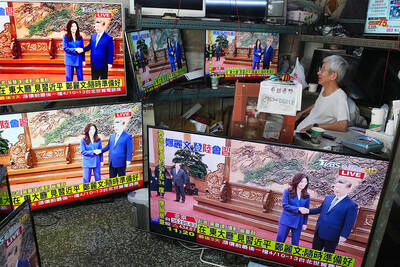
Chinese President Xi Jinping (習近平) and Chinese Nationalist Party (KMT) Chairwoman Cheng Li-wun (鄭麗文) met in Beijing yesterday, where they vowed to bring people on both sides of the Taiwan Strait closer to facilitate the “great rejuvenation of the Chinese nation.” The meeting was held in the East Hall of the Great Hall of the People, a venue typically reserved for meetings between Xi and foreign heads of state. In public remarks prior to a closed-door meeting, Xi, in his role as head of the Chinese Communist Party (CCP), said that Taiwan is historically part of China, and remains an “inalienable” and


 RSS
RSS