


Seven protesters who were injured during a crackdown on demonstrations against a Chinese envoy's visit to Taiwan earlier this month filed lawsuits alleging police brutality yesterday.
The seven who were involved in four cases of alleged police brutality showed medical documents, photographs and video recordings of their injuries and how they were injured during a news conference in front of National Taiwan Democracy Memorial Hall in Taipei before submitting their cases to Taipei District Court.
“I was talking with some friends on the sidewalk across a small street from a side entrance of the Grand Formosa Regent Taipei [on the night of Nov. 5],” said Huang Yi-ling (黃怡翎), one of the plaintiffs.
At the time, Association for Relations Across the Taiwan Strait Chairman Chen Yunlin (陳雲林), was at a dinner banquet hosted by Chinese Nationalist Party (KMT) Chairman Wu Poh-hsiung (吳伯雄) at the hotel.
As demonstrators surrounded the hotel, the guests were unable to leave until a little past 2am when some 2,000 police officers dispersed the crowd by force.
“When we got there at around 9:30pm, the area was still quiet. But about an hour later, a large number of police officers showed up,” Huang said. “One officer was saying something through a speaker from across the street, and we couldn't hear it very well, so we asked ‘are you talking to us?’”
The police did not answer, and the next thing Huang and her friends knew, they were being pushed back by officers using their shields, she said.
“It was quite strange, because the officers didn't push us away, instead they pushed us against the wall and started beating us with their batons,” Huang said, adding that she and her friends kept pleading for the officers to stop and yelling that there was no way out behind them, “but they continued for quite some time.”
Another plaintiff, Ted Chiang (江一德), said he turned his back to the riot police who were trying to disperse the crowd in front of the hotel, hoping to stop further physical clashes.
However, a video clip showed that he was pulled behind the police line.
“After I got pulled in, I fell on the ground, and the police officers hit me with batons and shields,” Chiang said.
“I just wanted to run away from the madness, but an officer hit my head with his baton, then I started bleeding all over,” he said, holding up a T-shirt with bloodstains and holes that he wore that night.
“To this day, I still feel dizzy and am still taking medicine,” he said.
Lin Feng-jeng (林峰正), executive director of the Judicial Reform Foundation, who helped organize a panel of attorneys to provide assistance to the victims of alleged police brutality, said: “It's very disappointing that the police have only looked into cases in which officers were attacked and tried to find out who attacked them while turning a blind eye to cases in which innocent citizens were wounded.”
“While [President] Ma Ying-jeou [馬英九] has constantly said that the ‘the problem [with demonstrations] is the violence,’ I would like to remind him that there is also the problem of police violence,” he said.
At a separate setting yesterday, Democratic Progressive Party (DPP) Taipei City Councilor Chou Wei-you (周威佑) accused the Taipei City Police Department of framing him — and possibly other protesters — by putting him on a list of violent protesters during Chen's visit.
The department issued a booklet of photos of 66 “violent protesters” on Wednesday and called on the public to help the police in identifying suspects who allegedly took part in the demonstrations.
The photo of Chou, who was allegedly punched in the left eye by an officer while he was protesting against Chen in front of the hotel, was in the booklet put together by the police on Wednesday morning, but the department removed his photo yesterday after the councilor challenged its inclusion.
“If the police department believes I am a suspect, then it is covering me by removing my photo. If not, did the department include my photo by mistake?” Chou said.
Chou later showed a video clip of the incident in front of the hotel that night to prove that he did not attack the police and that he was punched by an officer in the eye while trying to separate the police and protesters.
He and other DPP Taipei City councilors condemned the department's Songshan Precinct for lying about what happened that night by arguing that Chou was hit by a bottle of water, rather than by an officer, in its news release.
In response, Lee Wen-chang (李文章), deputy chief of the department's Criminal Investigation Division, said that the police hurt Chou by accident, adding that Chou's photo was included in the booklet by mistake because “the staff member who handled the booklet did not know it was Councilor Chou.”
Calling in question the department's handling of the aftermath of the protests, Chou urged Taipei Mayor Hau Lung-bin (郝龍斌) to look into the department's conduct.
“How many suspects in the booklet are innocent and treated unjustly like me? Such poor handling of the incident is a serious breach of human rights,” Chou said.
Putting handcuffs on his own hands, Chou said he refused to enjoy any privilege as a councilor and vowed to file a lawsuit against the police department.
DPP Taipei City Councilor Liu Yao-ren (劉耀仁) urged the public to provide evidence, such as photographs or videotapes showing police taking part in violence against the protesters and to file lawsuits against the police.
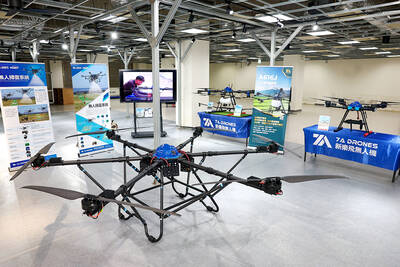
DRONE CENTRAL: Taiwan aims to become Asia’s democratic hub for drones, with most exports focused on high-quality military-grade models, an official said Taiwan’s drone industry is expected to expand significantly by 2030, producing 100,000 units per month and exporting half of them, the Ministry of Economic Affairs said yesterday. Current drone production capacity is about 15,000 units per month, but the industry can quickly scale up as demand increases, Industrial Development Administration Director-General Chiou Chyou-huey (邱求慧) told a news conference in Taipei. Taiwan’s drone output grew 2.5-fold last year to NT$12.9 billion (US$408.3 million) under a government program to develop the uncrewed vehicle sector, he said. The Executive Yuan in October last year approved plans to invest NT$44.2 billion into domestic production of uncrewed aerial
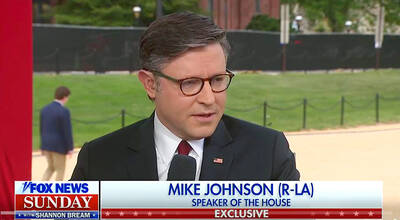
RESOLUTE BACKING: Two Republican senators are planning to introduce legislation that would impose immediate sanctions on China if it attempts to invade Taiwan US House of Representatives Speaker Mike Johnson on Sunday reaffirmed US congressional support for Taiwan, saying the US and “all freedom-loving people” have a stake in preventing China from seizing Taiwan by force. Johnson made the remarks in an interview with Fox News Sunday on US President Donald Trump’s summit with Chinese President Xi Jinping (習近平) last week. In an interview that aired on Friday on Fox News, just as Trump wrapped up a high-stakes visit to China, he said he has yet to green-light a new US$14 billion arms package to Taiwan and that it “depends on China.” “It’s a very good
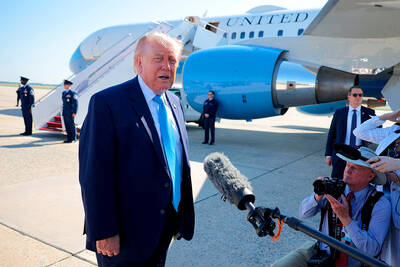
US President Donald Trump yesterday said he would speak to President William Lai (賴清德) as his administration considers whether to move ahead with a US$14 billion weapons sale to Taiwan — a potential arms deal that has drawn criticism from China. “Well, I’ll speak to him. I speak to everybody,” Trump told reporters yesterday when asked if he had any plans to call his counterpart, although he did not offer a time frame for when such a conversation could take place. Trump previously said he would speak to the person “that’s running Taiwan,” without specifying who he meant. “We have that situation very
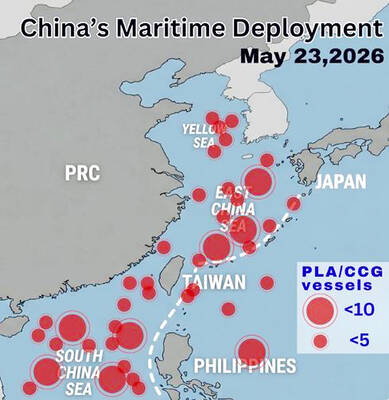
WARNING: China should stop engaging in actions that undermine regional peace and stability, as it would only build resentment among people across the Strait, the CGA said China has deployed more than 100 navy, coast guard and other vessels in waters from the Yellow Sea to the South China Sea and the western Pacific since US President Donald Trump and Chinese President Xi Jinping (習近平) met in Beijing, National Security Council Secretary-General Joseph Wu (吳釗燮) said yesterday. “In this part of the world, #China is the one & only PROBLEM wrecking the #StatusQuo & threatening regional peace & stability,” Wu wrote on X. In a separate post, he said Beijing was coercing Taiwan’s maritime domain, calling it illegal and provocative, after the Coast Guard Administration (CGA) expelled a


 RSS
RSS