


US president-elect Barack Obama was scheduled to meet his economic team yesterday and hold his first news conference since winning Tuesday’s election as the country awaited signs of how he might tackle the economic crisis.
Obama, who stands to inherit the worst financial crisis since the Great Depression, faced pressure to announce key economic jobs, including Treasury secretary, though there were no indications of when he might do so.
On Wall Street, stocks closed sharply lower for a second day. The Dow Jones Industrial Average tumbled 443.48 points, or 4.85 percent, after plummeting almost 500 points, or about 5 percent, on Wednesday — the biggest fall ever on the day after a presidential election.
Though the timing of the Treasury secretary announcement was uncertain, names being considered for the job included Timothy Geithner, president of the Federal Reserve Bank of New York, former Treasury secretary Lawrence Summers and former Federal Reserve Board chairman Paul Volcker.
Summers and Volcker were on the 17-member transition economic advisory board that was to meet with Obama yesterday, a statement from the transition office said. Others scheduled to take part in the meeting included Berkshire Hathaway chairman Warren Buffett and Roger Ferguson, former vice chairman of the Federal Reserve board of governors.
Obama made his first key administration appointment by naming US Representative Rahm Emanuel of Illinois, a brash veteran of former president Bill Clinton’s White House known for his take-no-prisoners style, as his chief of staff.
“I announce this appointment first, because the chief of staff is central to the ability of a president and administration to accomplish an agenda,” Obama said in a statement. “And no one I know is better at getting things done than Rahm Emanuel.”
The choice was quickly criticized by Republicans, who accused Obama of reneging on his campaign promise that he would bring change to Washington and reach across the aisle to bridge divides between the parties.
“This is an ironic choice for a president-elect who has promised to change Washington, make politics more civil and govern from the center,” House Republican Leader John Boehner of Ohio said.
But not all Republicans viewed the appointment harshly. South Carolina Senator Lindsey Graham, a close ally of Republican White House candidate John McCain, praised the choice.
“This is a wise choice by president-elect Obama,” Graham said. “Rahm knows Capitol Hill and has great political skills. He can be a tough partisan, but also understands the need to work together. He is well suited for the position.”
Aides would not say if there would be any announcements about administration jobs at the news conference.
US President George W. Bush pledged to do all he could to ensure a smooth transition before Obama takes the oath of office on Jan. 20.
“Over the next 75 days all of us must ensure that the next president and his team can hit the ground running,” Bush said at the White House.
He said he would discuss issues ranging from financial markets to the war in Iraq with Obama.
Obama said he and his wife Michelle looked forward to meeting Bush on Monday to start the transition process.
“I thank him for reaching out in the spirit of bipartisanship that will be required to meet the many challenges we face as a nation,” Obama said in a statement.
Obama received a top-secret intelligence briefing on Thursday. As president-elect he will be receiving president-level daily intelligence briefings.
Analysts expect Obama to begin putting together a strategy for the wars in Iraq and Afghanistan. Concern that al-Qaeda may try to test a new administration may also lend urgency to assembling the national security team quickly.
“We know that al-Qaeda and others try to test a new administration,” White House spokeswoman Dana Perino said. “I don’t know of anything specific, but we do know that is a heightened period of concern.”
Also on Thursday, Obama returned telephone calls to nine world leaders to thank them for having called to congratulate him on his election, a spokeswoman said.
Obama spokeswoman Stephanie Cutter said the president-elect spoke to Australian Prime Minister Kevin Rudd, Canadian Prime Minister Stephen Harper, French President Nicolas Sarkozy, German Chancellor Angela Merkel, Israeli Prime Minister Ehud Olmert, Japanese Prime Minister Taro Aso, Mexican President Felipe Calderon, South Korean President Lee Myung-bak and British Prime Minister Gordon Brown.
Sarkozy’s office said they spoke for 30 minutes and characterized the discussion as “extremely warm” as the president congratulated Obama on a “brilliant” election victory. The statement said they discussed international issues, particularly the financial crisis, and agreed to meet in the “quite near future.”
Harper’s office said in a statement that they spoke about an international financial summit in Washington on next Saturday and its importance for addressing the global financial crisis.
Obama had no plans to attend the meeting.
The prime minister’s office said the two leaders emphasized that there could be no closer friends and allies than the US and Canada, and vowed to maintain and further build upon the relationship. Harper’s office called it a warm exchange and said they agreed to talk again soon.
Calderon’s office said Obama pledged continued US support for Mexico’s fight against organized crime and drug trafficking. A statement from the Mexican president’s office said Obama told Calderon he was “conscious of the difficulty of the battle” and offered “decisive” US support.
Congress approved US$400 million in anti-drug aid for Mexico last June, but has yet to release the money.
Iranian President Mahmoud Ahmadinejad on Thursday congratulated Obama on his election win in a letter — the first time an Iranian leader has offered such wishes to a US president-elect since the 1979 Islamic Revolution.
The Iranian leader also said in the letter that he hopes Obama will “use the opportunity to serve the [American] people and leave a good name for history” during his term in office.
Also See: Taiwan’s Congress woes、EDITORIAL: Obama, his aides and Taiwan’s future、Gun crazy
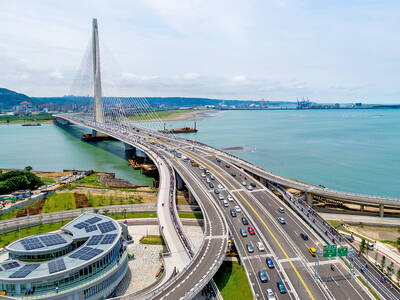
The Ministry of Transportation and Communications yesterday inaugurated the Danjiang Bridge across the Tamsui River in New Taipei City, saying that the structure would be an architectural icon and traffic artery for Taiwan. Feted as a major engineering achievement, the Danjiang Bridge is 920m long, 211m tall at the top of its pylon, and is the longest single-pylon asymmetric cable-stayed bridge in the world, the government’s Web site for the structure said. It was designed by late Iraqi-British architect Zaha Hadid. The structure, with a maximum deck of 70m, accommodates road and light rail traffic, and affords a 200m navigation channel for boats,
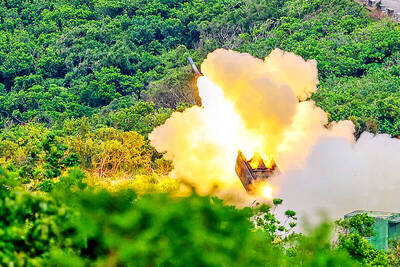
PRECISION STRIKES: The most significant reason to deploy HIMARS to outlying islands is to establish a ‘dead zone’ that the PLA would not dare enter, a source said A High Mobility Artillery Rocket System (HIMARS) would be deployed to Penghu County and Dongyin Island (東引) in Lienchiang County (Matsu) to force the Chinese military to retreat at least 100km from the coastline, a military source said yesterday. Taiwan has been procuring HIMARS and Army Tactical Missile Systems (ATACMS) from the US in batches. Once all batches have been delivered, Taiwan would possess 111 HIMARS units and 504 ATACMS, which have a range of 300km. Considering that “offense is the best defense,” the military plans to forward-deploy the systems to outlying islands such as Penghu and Dongyin so that

Taiwan Semiconductor Manufacturing Co (TSMC, 台積電), the world’s largest foundry service provider, yesterday said that global semiconductor revenue is projected to hit US$1.5 trillion in 2030, after the figure exceeds US$1 trillion this year, as artificial intelligence (AI) demand boosts consumption of token and compute power. “We are still at the beginning of the AI revolution, but we already see a significant impact across the whole semiconductor ecosystem,” TSMC deputy cochief operating officer Kevin Zhang (張曉強) said at the company’s annual technology symposium in Hsinchu City. “It is fair to say that in the past decade, smartphones and other mobile devices were
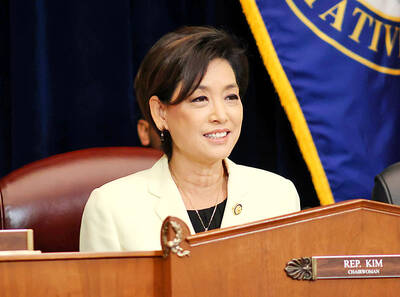
‘CLEAR MESSAGE’: The bill would set up an interagency ‘tiger team’ to review sanctions tools and other economic options to help deter any Chinese aggression toward Taiwan US Representative Young Kim has introduced a bill to deter Chinese aggression against Taiwan, calling for an interagency “tiger team” to preplan coordinated sanctions and economic measures in response to possible Chinese military or political action against Taiwan. “[Chinese President] Xi Jinping [習近平] has directed the People’s Liberation Army to be ready to invade Taiwan by 2027. China has a plan. America should have one too,” Kim said in a news release on Thursday last week. She introduced the “Deter PRC [People’s Republic of China] aggression against Taiwan act” to “ensure the US has a coordinated sanctions strategy ready should


 RSS
RSS