


Former president Chen Shui-bian (陳水扁) and several independence supporters filed a treason lawsuit against President Ma Ying-jeou (馬英九) yesterday, alleging that recent acts by Ma constituted “offenses against the external security of state.”
“Article 104 of the Criminal Code stipulates that anyone who collaborates with a foreign national or a foreign envoy to have the Republic of China [ROC] annexed by other countries has committed a crime punishable by death or a lifetime jail sentence,” Chen told a press conference in Taipei.
“[Association for Relations Across the Taiwan Strait Chairman] Chen Yunlin (陳雲林) and other Chinese leaders have repeatedly stated their intention to take Taiwan by force and through ‘peaceful means,’ and therefore we suspect that Ma’s meeting with Chen Yunlin constitutes collaboration,” he said.
While the Chinese Nationalist Party (KMT) government under Chiang Kai-shek (蔣介石) and his son president Chiang Ching-kuo (蔣經國) was anti-communist, the Ma administration is “afraid of China, pro-China and surrendering to China,” Chen Shui-bian said.
He also cited recent comments by Ma as evidence of Ma’s “illegal intentions.”
Ma said in an interview with the Mexican newspaper El Sol de Mexico that relations between Taiwan and China were not state-to-state but “region-to-region” relations.
Earlier, he said that the Taiwanese and Chinese are not different in terms of nationality but in where their home addresses are registered.
“According to the law, even if Ma hasn’t [successfully] committed the crime, an attempt is enough to convict him,” Chen Shui-bian said.
“Taiwan and China are, of course, in a hostile relationship — China now has more than 1,000 missiles pointing at Taiwan and, according to the Constitution, mainland China, currently occupied by the Chinese Communist Party regime, is part of our traditional territory,” said Chin Heng-wei (金恆煒), editor-in-chief of Contemporary Magazine and a political commentator. “Ma is committing treason [by meeting Chen Yunlin].”
When asked to comment on the lawsuit during a question-and-answer session at the legislature yesterday, Minister of Justice Wang Ching-feng (王清峰) said that “each individual case will be reviewed by the prosecutor,” but added “I’d say it’s just political talk.”
The Presidential Office declined to comment on the lawsuit filed against Ma.
However, the Mainland Affairs Council issued a statement accusing the former president of hypocrisy.
Although the former president is accusing Ma of colluding with the enemy by meeting Chen Yunlin, Chen Shui-bian invited then-Chinese president Jiang Zemin (江澤民) to have tea when Chen Shui-bian visited Kinmen in 2002, it said.
When asked for comment, KMT Legislator Shuai Hua-ming (帥化民) dismissed the lawsuit as “groundless” and said the public would never support Chen Shui-bian’s allegations.
KMT Legislator Lee Hung-chun (李鴻鈞) said that if the former president’s reasoning were solid, then 37,000 Taiwanese enterprises investing in China should also be charged with treason.
“Should they be arrested as well?” Lee asked.
ADDITIONAL REPORTING BY KO SHU-LING, FLORA WANG AND CNA

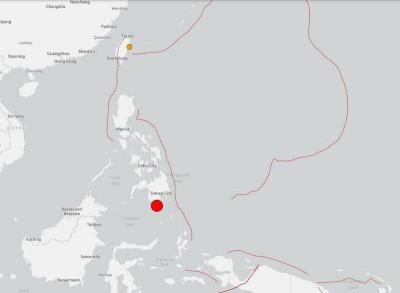
A magnitude 7.8 earthquake struck off the southern coast of Mindanao in the Philippines at 7:38am today, prompting the US Tsunami Warning System to issue an alert for neighboring countries, including Taiwan. The system issued a purple alert indicating a "tsunami threat." The potential threat zone includes Taiwan, the Philippines, Papua New Guinea, Yap and Palau. A spokesperson for Indonesia disaster mitigation agency said there were no reports of damage so far. Arlene Hollero, disaster chief of Maasim town in the Philippines' Sarangani Province, said their evacuation was underway in coastal villages and there were no reported casualties so far. DZBB radio, broadcasting from the

RESILIENCE: Taiwan plays a key role in semiconductors, energy, information infrastructure and advanced manufacturing, AIT Director Raymond Greene said Taiwan’s continued investment in deterrence and resilience remains vital, especially in uncrewed systems and other emerging technologies, American Institute in Taiwan (AIT) Director Raymond Greene said yesterday. Greene made the remarks at the annual National Strategic Summit on Supply Chain Resilience held by the Research Institute for Democracy, Society and Emerging Technology (DSET), a government-backed think tank. As Taiwan last year became the US’ fourth-largest trading partner and supply chain security is becoming more important, cooperation in emerging technologies continues to deepen between the two countries, he said. The US is committed to accelerating innovation, building key infrastructure, strengthening cooperation

The National Chungshan Institute of Science and Technology yesterday showcased its locally developed variants of the Vision 60 robotic patrol dog, which it plans to deploy on the nation’s outlying territories in the South China Sea. The variants were produced under the Joint Lab project — created by the institute and domestic companies — and assembled with domestically produced motors, lenses and artificial intelligence (AI) systems alongside licensed tech from the US, Missile and Rocket Systems Research Division deputy director Jen Kuo-kang (任國光) told the media event at a military base in Taipei’s Dazhi (大直) area. Taiwan has built up its strengths

RIGHT DIRECTION: Taiwan’s efforts to prevent forced labor include a proposal to ‘fully prohibit’ employers from withholding workers’ documents, an official said Taiwan is to establish a mechanism to restrict imports of goods linked to forced labor, the Executive Yuan said yesterday, after the US proposed imposing additional tariffs on Taiwanese goods over labor concerns. “The Ministry of Labor and the Ministry of Economic Affairs are to establish an interministerial review procedure,” Executive Yuan spokesperson Michelle Lee (李慧芝) said at a news briefing in Taipei. “The government is to use the Foreign Trade Act [貿易法] as the legal basis to restrict imports of goods produced with forced labor” and bring its supply chain governance more in line with international standards on human rights, resilience


 RSS
RSS