


The Department of Health (DOH) said yesterday that protein powder imported from China was found to contain 1.90 parts per million (ppm) to 5.03ppm of melamine.
Health authorities randomly tested 13 batches of protein powder, six of which were contaminated with melamine.
The tainted powder was produced by two companies in China — Jilin Jinyi Egg Products Co Ltd (吉林金翼蛋品有限公司) and Dalian Green Snow Egg Product Co, Ltd (大連綠雪蛋品發展有限公司).
Of the 393 tonnes of protein powder imported from China this year, 261 tonnes imported from Jilin Jinyi and Dalian Green Snow were found to be contaminated with melamine, deputy health minister Cheng Shou-hsia (鄭守夏) said at a press conference yesterday.
Protein powder is used in the food industry as a legal food additive.
It is commonly used to produce foam and add cohesiveness.
The department’s Bureau of Food and Drug Safety on Sunday randomly tested 40 samples of ham, vegetarian ham, fish paste and cakes, which are all products commonly made with protein powder. No melamine was detected in these finished products, Cheng said.
The 261 tonnes of tainted powder were imported by Kuohui (國暉食品香料化工有限公司), Paoli (寶立興業股份有限公司), Union Chemical Industrial Co Ltd (六和化工股份有限公司) and Ali-Mon Co (育盟股份有限公司).
Union Chemical imported malt extract and creamer found to contain melamine last month.
The four local companies have warehouses in Taipei, Tainan, Kaohsiung and Taoyuan counties.
Local health departments have already begun tracking down and recalling the powder, Cheng said.
Cheng emphasized that the department used one of the most sensitive testing methods — liquid chromatography/tandem mass spectrometry — which can detect melamine levels as low as 0.05ppm.
Cheng said that the department is requiring all companies that have imported protein powder from China, whether or not they have been found to contain melamine, to take the materials off the market.
The department also announced a ban on all imports of protein powder materials from China.
Taiwan imports about 704 tonnes of protein powder a year from countries including Germany, France, Sweden and Japan, so Taiwanese businesses can replace the China-made protein powder with supplies from elsewhere, Cheng said.
Contaminated milk powder, laced with the chemical melamine, has been blamed for causing the deaths of four infants and sickening more than 54,000 others in China.
Melamine is added to milk powder by some companies in China to falsely register foods as having a high protein content.
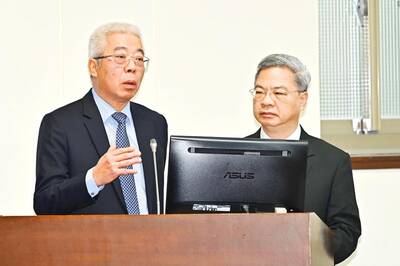
Taiwan has arranged for about 8 million barrels of crude oil, or about one-third of its monthly needs, to be shipped from the Red Sea this month to bypass the Strait of Hormuz and ease domestic supply pressures, CPC Corp, Taiwan (CPC, 台灣中油) said yesterday. The state-run oil company has worked with Middle Eastern suppliers to secure routes other than the Strait of Hormuz, through which about 20 percent of the world’s oil and liquefied natural gas typically passes, CPC chairman Fang Jeng-zen (方振仁) said at a meeting of the legislature’s Economics Committee in Taipei. Suppliers in Saudi Arabia have indicated they
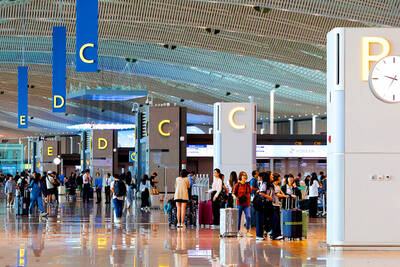
South Korea has adjusted its electronic arrival card system to no longer list Taiwan as a part of China, a move that the Ministry of Foreign Affairs said would help facilitate exchanges between the two sides. South Korea previously listed “Taiwan” as “Taiwan (China)” in the drop-down menus of its online arrival card system, where people had to fill out where they came from and their next destination. The ministry had requested South Korea make a revision and said it would change South Korea’s name on Taiwan’s online immigration system from “Republic of Korea” to “Korea (South),” should the issue not be
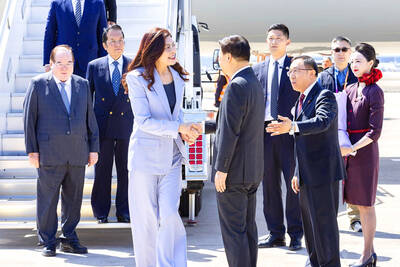
CCP ‘PAWN’? Beijing could use the KMT chairwoman’s visit to signal to the world that many people in Taiwan support the ‘one China’ principle, an academic said Chinese Nationalist Party (KMT) Chairwoman Cheng Li-wun (鄭麗文) yesterday arrived in China for a “peace” mission and potential meeting with Chinese President Xi Jinping (習近平), while a Taiwanese minister detailed the number of Chinese warships currently deployed around the nation. Cheng is visiting at a time of increased Chinese military pressure on Taiwan, as the opposition-dominated Legislative Yuan stalls a government plan for US$40 billion in extra defense spending. Speaking to reporters before going to the airport, Cheng said she was going on a “historic journey for peace,” but added that some people felt uneasy about her trip. “If you truly love Taiwan,
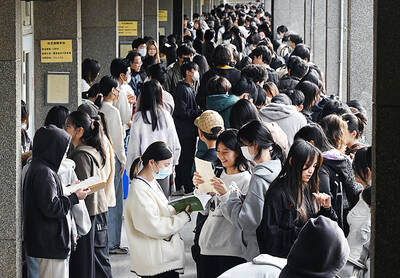
A global survey showed that 60 percent of Taiwanese had attained higher education, second only to Canada, the Ministry of the Interior said. Taiwan easily surpassed the global average of 43 percent and ranked ahead of major economies, including Japan, South Korea and the US, data from the Organisation for Economic Co-operation and Development (OECD) for 2024 showed. Taiwan has a high literacy rate, data released by the ministry showed. As of the end of last year, Taiwan had 20.617 million people aged 15 or older, accounting for 88.5 percent of the total population, with a literacy rate of 99.4 percent, the data


 RSS
RSS