


China has leapfrogged the US to become the world’s biggest carbon emitter and India is heading for third place, scientists said yesterday in a report that warned global greenhouse-gas emission levels were at record highs.
The report, by a research consortium called the Global Carbon Project (GCP), confirms an estimate that China has become the biggest producer of carbon dioxide (CO2), the principal gas that causes global warming.
Until 2005, rich countries emitted most of the world’s man-made CO2. Today, developing countries now account for 53 percent of the total, the GCP said.
“The biggest increase in emissions has been taking place in developing countries, largely in China and India, while developed countries have been growing slowly,” it said. “The largest regional shift was that China passed the US in 2006 to become the largest CO2 emitter, and India will soon overtake Russia to become the third largest emitter.”
The GCP said CO2 emissions last year were the equivalent to almost 10 billion tonnes of carbon. Fossil fuels accounted for 8.5 billion tonnes and changes to land use, mainly through deforestation, accounted for the rest.
Atmospheric concentrations of CO2 surged 2.2 parts per million (ppm) last year to reach 383ppm. The rise was 1.8ppm in 2006.
At 383ppm, CO2 levels are 37 percent above the benchmark in the year 1750 when the start of the Industrial Revolution unleashed voracious use of coal, oil and gas.
“The present concentration is the highest in the last 650,000 years and probably during the last 20 million years,” the report said.
It warned: “All of these changes characterize a carbon cycle that is generating stronger climate forcing, and sooner than expected.”
The document, which was to be unveiled simultaneously at conferences in Paris and Washington yesterday, also made these points:
• Emissions have risen starkly since the Millennium. From 2000 to last year, the average annual hike has been 2.0ppm. This compares with 1.3ppm per year in the 1970s, 1.6ppm in the 1980s and 1.5ppm in the 1990s.
• Fossil-fuel emissions this decade are running at four times those of the 1990s.
• Tropical deforestation also amounted to 1.5 billion tonnes of carbon last year, with Latin America and Asia each accounting for 600 million tonnes and Africa 300 million.
• Natural “sinks” — the ocean, forests and other land — are “a huge subsidy” to the global economy, worth US$500 billion annually for soaking up more than half of the CO2 that would otherwise be released into the atmosphere.
But these “sinks” are in bad condition. Their efficiency has fallen by 5 percent over the past 50 years “and will continue to do so in the future.”
The GCP report, Carbon Budget 2007, is authored by eight scientists in a project sponsored by the International Geosphere-Biosphere Program, the International Human Dimensions Program on Global Environmental Research and the World Climate Research Program.
It is based on UN data, statistical models and climate research published in major peer-reviewed journals and on energy data collected by the oil giant BP.
“Our numbers provide a reality check,” said Corinne Le Quere, from the British Antarctic Survey (BAS) and the University of East Anglia in Eastern England. “The scale of efforts [to reduce emissions] is not enough.”
Last year, China emitted 1.8 billion tonnes of carbon from fossil fuels, compared with 1.59 billion by the US. Russia was third with 432 million tonnes, followed by India with 430 million.
Leaders from about 180 nations are locked in a two-year round of talks aimed at crafting a global pact to fight climate change by reducing carbon dioxide that is lofted into the skies.
Greenhouse gases threaten to accelerate warming to levels that the UN Intergovernmental Panel on Climate Change said last year will increase floods and droughts, raise sea levels and extinguish thousands of species.
“It’s been all talk and until there’s action, emissions will continue to go up,” Martin Parry, who last year co-chaired one of the panel’s three working groups, said yesterday in a telephone interview from his home in eastern England.
“The window of opportunity we have in order to achieve an international agreement and act upon it is beginning to close. We have potentially serious damage in store,” he said.
Emissions need to peak by 2015 and drop by 50 percent by 2050 to limit warming to 2°C more than the level before the Industrial Revolution in the mid-18th century, the UN panel proposed.
Global talks aim to close a deal at a conference of the UN Framework Convention on Climate Change in Copenhagen in December next year.
With emissions currently tracking the high end of scenarios examined by the UN, temperatures may rise as much as 6.3°C by 2100, said Le Quere, a member of the GCP’s steering committee.
That would make the melting of Greenland’s ice sheet inevitable, with enough water to raise sea levels by about 7m, she said.
“Things are happening very, very fast,” Le Quere said. “We already know this is a huge problem but the actions that are taken now are extremely important in determining the rate of warming.”
The pact being discussed at the global talks will replace the Kyoto Protocol, which expires in 2012. Under that agreement, 37 developed countries agreed to cut emissions from 1990 levels by a combined 5 percent by 2012.
The largest emitter, the US, never signed Kyoto, and developing countries did not set targets.
Developed countries are responsible for 80 percent of historic emissions and it’s up to them to take the lead in slashing output of the gas, Le Quere said. “This is a reality check of what’s actually happening: The industrialized countries have to cut their emissions much, much faster than they are doing now.” she said.
“There’s a lot of effort to curb emissions of CO2 but the scale is not big enough. It has to be on a much, much larger scale. The scale of the problem is enormous,” she said.

PROVOCATIVE: Chinese Deputy Ambassador to the UN Sun Lei accused Japan of sending military vessels to deliberately provoke tensions in the Taiwan Strait China denounced remarks by Japan and the EU about the South China Sea at a UN Security Council meeting on Monday, and accused Tokyo of provocative behavior in the Taiwan Strait and planning military expansion. Ayano Kunimitsu, a Japanese vice foreign minister, told the Council meeting on maritime security that Tokyo was seriously concerned about the situation in the East China and South China seas, and reiterated Japan’s opposition to any attempt to change the “status quo” by force, and obstruction of freedom of navigation and overflight. Stavros Lambrinidis, head of the EU delegation to the UN, also highlighted South China Sea

The final batch of 28 M1A2T Abrams tanks purchased from the US arrived at Taipei Port last night and were transported to the Armor Training Command in Hsinchu County’s Hukou Township (湖口), completing the military’s multi-year procurement of 108 of the tanks. Starting at 12:10am today, reporters observed more than a dozen civilian flatbed trailers departing from Taipei Port, each carrying an M1A2T tank covered with black waterproof tarps. Escorted by military vehicles, the convoy traveled via the West Coast Expressway to the Armor Training Command, with police implementing traffic control. The army operates about 1,000 tanks, including CM-11 Brave Tiger
Taiwan Semiconductor Manufacturing Co (TSMC, 台積電), the world’s largest contract chipmaker, said it expects its 2-nanometer (2nm) chip capacity to grow at a compound annual rate of 70 percent from this year to 2028. The projection comes as five fabs begin volume production of 2-nanometer chips this year — two in Hsinchu and three in Kaohsiung — TSMC senior vice president and deputy cochief operating officer Cliff Hou (侯永清) said at the company’s annual technology symposium in Silicon Valley, California, last week. Output in the first year of 2-nanometer production, which began in the fourth quarter of last year, is expected to
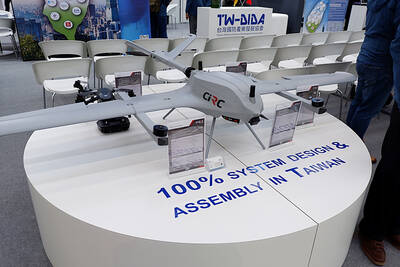
Taiwan’s drone exports surged past US$100 million in the first quarter, exceeding last year’s full-year total, with the Czech Republic emerging as the largest buyer, the Ministry of Economic Affairs said. Exports of complete drones reached US$115.85 million in the period, about 1.2 times the total recorded for all of last year, the ministry said in a report. Exports to the Czech Republic accounted for about US$100 million, far outpacing other markets. Poland, last year’s top destination, recorded about US$11.75 million in the first quarter. Taiwan’s drone exports have expanded rapidly in the past few years, with last year’s total


 RSS
RSS