

Thailand’s ruling party endorsed the brother-in-law of former prime minister Thaksin Shinawatra yesterday as its nominee to become the next prime minister, setting the stage for a showdown with anti-government protesters.
Somchai Wongsawat, 61, became acting prime minister last week when Samak Sundaravej — also dismissed by protesters as a stand-in for Thaksin — was ordered to resign after seven months in office for violating the Constitution.
Parliament is scheduled to vote on the nomination tomorrow.
The announcement by the ruling People’s Power Party drew a swift rejection from protesters who have occupied the prime minister’s official compound for three weeks, saying they will not allow another ally of Thaksin to take office.
“Somchai is very close to the Shinawatra family,” said Chamlong Srimuanng, one of the protest leaders. “He is Thaksin’s brother-in-law and will be even more his proxy than Samak ever was.”
Thaksin, who recently fled to London to escape corruption charges, was deposed as prime minister in a 2006 military coup but remains the central figure in Thailand’s long-running political crisis.
The People’s Alliance for Democracy, which has led the anti-government campaign, was formed in early 2006 to oppose Thaksin.
Samak, a close Thaksin ally, was elected by a wide majority in December but was quickly dismissed by the alliance as a proxy for Thaksin.
Street protests began in May and gained momentum when the alliance stormed Government House on Aug. 26, turning its manicured grounds into a tent camp for protesters.

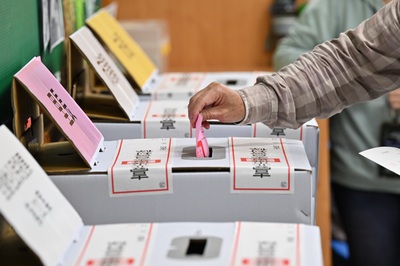
Preliminary voter turnout in Taipei for today’s nine-in-one local elections reached 68.85 percent, surpassing the 67.7 percent recorded in the 2022 mayoral race, according to initial tallies reported by district offices to the Taipei Department of Civil Affairs. Among the capital’s 12 administrative districts, Nangang District (南港) posted the highest preliminary turnout at 72.19 percent, while Wanhua District (萬華) recorded the lowest at 65.65 percent, the department said. Turnout climbed steadily throughout the afternoon ahead of the 4pm close of polls in the closely watched Taipei mayoral race. Taiwanese went to the polls today to choose more than 11,000 local government positions across
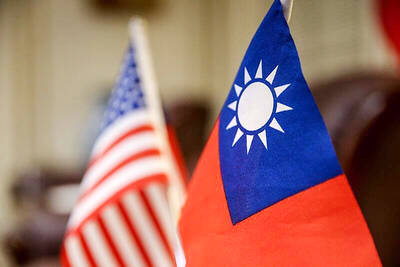
‘NOT FINAL’: US President Donald Trump proposed new tariffs on trading powers, including Taiwan, but signed agreements would still hold sway, a source said Tariff rates proposed by Washington under a Section 301 investigation into structural overcapacity would be procedural recommendations rather than final decisions, and Taiwan’s final rate is expected to revert to the agreed 15 percent non-stacked cap, a source familiar with Taiwan-US trade affairs said yesterday. US President Donald Trump later yesterday proposed new tariffs on major trading powers, including China. His administration proposed levies on 14 trading partners to combat structural excess industrial capacity, with the highest rate of 20 percent to hit China, which Washington accuses of flooding world markets with cheap exports of everything from steel to electric vehicles and
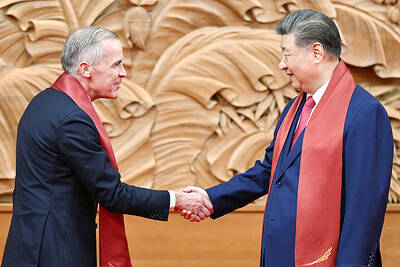
CALL FOR COLLABORATION: ‘We have a high respect of Prime Minister [Mark] Carney’s vision, and we want to be part of this vision,’ the deputy minister of foreign affairs said Canadian Prime Minister Mark Carney risks exposing Canada to the very economic coercion he has cautioned against by deepening trade ties with China, Deputy Minister of Foreign Affairs Chen Ming-chi (陳明祺) said on Saturday, adding that Taiwan has learned the hard way that dependence on Beijing comes with consequences. “We worry. We worry,” Chen said in an interview at the Halifax International Security Forum in Nova Scotia when asked about Carney’s efforts to improve relations with China. Carney has said that major powers are using economic integration as a weapon, citing US tariffs and China’s restrictions on critical minerals. He
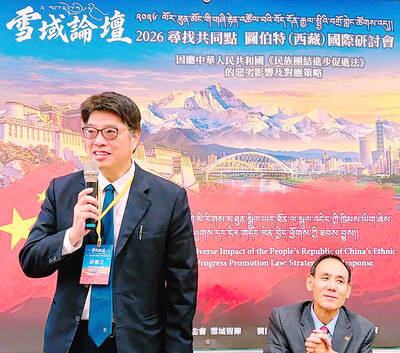
LONG-ARM TACTICS: China’s new law allows authorities to label anyone who does not promote unification as ‘undermining ethnic unity,’ the Mainland Affairs Council said China’s Ethnic Unity and Progress Promotion Law disguises unification as ethnic unity, escalating the Chinese Communist Party’s (CCP) legal warfare against Taiwan from “opposing independence” to “forcing unification,” Mainland Affairs Council Minister Chiu Chui-cheng (邱垂正) said yesterday. The Tibet Religious Foundation of His Holiness the Dalai Lama yesterday held a forum “addressing the adverse impact of the People’s Republic of China’s Ethnic Unity and Progress Promotion Law and strategies for response.” Chiu in his speech said the law, that was implemented on July 1 is not only a set of legal regulations, but also a crucial part of the “long-arm


 RSS