


Vice Premier Paul Chiu (邱正雄) last night announced that the securities transaction tax would be cut from 0.3 percent of the transaction price to 0.15 percent for half a year.
“Capital market is an important part of the financial market and an essential channel for businesses to raise funds … to help businesses raise funds in a slackening economy, restore stock investors’ confidence and help the stock market sail through the international economic quagmire,” Chiu told a news conference held at 10pm.
As the 0.3 percent tax rate is stipulated by Article 2 of the Securities Transaction Tax Act (證券交易稅條例), the Executive Yuan will propose an amendment to the legislature for review.
Chiu said the reduction in the stock exchange tax can help boost the stock market, as shown when the turnout rose to NT$121.7 billion from NT$ 3.3 billion a year after the stock exchange tax was cut in half in Jan. 1989 and the turnout increased to NT$101.267 billion from NT$22.553 billion a year after the tax was cut in half in Feb. 1993.
The decision to slash the securities transaction tax was reached after a three hour meeting between ranking officials held at the Presidential Office late yesterday afternoon.
President Ma Ying-jeou (馬英九) met Premier Liu Chao-shiuan (劉兆玄) and economic officials at 5:30pm to deal with the controversial issue of whether the securities transaction tax should be scrapped in a bid to revive the stock market.
After promising to take a backseat on domestic affairs, Ma was forced to deal with the issue when the officials brought their proposal for his approval yesterday afternoon.
Vice President Vincent Siew (蕭萬長), who recently voiced concerns over the Cabinet’s ability to cope with the current economic downturn, was also at the meeting.
Some Chinese Nationalist Party (KMT) lawmakers have suggested Siew replace Liu and reshuffle the Cabinet, while Legislative Speaker Wang Jin-pyng (王金平) have recommended that the Cabinet consult Siew more frequently on economic and financial matters.
Noting Siew’s rich experience in the field of economics, Ma lauded Siew as a “problem solver” who could deal with the nation’s economic ills when he announced his choice of a running mate in late 2006.
Some KMT lawmakers have complained that Siew has never been given a chance to put his strengths to work.
Slashing the stock transaction tax, which currently stands at 0.3 percent, is one of the measures under consideration to boost market sentiment, following a spate of suggestions from the business community and the equity market’s dismal performance.
The issue became a subject of controversy when Minister of Finance Lee Sush-der’s (李述德) remarks at a news conference on Monday were widely interpreted by local media as meaning the government would cut the stock transaction tax.
At the request of the Executive Yuan, the ministry issued a statement later that night revising Lee’s remarks, saying it has yet to reach a decision on the matter.
Some have questioned the need to cut the stock transaction tax as the country doesn’t impose a levy on capital gains from securities. It could also result in a loss in tax revenues of NT$60 billion (US$1.88 billion) per annum if the tax were cut in half.
The stock transaction tax will be one of the economic proposals to be discussed at the Cabinet meeting today, where a review of new tax incentives to encourage businesses investment, interest subsidies for housing loans and other measures aimed at propping up the economy will be conducted.
Also see stories:
New poll shows support for Cabinet reshuffle, DPP saysAnalysts skeptical on bourse tax cut EDITORIAL: When `sorry' is not `sorry'
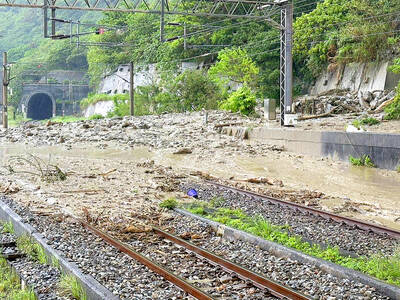
ROLLER-COASTER RIDE: More than five earthquakes ranging from magnitude 4.4 to 5.5 on the Richter scale shook eastern Taiwan in rapid succession yesterday afternoon Back-to-back weather fronts are forecast to hit Taiwan this week, resulting in rain across the nation in the coming days, the Central Weather Administration said yesterday, as it also warned residents in mountainous regions to be wary of landslides and rockfalls. As the first front approached, sporadic rainfall began in central and northern parts of Taiwan yesterday, the agency said, adding that rain is forecast to intensify in those regions today, while brief showers would also affect other parts of the nation. A second weather system is forecast to arrive on Thursday, bringing additional rain to the whole nation until Sunday, it
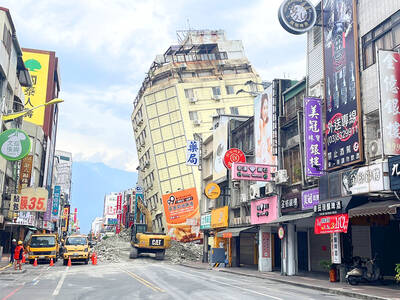
LANDSLIDES POSSIBLE: The agency advised the public to avoid visiting mountainous regions due to more expected aftershocks and rainfall from a series of weather fronts A series of earthquakes over the past few days were likely aftershocks of the April 3 earthquake in Hualien County, with further aftershocks to be expected for up to a year, the Central Weather Administration (CWA) said yesterday. Based on the nation’s experience after the quake on Sept. 21, 1999, more aftershocks are possible over the next six months to a year, the agency said. A total of 103 earthquakes of magnitude 4 on the local magnitude scale or higher hit Hualien County from 5:08pm on Monday to 10:27am yesterday, with 27 of them exceeding magnitude 5. They included two, of magnitude

CONDITIONAL: The PRC imposes secret requirements that the funding it provides cannot be spent in states with diplomatic relations with Taiwan, Emma Reilly said China has been bribing UN officials to obtain “special benefits” and to block funding from countries that have diplomatic ties with Taiwan, a former UN employee told the British House of Commons on Tuesday. At a House of Commons Foreign Affairs Committee hearing into “international relations within the multilateral system,” former Office of the UN High Commissioner for Human Rights (OHCHR) employee Emma Reilly said in a written statement that “Beijing paid bribes to the two successive Presidents of the [UN] General Assembly” during the two-year negotiation of the Sustainable Development Goals. Another way China exercises influence within the UN Secretariat is
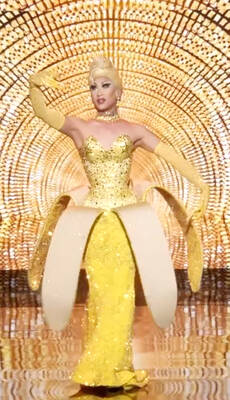
Taiwan’s first drag queen to compete on the internationally acclaimed RuPaul’s Drag Race, Nymphia Wind (妮妃雅), was on Friday crowned the “Next Drag Superstar.” Dressed in a sparkling banana dress, Nymphia Wind swept onto the stage for the final, and stole the show. “Taiwan this is for you,” she said right after show host RuPaul announced her as the winner. “To those who feel like they don’t belong, just remember to live fearlessly and to live their truth,” she said on stage. One of the frontrunners for the past 15 episodes, the 28-year-old breezed through to the final after weeks of showcasing her unique


 RSS
RSS